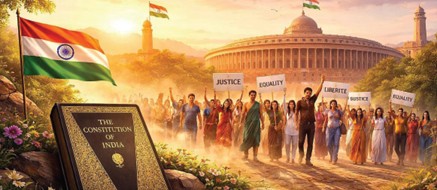
Every year, Constitution Day reminds India of the ideals enshrined in its founding document: justice, liberty, equality and fraternity. Yet, beneath the celebrations and official affirmations lies a difficult question: how far has the Republic translated these constitutional promises into the lived experiences of its citizens? India’s Constitution was revolutionary not merely because it established democratic institutions, but because it sought to transform a deeply hierarchical society. Nearly eight decades later, the contradiction between constitutional ideals and social realities remains one of the defining challenges of Indian democracy. Political equality and the question of electoral inclusion India adopted universal adult franchise at the very inception of the Republic, extending voting rights without distinctions of caste, gender, religion or economic status. This was a remarkable democratic commitment for a newly independent country. However, the recent Special Intensive Revision (SIR) of electoral rolls has brought the question of electoral inclusion back into focus. More than 13.37 crore names were left off draft electoral rolls across 30 states and Union Territories during the revision exercise, according to reported figures. These omissions do not establish that every affected individual was an eligible voter or that all deletions were wrongful. Nevertheless, their scale raises an important question: are the mechanisms for verification, correction and grievance redressal sufficiently accessible to ensure that no eligible citizen is excluded from the democratic process? Electoral integrity must not become a trade-off against universal participation. The credibility of democracy rests equally on accurate electoral rolls and effective safeguards for the right to vote. social equality: the unfinished battle against caste The Constitution abolished untouchability under Article 17 and prohibited discrimination under Article 15. Yet caste continues to determine access to dignity, opportunity and social acceptance. According to NCRB data, 48,669 cases were registered under the Scheduled Castes and Scheduled Tribes (Prevention of Atrocities) Act in 2024, while nearly 2.88 lakh cases remained pending trial at the end of that year. The deaths of Rohith Vemula and Payal Tadvi, amid allegations of caste-based discrimination in educational institutions, expose how institutional spaces that should enable social mobility can reproduce entrenched hierarchies. Caste discrimination is not confined to rural spaces or traditional occupations. It persists in universities, workplaces, housing markets and everyday social interactions. Constitutional equality cannot be considered meaningful when an individual’s caste continues to influence how they are treated, accommodated or recognised. gender justice beyond legal guarantees The promise of equality also remains incomplete for women. In 2024, approximately 1.20 lakh cases of cruelty by husbands or their relatives were registered in India. The same year also recorded 67,809 POCSO assessment are transparent, credible and accountable. fraternity and the right to belong cases involving girl children, according to an analysis of NCRB data. These figures represent registered cases, not the full extent of violence, given persistent under-reporting. Beyond criminal violence, patriarchal restrictions on education, mobility, marriage and personal autonomy continue to constrain women’s choices. The persistence of forced marriages and control over women’s lives demonstrates that legal protection alone cannot dismantle deeply embedded gender hierarchies. A constitutional democracy cannot claim gender equality merely because women possess formal rights. Equality must extend to their freedom to make decisions, participate in public life and live without fear. rule of law and the crisis of institutional accountability The constitutional promise of justice is equally tested by how the criminal justice system functions. Article 21 guarantees the right to life and personal liberty, while the presumption of nonengagement with social and political issues also raises an ethical question: should public influence not carry a responsibility towards constitutional values? equal opportunity and the cense requires that an accused person not be treated as guilty before conviction. Yet, thousands of undertrial prisoners remain incarcerated for prolonged periods. NCRB data for 2024 recorded more than 3.68 lakh undertrial prisoners, including 8,886 who had spent over five years in custody. The prolonged pre-trial incarceration of individuals such as Umar Khalid, whose case remains pending, raises difficult questions about bail, procedural delays and the balance between national security legislation and personal liberty. The issue is not to prejudge individual cases, but to ask whether access to timely justice is becoming increasingly disconnected from the constitutional guarantee of liberty. Similarly, freedom of expression under Article 19(1) (a) must be protected not merely in principle but in practice. Journalists, academics, artists and public personalities should be able to question authority and speak against injustice without disproportionate consequences. Selective public aspirations of young India For millions of young Indians, competitive examinations represent a pathway to economic security and social mobility. However, recurring examination irregularities, paper leaks, cancellations and recruitment delays undermine the principle of equal opportunity. A parliamentary standing committee examining the functioning of the National Testing Agency identified serious concerns surrounding several examinations conducted in 2024, including NEET-UG and UGC-NET. Behind every disrupted examination are lakhs of aspirants who invest years of preparation, financial resources and personal sacrifices. A Republic that promises equality of opportunity must ensure that public recruitment and educational as perhaps the most neglected constitutional ideal is fraternity. In India’s urban centres, access to housing can still be influenced by caste, religion and food preferences. Academic research has documented persistent caste-based residential segregation across Indian cities, while rental-housing experiments have identified discrimination against Muslim applicants. When individuals are denied accommodation because of their identity or community, the constitutional promise of fraternity is reduced to a ceremonial expression. Urbanisation and economic development cannot produce inclusive societies if social segregation simply moves from villages into apartment complexes and gated communities. from Political democracy to social democracy The ambition of Viksit Bharat 2047 must therefore be evaluated beyond GDP growth, infrastructure, technological advancement and geopolitical influence. A developed nation cannot remain socially fractured, where caste determines dignity, gender restricts autonomy, religious identity influences access to housing and institutional failures undermine opportunity. India must aspire to become not merely a developed economy, but a Samaveshi Bharat. B. R. Ambedkar repeatedly warned that political democracy could not survive without social democracy. In his final address to the Constituent Assembly on 25 November 1949, he cautioned against the contradiction of political equality existing alongside social and economic inequality. For Ambedkar, social democracy rested on three inseparable principles: liberty, equality and fraternity. The realisation of this vision requires constitutional morality—the willingness of citizens, political leaders and institutions to uphold constitutional principles even when they conflict with personal prejudices, political convenience or entrenched social interests. Constitutional morality cannot remain the responsibility of courts and legislatures alone; it must become a democratic ethic reflected in everyday conduct. The success of the Constitution will not be determined by the grandeur of Constitution Day celebrations, but by the dignity experienced by those at the margins. As India moves towards 2047, the fundamental question is not simply whether it will become a global power, but whether every Indian will experience the equality, liberty and fraternity promised by the Republic. Girish M is an independent policy researcher based in Mysuru, Karnataka.
0