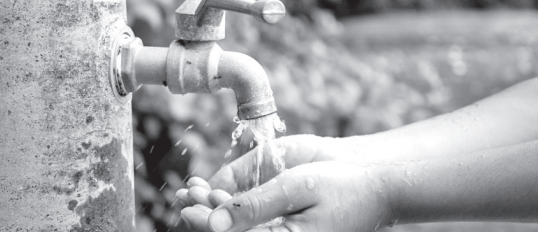
Tonight, two Indians will drink water. One will open a refrigerator, take out a chilled bottle and pay for water that nature once gave freely. The other will walk some distance, fill a container and carry it home, hoping that what looks clean is actually safe. Between these two glasses lies one of our most uncomfortable contradictions. We live in a land of rivers and monsoons, lakes and wells, dams and canals. Yet safe drinking water remains a privilege unevenly distributed. For some, water is bottled, branded, filtered, mineralised and delivered to the doorstep. For millions, it is still a daily negotiation, with distance, availability and uncertainty.Something that should be a basic right is slowly becoming a commodity.
serves recognition, and failures detailed study. And yet, somewhere along the way, the scale of what JJM attempted, and achieved, has been overshadowed by criticism of what remains unfinished. That deserves a closer look. Before JJM, only about their own mission, to make every drop work more than once. precisely where the assessment can become unfair. Should a transformation of this magnitude be called unsuccessful because the final mile is still being completed? An independent functionality assessment covering nearly 2.38 lakh households found tap connections in 98.1% of households in surveyed Har Ghar Jal villages; 86.5% had working connections, 80.2% received adequate quantity and 83.6% received water regularly according to schedule. The honest conclusion, therefore, is neither triumphalism nor dismissal. JJM is not the end of India’s waThe beauty of a missionbased approach is that it turns an overwhelming crisis into achievable national goals. Water demands patience, planning and permanence. And its never merely about water. Every hour saved from collecting it can become an hour of education or productive work. Every illness prevented saves a family and the economy a cost. Water security is therefore about health, livelihoods, agriculture, cities, ecology, and ultimately, dignity. JJM has It was against this reality that the Jal Jeevan Mission (JJM)emerged with a deceptively simple question: why should people travel to water when water can travel to people? But putting a tap inside a rural home is far more difficult than it sounds. The pipeline must cross mountains and deserts, forests and floodplains, scattered habitations and difficult terrain. It must reach places where groundwater is abundant,and others where the underground reserves are quietly disappearing.
The progress of JJM de3.23 crore rural households, roughly 17% had tap-water connections. By March 2026, that number had risen to about 15.82 crore, or nearly 82% of rural households. That is not the story of a small infrastructure programme. It is the story of attempting to change the daily reality of tens of millions of families across one of the world’s most geographically and socially diverse countries. Yet JJM is sometimes dismissed because every tap does not yet provide perfect, uninterrupted service. There is a legitimate point here. A tap without water is merely plumbing. But this is demonstrated that India can attempt a water transformation at extraordinary scale. The dream is simple: A country where no family buys bottled water because it fears its tap. Where no woman spends hours searching for water. Where no village waits anxiously to discover whether its source will survive another summer.
Only then will clean water stop being a luxury, and quietly become what it was always meant to be: an everyday certainty. ter story. It is the beginning of a much larger one. But the true learning is that India needs more missions of such scale. What we need now is a generation of water missions, each addressing a different part of the same crisis. One to bring dying ponds, lakes and traditional water bodies back to life. One to recharge the groundwater, the invisible reservoir on which so much of the country depends. One to transform agriculture so that we grow more with every drop, because the greatest water savings may ultimately happen not at the household tap, but in the field. Our cities need
The writer is a bilingual author with five published titles to his credit.