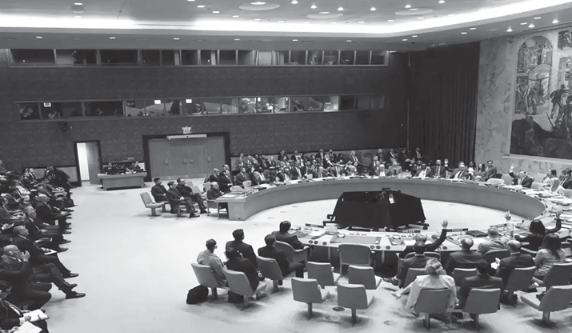
As world leaders gathered in New York for the 81st UN General Assembly in September 2026, a familiar question returned: will India ever get a permanent seat on the UN Security Council? The week offered plenty of encouragement. On 22 September, the G4 foreign ministers of Brazil, Germany, India and Japan said the Council could no longer discharge its primary responsibility for international peace and security.
Four days later, Russian Foreign Minister Sergey Lavrov backed India’s bid from the Assembly podium. Yet only two months earlier, the Assembly had rolled the reform talks over for another year, extending a process now in its 18th year. Speeches and endorsements, however, matter less than whether they can be turned into votes. India’s bid can be judged on three counts: what India would bring, how much support it has, and what stands in its way.
On the first two, the picture is stronger than the slow pace of reform suggests. The third is where the difficulty lies. Start with what India brings. It is the world’s most populous country. Its $4.15 trillion economy ranks sixth at market exchange rates and third in purchasing-power terms. More importantly, India does the UN’s practical work. Till now, it has sent more than 290,000 per sonnel to over 50 peacekeeping missions, with over 5,000 Indian personnel currently deployed in 9 active missions. A record no other G4 country approaches.
It also pays its UN dues in full and on time. That matters at a time when the UN has had to cut its 2026 budget by about 15 per cent because others have not paid. India also brings an agenda. Its SHANTI campaign for an elected seat in 202829 prioritises the Global South, counter-terrorism and peacekeeping. Many developing countries share these concerns but rarely see them at the top of the Council’s list. During its G20 presidency, India secured permanent membership of that grouping for the African Union. And because it keeps working ties with both Washington and Moscow, it could talk to both sides of a divided Council.
Critics read that last point differently. India has abstained on General Assembly resolutions on Ukraine, most recently a February 2026 call for a ceasefire. To some, this looks like fencesitting rather than bridgebuilding. A permanent member is expected to take positions, not only to keep doors open. The second count is support, and on paper India is well placed. The United States, the United Kingdom, France and Russia have all backed its bid.
More important was India’s move in April 2026 to endorse the African Group’s model of a 26-member Council with new permanent seats. Africa has 54 votes, the largest regional group at the UN. By backing Africa’s plan instead of competing with it, India has strengthened its hand where the numbers count. Still, India should not mistake applause for votes. Supporting India costs these four countries little, because they know reform is unlikely to happen soon. The real test is whether they back a negotiating text once it is on the table.
The third count, the obstacles, is where progress stalls. Amending the Charter takes two steps. First, two-thirds of the General Assembly, or 129 of 193 states, must adopt the amendment. Then two-thirds of members, including all five permanent members, must ratify it. No reform can pass without the powers that already hold seats. China is the one permanent member that has not backed India. Beijing says only that it “understands” India’s aspirations, a formula it has used for more than a decade without endorsing the bid. Its caution is widely linked to its ties with Pakistan and to Japan’s place in the G4. The G4 brings its own problem.
Lavrov’s support for India came with opposition to seats for Germany and Japan. The partnership that gives India weight also adds to its opponents. India should not leave the G4, since acting alone would look like one country seeking privilege. But it would be wise to lean more on Africa, whose votes are larger and whose grievances are harder to dismiss. The veto divides supporters too. Washington backs new permanent members but not new vetoes, while African states reject second-class membership.
The G4 once offered to defer the veto for new members for 15 years. In April 2026, however, India sided with Africa’s “all-or-none” position. This is a calculated gamble. It secures the votes India needs most but widens the gap with Washington, whose ratification India also needs. Sooner or later, India will need a formula that lets both sides claim a win. Opposition is also organised. On 24 September, the Uniting for Consensus group, led by Italy and including Pakistan and South Korea, restated its opposition to any new permanent seats.
A day later, Pakistani Prime Minister Shehbaz Sharif warned the Assembly that diverting the Indus waters would be treated as an act of war. It was a reminder that regional disputes follow India into every UN debate. Reform needs an agreed plan, enough votes and trust among rivals. None exists today, and India cannot create them alone. But its patience should not be mistaken for passivity. With its G4 partners, it is pushing for a consolidated model and an eventual vote. It is also contesting the 2028–29 elected seat against Tajikistan, in a vote due in June 2027.
In the short run, that seat may matter more. A strong term would let India show, rather than claim, what kind of permanent member it would be. Permanent membership will not come quickly, or through speeches. But a country that does the Council’s work, pays its dues and brings Africa with it has a stronger claim than the stalled talks suggest. India’s task now is to turn this year’s words of support into votes.
*Sachin Yadav is a Ph.D. scholar in International Studies at Jamia Hamdard, New Delhi With a background in economics and education. His research focuses on South Asia, India’s Neighbourhood and Geoeconomics. His previous work has appeared in The Diplomat, Geopolitical Monitor, the Indian Council of World Affairs (ICWA), Modern Diplomacy, Kabul Now, Dhaka Tribune, Nepal News, Times Now News and other platforms.