Today marks 25 years of PM Narendra Modi’s journey in public office. His leadership has evolved through his approach to governance, public communication, development, technology and foreign policy
Twenty-five years in public life is a long enough period to judge not merely the longevity of a political career, but its imprint on the character of governance itself. On October 7, 2001, Narendra Modi became the Chief Minister of Gujarat. A quarter of a century later, he stands at the centre of India’s political landscape, having served as Gujarat’s Chief Minister and then as Prime Minister since 2014.
His journey from the grassroots of the political organisation to the leadership of the world’s largest democracy is, in many ways, a story about the changing scale, style and language of Indian political leadership. What makes Modi’s political journey distinctive is not simply the number of years he has spent in office. It is the manner in which he has attempted to redefine what voters expect from government and what a political leader communicates to society.
His politics has increasingly linked delivery with dignity, development with aspiration, nationalism with national capability, and India’s civilisational identity with its global ambitions. Modi’s origins remain an important part of this story. Coming from a modest family background and rising through organisational politics, he did not inherit a political constituency or a family-established position.
His political career was built through years of organisational work before he became Gujarat’s chief minister. That background shaped an approach in which political communication was rarely separated from direct engagement with ordinary citizens. Gujarat became the first laboratory of this approach. His tenure thereplaced strong emphasis on infrastructure, investment, electricity, roads, water management, agriculture and administrative efficiency.
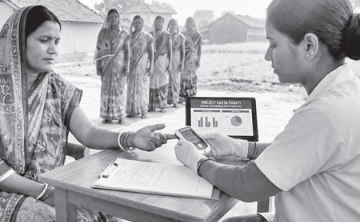
Whatever the debates surrounding the Gujarat model, it established Modi nationally as a leader who presented governance primarily through the language of measurable development. In 2014, that model moved from Gandhinagar to New Delhi. The most visible change was perhaps the conversion of welfare from an abstract promise into a technology-enabled delivery system. Jan Dhan accounts, Aadhaar-linked services and mobile connectivity created the architecture for direct benefit transfers.
Ujjwala brought cookinggas connections to millions of households; Swachh Bharat placed sanitation at the centre of public policy; PM Awas focused on housing; Saubhagya targeted household electrification; Jal Jeevan Mission expanded access to tap water; and Ayushman Bharat attempted to widen access to health protection. The significance of these programmes lies beyond their individual numbers. They changed the vocabulary of welfare politics.
The beneficiary was increasingly addressed not merely as someone entitled to state assistance, but as a citizen entitled to a bank account, a house, electricity, sanitation, clean cooking fuel, drinking water and healthcare. At the same time, Modi’s India has pursued infrastructure on a scale designed to match an aspiring economy. Highways, railways, airports, metros, logistics corridors, ports and digital networks have expanded rapidly. India’s digital public infrastructure, particularly UPI, has become an important symbol of how technology can be deployed for mass-scale public use.
This is where Modi’s political language departs from the traditional grammar of Indian politics. The vocabulary is no longer confined to poverty alleviation or redistribution. It increasingly includes aspiration, entrepreneurship, manufacturing, innovation, start-ups, infrastructure and global competitiveness. National security has undergone a similar shift in political communication. Terrorism, defence preparedness, border security and strategic autonomy have moved closer to the centre of political discourse.
Surgical strikes, the Balakot air strike, defence indigenisation and the growth of domestic defence production have been presented as part of a broader effort to build greater national capability. The idea of Aatmanirbhar Bharat extends this thinking beyond defence. It seeks to connect economic strength with strategic autonomy — from electronics and semiconductors to pharmaceuticals, renewable energy and defence manufacturing. But Modi’s political project is not confined to economics and security.
Culture has become another important dimension of governance and national identity. The renewed public emphasis on India’s civilisational heritage, yoga, temples, traditional knowledge and cultural diplomacy reflects an attempt to place India’s historical identity alongside its modern aspirations. The redevelopment of ma- jor pilgrimage and heritage centres has reinforced this cultural dimension of public life. Internationally, the transformation has been equally visible. India’s G20 presidency, its engagement with the Global South, the International Solar Alliance, the Global Biofuel Alliance and expanding strategic partnerships have sought to position India not merely as a participant in global affairs but as a country capable of shaping the conversation.
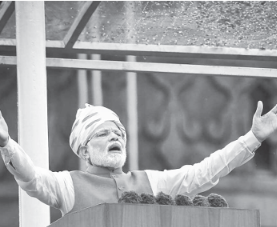
Yet perhaps Modi’s most consequential innovation has been political rather than administrative: the direct relationship between leader and citizen. From Mann Ki Baat to social media, digital platforms, mass rallies and highly personalised political messaging, Modi has built an unusually direct communication ecosystem. His political style combines technology with traditional mass mobilisation. The result is a form of leadership in which governance, communication and political organisation reinforce one another. This has also had consequences for the BJP.
Under Modi’s leadership, the party expanded its geographical and social reach, won major electoral mandates in 2014 and 2019, and returned to government in 2024 for a third consecutive term as the largest party in the Lok Sabha. The BJP’s organisational machinery, welfare narrative, ideologi- cal framework and Modi’s personal political appeal have operated together in a way that has reshaped India’s electoral politics. The most important point, however, is that Modi’s 25 years cannot be understood only through electoral victories or government schemes. His larger contribution — and the subject on which history will ultimately judge him — is whether he has altered the expectations Indians place on political leadership.
The journey represents a movement from governance as administration to governance as transformation; from welfare as relief to welfare as empowerment; from development as infrastructure to development as aspiration; and from India as a regional power to India seeking a larger voice in the world. Twenty-five years after entering the Chief Minister’s office, Narendra Modi remains an unusually consequential figure in Indian public life. Modi has changed the vocabulary through which Indian politics talks about government, development, identity, technology, security and India’s place in the world. From Gujarat to the globe, his 25-year journey is ultimately the story of an attempt to reinvent what political leadership in contemporary India can mean.
*The author is BJP State Spokesperson, Odisha