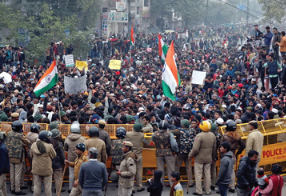
India is the world’s largest democracy, not a country governed by street pressure, political intimidation or the collective anger of organised crowds. The right to protest, criticise the government and question those in power is fundamental to democracy. But these freedoms cannot become instruments to threaten elected governments, intimidate constitutional institutions or create an atmosphere in which political demands are enforced through disruption rather than democratic debate.
India cannot afford to become a mobocracy. The distinction between democracy and mobocracy is fundamental. Democracy derives its legitimacy from the Constitution, elections, institutions and the rule of law. Mobocracy, on the other hand, derives its power from numbers, intimidation and the ability to create disorder.
In a democracy, governments are changed through ballots, not barricades. Allegations are examined through evidence, not accepted merely because a crowd repeats them. Accountability is established through constitutional mechanisms, not through threats of strikes, shutdowns or indefinite protests.
The recent political climate raises an important question: are some opposition parties increasingly treating electoral setbacks as reasons to seek political legitimacy through permanent agitation? For years, sections of the opposition, particularly Congress and AAP, TMC, RJD & SP have questioned the credibility of Electronic Voting Machines (EVMs). Following the 2017 Assembly election results, allegations of EVM manipulation became prominent.
The Election Commission subsequently invited recognised political parties to participate in an EVM Challenge on June 3, 2017. Congress and AAP did not participate, citing objections to the challenge conditions. No successful demonstration of the alleged manipulation was established. The debate subsequently shifted to questions about voter turnout percentages. The Election Commission provided clarifications and maintained that there was no abnormality.
Despite making repeated political allegations, opposition parties did not substantiate these claims through a single successful legal challenge establishing electoral manipulation. If there were genuine discrepancies, the appropriate course was to present verifiable evidence before the courts rather than repeatedly manufacture political narratives.
The controversy then moved towards electoral rolls and the Special Intensive Revision (SIR). The basic question is straightforward: should India maintain accurate electoral rolls, free from duplicate entries, deceased electors and persons who are legally ineligible to vote? SIR is not merely an exercise conducted by officials sitting in Delhi.
It involves ground-level verification through Booth Level Officers (BLOs), while Booth Level Agents (BLAs), appointed by recognised political parties, can participate in scrutiny and identify discrepancies. The process includes publication of draft electoral rolls, opportunities to submit claims and objections, and avenues for appeal.
Political parties have an important responsibility to deploy their BLAs and participate actively rather than limit their engagement to press conferences and political accusations. The Supreme Court’s judgment of May 27, 2026, upheld the legality of the SIR exercise. The Court recognised the Election Commission’s authority under Article 324 of the Constitution read with Section 21(3) of the Representation of the People Act, 1950.
Opposition parties should therefore identify specific cases, affected voters and documentary evidence rather than rely exclusively on sweeping allegations. If genuine voters are being removed, the Election Commission must investigate and restore eligible names.
The question of undocumented migration from Bangladesh and Myanmar also deserves serious attention, particularly in border states. Electoral eligibility is determined by citizenship and statutory qualifications, not religion, language or political preference.
If foreign nationals have been unlawfully included in electoral rolls, the authorities must identify and remove such entries through due process. No party should be permitted to exploit the issue, and no genuine Indian citizen should be deprived of voting rights.
The prolonged absence of Congress from power in several major states also provides an important political context. Tamil Nadu has not had a Congress Chief Minister since 1967, West Bengal since 1977, Uttar Pradesh since 1989, Bihar since 1990, Gujarat since 1995 and Odisha since 2000.
As of 2026, these represent approximately 59, 49, 37, 36, 31 and 26 years respectively without a Congress Chief Minister in these states. These figures reflect a prolonged electoral decline. Such a record should prompt serious introspection about leadership, organisation, political messaging and public confidence.
Electoral setbacks cannot be overcome by repeatedly questioning the legitimacy of democratic institutions or treating every unfavourable verdict as evidence of manipulation. The democratic response to declining electoral support must be organisational renewal, credible leadership and reconnecting with voters.
Street mobilisation cannot become a substitute for electoral acceptance, and constitutional institutions cannot be made responsible for a party’s political fortunes. party. They belong to the Republic. Their decisions can be challenged through lawful procedures.
But threatening judges, delegitimising institutions without evidence or attempting to dictate outcomes through street pressure weakens the constitutional structure that protects every citizen.
The opposition has a constitutional responsibility to question the government, challenge policies and offer credible alternatives. But it must also accept electoral verdicts. Losing an election is not the loss of democracy.
The responsibility of political leadership becomes even greater when it comes to young people. They must not become instruments of political confrontation. Provocative rhetoric, calls for confrontation and the glorification of institutional disruption can turn legitimate dissatisfaction into destructive mobilisation.
There is also a wider international context that deserves informed scrutiny. Bangladesh, Nepal, France, Spain, Portugal and Albania have witnessed mass protests, political demonstrations and episodes of instability in recent years. Progressive International and other transnational political organisations have also become subjects of political debate in India.
Questions concerning meetings, political associations, memoranda of understanding and international engagements involving Indian political leaders should be answered transparently. Political parties must be accountable for their international partnerships, advocacy networks and funding arrangements.
Opposition leaders have every right to address foreign universities and international forums, but India’s domestic constitutional disagreements should be resolved through democratic institutions rather than external political pressure. The Supreme Court, Election Commission, Parliament and other constitutional bodies are not the property of any political Political dissatisfaction is not a constitutional emergency.
A government cannot be compelled to resign merely because an opposition party demands it, and a constitutional authority cannot be removed simply because a political campaign declares it unacceptable.
India’s democratic strength lies in its ability to accommodate disagreement without surrendering to disorder. The choice before the political class is clear: strengthen democracy through debate, evidence, elections and constitutional accountability, or weaken it through intimidation, manufactured outrage and street vetoes.
India is a constitutional democracy, not a permanent protest camp. Nobody should be allowed to hold the Republic hostage to the power of an organised crowd. India can accommodate a thousand voices of dissent; it cannot afford mobocracy.