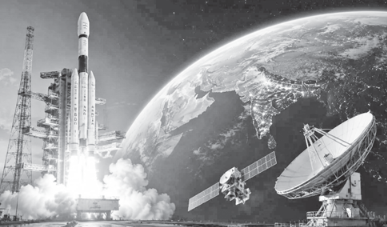
Space Exploration has emerged as one of the most significant dimensions of scientific, technological, economic and strategic development in the twenty-first century. From satellite communication and weather forecasting to navigation, disaster management and national security, space technology has become an integral part of modern society.
India, with its remarkable achievements through the Indian Space Research Organisation (ISRO), has established itself as an important player in the Global Space Community. Missions such as Chandrayaan-3, Mangalyaan and Aditya-L1 have demonstrated India’s scientific capabilities and strengthened its international reputation.
However, the growing importance of Space Activities has also created new legal and regulatory challenges. The increasing participation of private companies, the commercialisation of satellite services, the emergence of Space Tourism and the possibility of space resource exploration have made the existing regulatory framework inadequate.
Although India has introduced the Indian Space Policy, 2023, and established the Indian National Space Promotion and Authorization Centre (IN-SPACe), it still lacks a comprehensive, dedicated Space Legislation enacted by Parliament. A robust Space Law is therefore essential to regulate India’s expanding space sector, protect national interests, ensure accountability, promote private investment and fulfill international obligations.
India must move beyond policybased regulation towards a comprehensive statutory framework that can address both present challenges and future developments in outer space.
THE GROWING IMPORTANCE OF INDIA’S SPACE SECTOR
India’s Space Programme has evolved from a modest scientific initiative into a major contributor to national development. Satellites play an important role in telecommunications, agriculture, education, environmental monitoring, navigation, meteorology and disaster management. Space-based technologies also support India’s defence capabilities and strategic autonomy.
The success of Chandrayaan-3 in achieving a soft landing near the Lunar South Pole in August 2023 was a historic milestone. Similarly, the Mars Orbiter Mission demonstrated India’s ability to undertake complex interplanetary missions at comparatively low costs. More importantly, the Indian Space Sector is no longer restricted to government institutions.
Private enterprises and start-ups are increasingly involved in satellite manufacturing, launch vehicles, space based applications and other commercial activities. This transition creates opportunities for economic growth, employment generation, technological innovation and international cooperation. Without a comprehensive legal framework, India’s ambition to become a leading Global Space Economy may face unnecessary regulatory uncertainty.
ABSENCE OF A COMPREHENSIVE SPACE LEGISLATION
One of the strongest arguments for introducing a robust Indian Space Law is the absence of a dedicated statutory framework governing the entire Space Sector. India currently regulates Space Activities through various policies, guidelines and administrative arrangements.
These include the Indian Space Policy, 2023, the establishment of IN-SPACe and the Norms, Guidelines and Procedures for Implementation of the Indian Space Policy, 2023, issued in 2024. Although these measures have facilitated private participation, they do not provide the same legal certainty and enforceability as legislation enacted by Parliament.
The Indian Space Policy, 2023, outlines the roles of ISRO, IN-SPACe, NewSpace India Limited (NSIL) and non-governmental entities. It also encourages private participation in the development and operation of Space Infrastructure. However, a policy framework cannot adequately replace a comprehensive law dealing with statutory powers, legal rights, obligations, penalties and dispute resolution.
The need for legislation has also been recognised by parliamentary committees. In March 2026, a parliamentary committee observed that India’s Space Activities were not governed by a comprehensive legislative framework and recommended the introduction of a robust law to regulate, authorise and supervise Space Activities. A dedicated Space Activities Act would provide a stable legal foundation for India’s expanding space ecosystem.
REGULATION OF PRIVATE SPACE COMPANIES
The growing participation of private companies is one of the most important developments in India’s Space Sector. Start-ups and established businesses are increasingly developing launch vehicles, satellites, propulsion systems and Space-Based Services. Companies such as Skyroot Aerospace, Agnikul Cosmos and Pixxel demonstrate the growing potential of India’s Private Space Industry.
However, Commercial Space Activities involve considerable financial investment and technological risks. A private company launching a satellite or operating a space object must comply with several regulatory requirements. These include obtaining authorisations, ensuring technical safety, complying with international obligations and addressing potential thirdparty damage. A Comprehensive Space Law would India is a party to this Convention.
Consequently, India may face international liability for damage caused by space objects for which it qualifies as a launching State. The situation becomes more complicated when private companies undertake commercial space activities. Although a private company may operate a satellite or launch vehicle, international responsibility under the Outer Space Treaty remains with the State.
Establish clear procedures for licensing, registration, supervision and monitoring of private space activities. Most importantly, a transparent legal framework would encourage domestic and foreign investors by reducing uncertainty and establishing predictable rules for conducting business. India’s ambition to become a global hub for commercial space activities cannot be achieved without a strong and reliable regulatory environment.
LIABILITY FOR DAMAGE CAUSED BY SPACE ACTIVITIES
Liability is one of the most critical aspects of Space Law. Space activities involve significant risks, and accidents can cause substantial damage to individuals, property, aircraft, satellites and other space objects. For example, a malfunctioning satellite or an uncontrolled rocket component may fall to Earth and damage private property or public infrastructure.
Similarly, a collision between satellites can generate debris and threaten other operational spacecraft. Under the Convention on International Liability for Damage Caused by Space Objects, 1972, a launching State is absolutely liable for damage caused by its Space Objects on the surface of the Earth or to aircraft in flight.
For damage occurring elsewhere than on the Earth’s surface, liability is generally based on fault. A robust Indian Space Law must, therefore, clearly establish the liability of private operators, the circumstances in which the government may seek reimbursement, insurance requirements and procedures for compensating affected parties.
SPACE DEBRIS AND ENVIRONMENTAL PROTECTION
Space Debris has become one of the most serious challenges to the long-term sustainability of outer space activities. Space Debris includes defunct satellites, abandoned rocket stages, fragments resulting from collisions and other nonfunctional objects orbiting the Earth. Even relatively small fragments can damage operational satellites because of their extremely high orbital velocities.
The increasing number of satellites launched by different countries and private companies has intensified concerns regarding orbital congestion and collisions. India is also exposed to these risks. ISRO has undertaken collision avoidance manoeuvres to protect its operational satellites from potentially dangerous encounters with other Space Objects.
A robust Space Law should introduce legally enforceable requirements concerning Space Debris mitigation, satellite end-oflife disposal, responsible orbital operations and environmental risk assessments.
COMPLIANCE WITH INTERNATIONAL SPACE LAW
India is an important participant in the International Space Governance System. It has signed and ratified the major United Nations Space Treaties, including: o The Outer Space Treaty, 1967. o The Rescue Agreement, 1968. o The Liability Convention, 1972.
The Registration Convention, 1975. These international instruments establish important principles concerning the peaceful exploration of Outer Space, State responsibility, liability for damage, assistance to astronauts and registration of space objects.
Article VI of the Outer Space Treaty specifically provides that States bear International Responsibility for National Activities in Outer Space, including activities undertaken by non-governmental entities. Such activities must be authorised and continuously supervised by the appropriate State. Therefore, India must ensure that Private Space Activities are adequately regulated through domestic legislation.
FUTURE PROSPECTS
India stands at a crucial stage in the development of its space sector. Its achievements in lunar exploration, satellite technology and launch capabilities have established the country as a respected spacefaring nation. The growing participation of private enterprises has further expanded the possibilities of Commercial Space Development.
However, technological advancement must be accompanied by legal development. A Space Sector operating without a comprehensive statutory framework faces challenges relating to accountability, liability, environmental sustainability, national security and investor confidence.
The Indian Space Policy, 2023, and the establishment of IN-SPACE represent important steps towards reforming the sector. Nevertheless, these initiatives must be supported by a dedicated law enacted by Parliament. A robust Indian Space Law would not merely regulate space activities; it would create the legal foundation for innovation, investment, responsible exploration and international cooperation.
It would protect India’s national interests while ensuring that private enterprises can operate within a predictable and transparent regulatory environment. Ultimately, India’s future in Space should not be determined by technological capabilities alone. It must also be supported by a strong legal framework that promotes responsibility, accountability and sustainability.
India needs a robust Space Law not only to govern its growing presence in Outer Space but also to secure its position as a responsible global leader in the emerging Space Economy.
*Dr.S. Krishnan is an Academician and an Experienced Journalist based in Jaipur. Mr. Tarun Sharma is a 3rd Year Student of BALLB in Seedling School of Law and Governance, Jaipur National University, Jaipur. Mr. Mayur Mahajan is a 3rd Year Student of BBALLB (H) in Seedling School of Law and Governance, Jaipur National University, Jaipur.