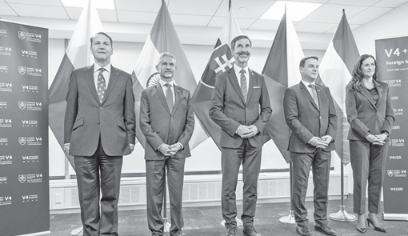
The first meeting of Visegrád Four (V4) foreign ministers with India on September 21 in New York highlights an important change in India’s strategy for dealing with Europe. India is finally moving beyond a solely great-power-centric approach and discussing the idea of strategic autonomy in terms of a networked approach that allows cooperation with Central European countries which have relevant industries, technologies and diplomatic experience. The V4 format is important because India is not superseding bilateralism with regionalism. Rather, it is putting minilateralism on top of established bilateral connections in order to create another framework for integrating economic, technological, and diplomatic interests.
As part of PM Narendra Modi’s visit to Poland in 2024, India established its Strategic Partnership with Warsaw; in 2025, President Droupadi Murmu visited Slovakia, while ministers from India have started interacting actively with representatives of Czechia and Hungary. Thus, New York meeting institutionalises an already existing trajectory instead of creating an entirely new one. External Affairs Minister S. Jaishankar described the V4 countries as possessing “very strong, very distinctive capability” and as “industrial economies” with “great innovation and technology talent”.
The decision to establish an Annual Business Forum and hold foreign ministers’ meetings annually gives this engagement an institutional energy storage, industrial efficiency, and resilient infrastructure could be considered in practice healthcare. For New Delhi, this partnership satisfies its increasing need for technology and knowledge-related collaborations along with typical trading activities while presenting Prague with new wear and opportunities to work in the Indo Pacific region within the EU context. framework. The broader significance is that India’s strategic autonomy is increasingly being pursued through diversification of partnerships, not merely diversification among great powers.
Contemporary international power politics involves the idea of complex interdependence with the capability varying across the states. A state may not be a major power in order to possess important technologies, manufacturing capabilities, research capabilities and diplomatic strength. Here, the V4 serves as a good example. Poland serves as an important industrial and technological hub in the European Union. The trade volume between India and Poland is expected to exceed €5.6 billion in 2025 while Poland sees potential in defence industry and new technologies like space. Poland is estimated to attract more than $3 billion in investments from India.
The partnership with Poland is not just about having access to the market for India. The country gets another partner in defence, engineering and advanced technology, while for Poland India provides market size, investments and access to the major Asian economy. Czechia offers a different set of skills. Its 2024 Strategic Partnership with India is built upon fields such as applied science, scientific mobility, cooperation in the military industry, cybersecurity, environmental technology, energy and Slovakia brings new possibilities. Bilateral trade between the two nations reached around €1.8 billion by 2025, with cooperation extending to nuclear energy, innovation, digital technology and military applications. India has also aimed to diversify its bilateral trade profile, stressing collaboration in tech, clean energy, auto industry, pharma, biotechnology, aerial technologies and fintech.
Hungary adds its own expertise in the field of car manufacturing, water management, agricultural technologies, production equipment, medicine, biotechnology and clean energy. It follows that the strength of V4 is in its complementarity nature rather than this uniformity. This creates a possible network-power aspect to the framework. India could thus be in a position to connect four bilateral partnerships with one another and with its own economic objectives using the V4 format instead of managing those four pairs separately. The relationship is favourable in both directions. India receives access to specialised technologies, investments, production capabilities and European value chains. V4 economies receive access to Indian capital, market size, technological know-how and one of the world’s major growth centres. Czech Foreign Minister Petr Macinka, who spoke at the meeting in New York, highlighted this reasoning by saying: “We need more partnerships, but without creating dependencies.” This comes closer to strategic hedging than to alignment.
Neither party needs to abandon the existing partnerships; both parties can only enhance their strategic opportunities by expanding existing partnerships. The suggested Annual Business Forum could enshrine this logic into a geo economic statecraft. Its success depends on whether it succeeds in finding actual synergies in auto and engineering value chains, pharmaceuticals, defense technology, space, digital systems, and clean energy technology. Slovakia’s Innovation and Technology Day of 2025, which resulted in over 300 business negotiations held in Delhi, demonstrates the possibilities of The diplomatic aspect of the situation is another factor. Each of the four Visegrad countries has supported India’s acquisition of permanent membership in the UN Security Council, while Slovakia has also supported India’s candidature for a temporary seat for 2028 to 2029. This leads to additional diplomatic possibilities but does not mean that one can conclude about the existence of a coherent V4 foreign policy. So the larger implication is that it is not only about Central Europe. It is about the changing meaning of strategic autonomy as such. this engagement.
The next step is to transform these contacts into investment, joint ventures, research cooperation, technology transfer, and co-production. It is possible that defence would play an important role in shifting the ties from transactions to the level of mutual dependency in the spheres of industry and strategy. Jaishankar noted that India has great traditions of defence cooperation with the V4 and wishes to bring this to another level. In its turn, Poland has brought attention to defence and space as promising sectors, while the innovation partnership of Czechia includes defence partnership as well. The situation allows India to transform procurement into components and maintenance, research and development, joint production, etc.
From the point of view of the V4, India is an attractive defence player and has a great industrial base for the production links. Energy is another field of issue-based collaboration. Slovakia connected the concept of the V4+India initiative with energy security, the disruption of transport communications, the conflict in Ukraine, the events in the Middle East, and the evolution of global trade. Despite the differences in the vulnerabilities experienced by India and Central Europe, both parties are interested in minimizing dependence on supply chains. Therefore, areas like nuclear energy, clean technologies, It could indicate a larger argument of India’s statecraft: strategic autonomy is not merely about maintaining a balance among great states, but also about creating a wide enough system of specialized alliances to maintain its own interests amidst the fragmentation process of the world.
*Janvi Singhi is an Independent Researcher and Gold Medalist in International Relations based in Hyderabad. She is currently working as a Research Associate at the Organization for Threat Assessment and Peacebuilding (OTAP), Asia Pacific Bureau. Simran Keshwani is a Sydneybased political economist specialising in India’s clean-energy transition, industrial strategy and Indo-Pacific economic security.