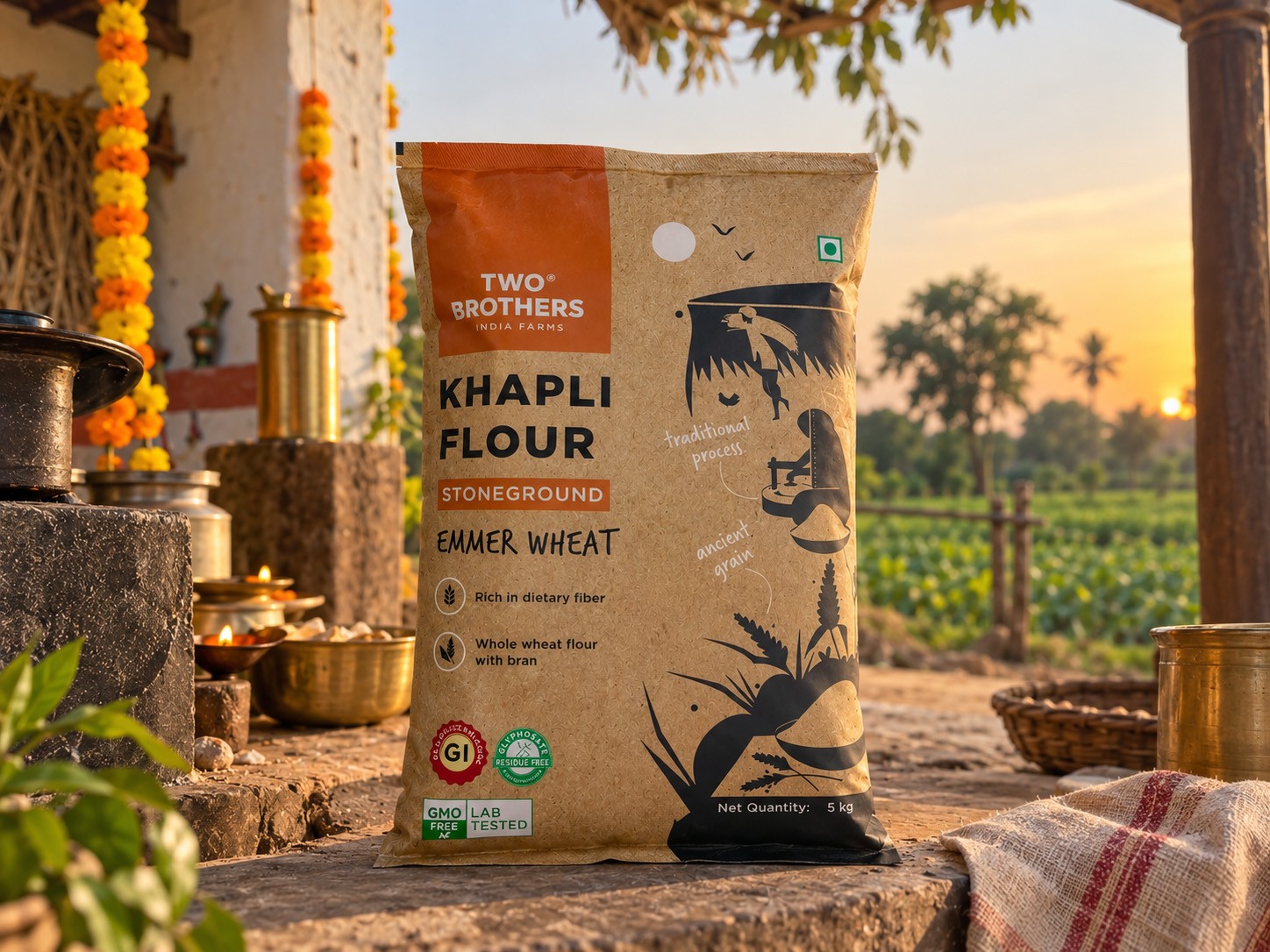
Every Diwali, the same advice appears in newspapers, WhatsApp forwards and clinics. Eat fewer sweets. Choose dry fruit over barfi. Skip the second gulab jamun. The advice is sound and strangely incomplete. It treats blood sugar as something that happens at the dessert table, when in reality it is shaped, meal after meal, by the largest component of the plate: the staple.
In an Indian home that staple is wheat. It arrives as rotis, parathas, puris, theplas and kachoris, and in festive weeks it arrives more often, in richer forms and larger portions. The sweets get the blame, but the flour does much of the work. This article looks at how the festive spike happens, what “low GI” means and does not mean, and how Two Brothers India Farms and its Khapli Atta, made from an ancient Emmer wheat, fit into a festive kitchen.
Why Diwali Is a Metabolic Stress Test
Diwali is not one meal; it is a fortnight of them. Dhanteras, Lakshmi Puja, Govardhan Puja and Bhai Dooj each bring their own menus, guests and obligation to eat. Portions grow, meal timing shifts, sweets are everywhere and refusing them feels rude, fried food becomes routine, activity drops and late nights cut into sleep, which itself makes blood sugar harder to regulate.
For someone with healthy glucose regulation this is uncomfortable but manageable. For the roughly 101 million Indians living with diabetes (11 percent of the population, according to the ICMR-INDIAB study of more than 113,000 people across 31 states and union territories) and the estimated 136 million more in the prediabetic range, it can be a serious test. Yet public discussion fixates on mithai, as if removing sweets alone would neutralise the effect.
The Spike Nobody Talks About: The Staple
Starch, the main component of wheat flour, is a long chain of glucose molecules. Digestive enzymes break the chains down and glucose enters the blood. How quickly that happens depends on the particle size of the flour, the fibre and protein around the starch, and how the food is cooked and combined.
The glycaemic index, or GI, is a scale from 0 to 100 that ranks carbohydrate foods by how quickly they raise blood glucose compared with pure glucose. A GI of 55 or below is considered low, 56 to 69 medium and 70 or above high. Low GI foods produce a gradual rise; high GI foods produce a sharp spike, often followed by a steep fall.
Now consider a festive lunch of puris, a rich sabzi, rice, a sweet and a fried snack. Three or four puris or rotis form a large part of it by volume. If the flour is a fine, fast-digesting commercial atta, the starch load arrives quickly, and a sweet on top compounds the rise. A person can cut down on sweets and still see large glucose swings if the staple is high GI and the portions are big. Conversely, a modest sweet eaten alongside a slow-digesting, high-fibre staple may produce a far gentler rise. The staple sets the baseline; the sweets add to it.
An honest note on limits: GI is measured on single foods in a lab, while people eat mixed meals. It varies between individuals, and it says nothing about portion size. A low GI atta is a useful tool, not a licence to eat without limits.
Two Brothers Khapli Atta: An Ancient Grain With a Different Profile
Khapli wheat, botanically Triticum dicoccum and commonly called Emmer, is among the oldest cultivated grains in human history, with roots stretching back around ten thousand years. It was once a staple across the Deccan plateau until the Green Revolution of the 1960s pushed high-yield hybrid wheats to the fore and Khapli to the margins. Two Brothers India Farms, founded by brothers Satyajit and Ajinkya Hange on their family land near Pune, has been one of the brands most closely associated with bringing it back into Indian kitchens. You can read more about the farm and its philosophy on the Two Brothers India Farms story page.
The traits that made Khapli commercially unattractive, slower growth and lower yield, are the ones that make it interesting nutritionally. Lab tests cited by Two Brothers India Farms show Khapli Atta at 7.8 percent dietary fibre against 3.1 percent in commercial wheat flour, the basis of the “50 percent more fibre” claim. Its gluten is structurally different from modern bread wheat and well below the 13.24 percent measured in commercial flour; the product page describes a range of about 5.5 to 9 percent, varying by batch. The brand summarises these points on its Khapli Atta benefits page.
Fibre is the key to the low GI story. A higher-fibre flour slows gastric emptying and limits how quickly enzymes reach the starch, encouraging a gradual release of glucose. Milling adds to this. Much city atta is roller-milled into a very fine powder whose starch is easily accessible. Stone grinding, used across the Two Brothers stone-ground atta range, produces a coarser flour that retains more of the grain’s natural oils and fibre, so starch is released more slowly. None of this makes Khapli a medicine, and Two Brothers does not present it as one. It is a better-behaved staple, made from a single ingredient with nothing added.
A Festive Plate, Re-Examined
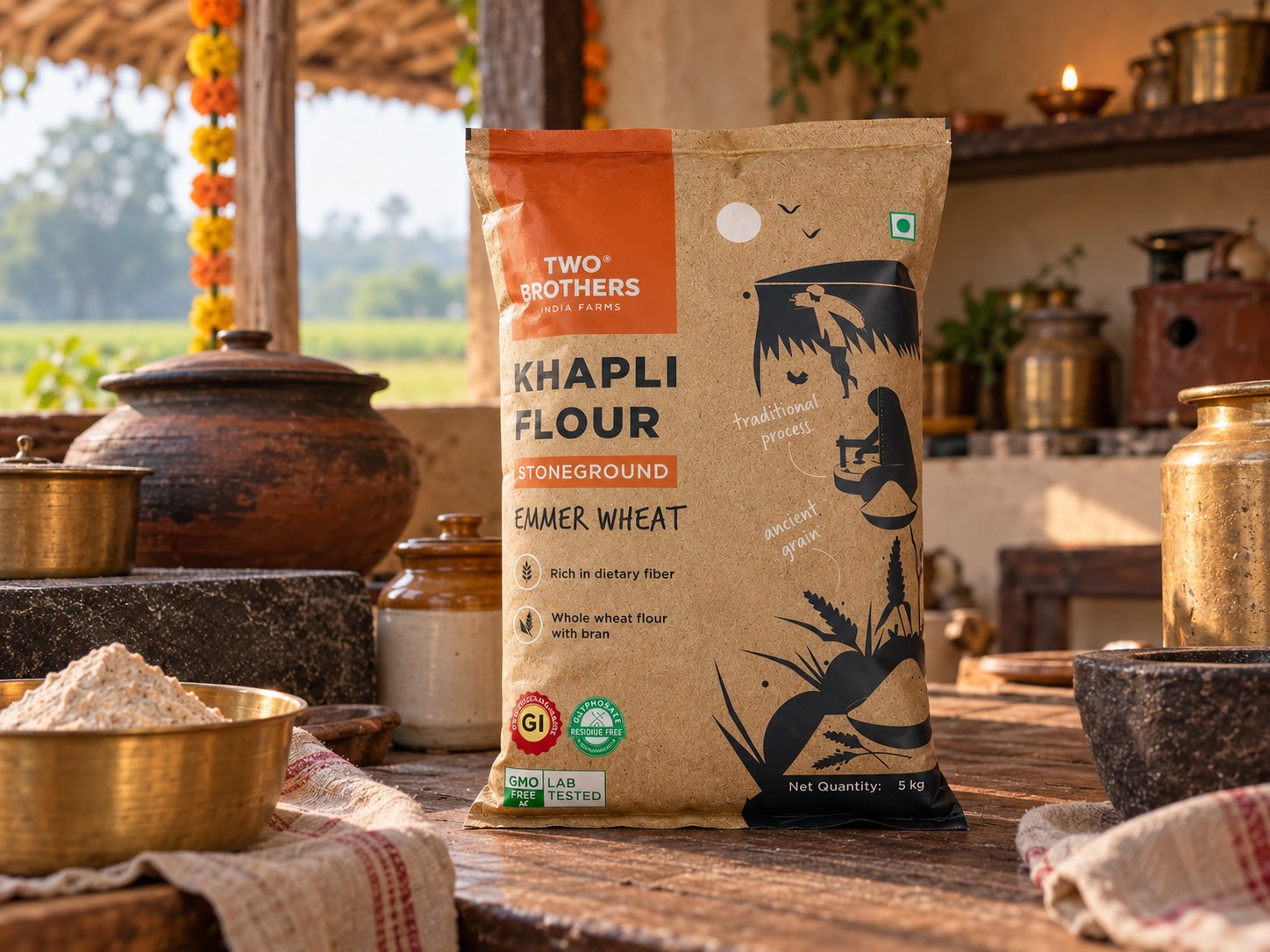
Picture a Diwali family lunch. It opens with a fried kachori or samosa made with refined flour. The main plate has two or three puris or rotis, a paneer dish, dal, rice and raita. Dessert follows, then more snacks, fruit and sugared tea through the afternoon. The glucose load arrives in waves, and the body answers each with a surge of insulin. For people whose insulin response is impaired, the peaks are higher and last longer.
Now change one thing: use a low GI, high-fibre, stone-ground Khapli Atta for the rotis, parathas and puris. The starch load of the main course is digested more slowly, and the fibre slightly blunts the rise from the sweet that follows. The difference is not dramatic in isolation, but it repeats at every meal across the fortnight, where small effects accumulate. Khapli does not neutralise mithai. It adjusts the one lever most households never think to touch, and it needs no willpower.
Habits That Work Alongside
– Eat sweets after a meal, not on an empty stomach. Fibre, protein and fat in the meal slow absorption.
– Start with fibre and protein. Beginning with salad, dal or sabzi before roti or rice can reduce the post-meal rise.
– Keep portions honest. Two rotis instead of four, or one sweet instead of three, keeps the pleasure and cuts the load.
– Walk after meals. Ten to fifteen minutes helps muscles take up glucose.
– Watch the drinks. Sweetened tea and packaged juices add sugar without fibre.
– Protect sleep. Poor sleep reduces insulin sensitivity.
The ICMR-NIN 2024 dietary guidelines recommend keeping added sugar below 5 percent of energy and cereals and millets to no more than about 45 percent of calories. Both are useful anchors for festive planning. For households that want to go further, Two Brothers groups its slower-digesting staples, including Khapli Atta, Khapli grains and Kalanamak rice, in a dedicated low GI products collection.
Why Glyphosate-Free Matters in a Staple
Modern wheat farming often relies on glyphosate-based herbicides, and residues can persist through milling into flour. The World Health Organization’s cancer agency has classified glyphosate as probably carcinogenic to humans, and India has no widely published residue limit for glyphosate in wheat flour, so consumers cannot easily judge what their atta contains.
Two Brothers India Farms’ Khapli Atta is certified Glyphosate Residue Free by The Detox Project, which tests products in laboratories. Founder Satyajit Hange has explained the logic: certifying the ghee was worthwhile, but atta and jaggery are eaten far more often, so it made sense to certify them too. The ingredient list is a single line, Khapli (Emmer long) wheat, with no additives, fillers or preservatives.
Choosing the Right Two Brothers Khapli Atta
The full Two Brothers Khapli Atta range now covers three flours, each suited to a slightly different need.
Khapli Wheat Atta (stone-ground) is the flagship single-ingredient flour, sold in 2 kg, 5 kg and 10 kg packs at ₹425, ₹995 and ₹1,891 at the time of writing. Families who go through atta quickly during the festive fortnight can opt for the larger Khapli Atta packs. The flagship holds a 4.9 out of 5 rating from more than 1,700 reviews.
Khapli Multigrain Atta blends 50 percent Khapli with 50 percent jowar, barley, ragi, soybean, horse gram, chickpea and flaxseed for more fibre and protein. It comes in 2 kg, 5 kg and 10 kg packs at ₹395, ₹945 and ₹1,745, and is not gluten-free.
High Protein Khapli Atta adds soy flour, Bengal gram, soy protein isolate and finger millet for about 11 grams of protein per two rotis. It is available from a 1 kg pack at ₹295 up to 10 kg, and contains soy and gluten.
For festive cooking, the flagship Khapli Atta is the easiest place to start, particularly for parathas, rotis and puris. Use warm water, rest the dough and roll slightly thicker; Khapli puris puff well, though they are a little denser and nuttier than refined-flour puris. It also works in traditional halwa and laddu recipes, but a Khapli laddu is not a free pass, and portions still matter. The brand’s Khapli Atta usage guide has more kneading and cooking tips.
Gifting and Social Proof
Diwali is also the season of gifting, and families increasingly ask whether a gift will actually be used. A pack of ancient-grain atta says the giver cares about daily health, and it is welcome among elders managing blood sugar and health-conscious friends. Two Brothers India Farms offers curated Diwali gift hampers that can combine atta with ghee, jaggery and other staples, and a wider Diwali cooking collection for stocking the festive pantry.
More than 69,000 Indian families now cook with Two Brothers Khapli Atta, and the main product page shows more than 1,700 reviews at an average of 4.9 out of 5. Reviewers often mention better digestion, less post-meal heaviness and steadier energy. Reviews are not clinical evidence, but for a daily staple, repeat purchase at this scale suggests people find the taste and the effect worth keeping.
What Low GI Atta Cannot Do
It does not treat or cure diabetes; management depends on medical supervision, medication where prescribed, monitoring, activity and overall diet. It is not gluten-free, so people with coeliac disease or wheat allergy should avoid it. Portions still matter, and individual glucose responses vary with genetics, gut microbiome, sleep and stress. Anyone with diabetes or prediabetes should speak to their doctor or dietitian before changing their diet during a festive period, when medication and meal timing may already be disrupted.
Frequently Asked Questions
Is Khapli Atta low GI? Two Brothers India Farms positions its Khapli Atta as a low glycaemic index flour, supported by its 7.8 percent fibre, stone-ground milling and Emmer wheat structure.
Is Khapli Atta good for diabetics? It is a lower-glycaemic staple that many people managing blood sugar choose, but it is a food, not a treatment. Follow medical advice and monitor your own response.
How much fibre and gluten does it have? Lab figures put fibre at 7.8 percent versus 3.1 percent in commercial flour, and gluten well below the 13.24 percent in commercial flour.
Is it gluten-free? No. It is a wheat flour, though with lower gluten of a different structure.
Can I make puris and parathas with it? Yes. Use warm water, rest the dough and roll slightly thicker.
Is it glyphosate-free? It is certified Glyphosate Residue Free by The Detox Project.
More answers are on the official Khapli Atta FAQ page.
Rethinking the Festive Plate
The festive blood sugar spike is usually described as a sweet problem. The evidence suggests it is a plate problem: portion, timing, refined starch, sugar, fried food and inactivity, of which the sweets are only the most visible part. The plate can be changed without giving up the festival, and the staple is the one place where a single substitution reshapes every meal.
Diwali does not need less joy, fewer guests or smaller celebrations to be kinder to blood sugar. It needs a smarter foundation. A low GI, high-fibre, stone-ground Khapli Atta from Two Brothers India Farms will not turn a festive feast into a diet meal, and it is not meant to. It quietly changes what the roti does inside the body, three or four times a day, so the sweets on the table can stay exactly where they belong: as a celebration.