Egypt is one of the very few countries that share a border with ‘Gaza’. The border is 12-km-long and well-fenced. Those fences on the Egyptian side send a message. The country tries to isolate itself as much as humanly possible from the other side of the border. It is only some 400 km away from the ‘hard’ border with Gaza that the visitor finds the city of the pyramids and King Tutankhamun.
The history of this region is impressive. But the city itself is rather dominated by offices, massive international hotels and huge numbers of boring apartment buildings. The one building that dominates all others is the high rising office of the Ministry of Foreign Affairs. The over 30-storey building on the banks of the Nile is visible from almost every part of the city. You can’t miss it. It stands there as if to claim the position of Egypt as an international player with status and relevance. And that is only fair.
Egyptian diplomats are known to be ‘people to be reckoned with’. They often take positions courageously opposing ‘Western’ points of view. They rather align with regional partners, including Oman, Yemen, Qatar, Bahrain and the United Arab Emirates. It is only two years ago, in May 2024, that Egypt actively sponsored a UNGA resolution to grant Palestine ‘full membership’ privileges of the UN.
However, the international position of Egypt seems somewhat bleak compared to ‘what it used to be’. There was a time that high-level delegations from the US and Brussels would make an obligatory stop over to consult with Egyptian officials before travelling to other capitals in the Middle East. However, the last visit of a US President to Cairo was in 2009 when Barack Obama delivered his famous speech.
The last visit of President of the European Commission Ursula von der Leyen was in 2023. Egypt seems to have lost at least some of its international relevance, certainly when it comes to more recent events in the region. With all its neighbours, including Libya and Sudan, in long-term turmoil, Egypt sometimes seems paralysed and a shadow of itself as we know it from the past. In a rare move to regain some relevance and position, Egypt recently offered its assistance to the Saudi Arabian King in his conflict with the Houthis.
The silence from the highrising MFA office in Cairo is indicative of the complex position of many a government in the region — caught between a hard place and a rock. Because the public international positions that the Egyptian government takes do not only depend on a public opinion that is inspired by sentiments of historic and humanistic solidarity but also on the need to guarantee the safety of a nation.
A complex balancing act. Cairo has seen large-scale demonstrations in 2022 and 2023 in solidarity with the Palestinian cause. In October 2023, massive student demonstrations occurred at the American University in Cairo following the initial escalation in Gaza. The University campus was used since it was hard to demonstrate outside university grounds because the authorities supressed political rallies.
Al Jazeera reported as early as 2022 on actions coming out of the Egyptian Journalists’ Syndicate under the leadership of journalist Khaled El-Balshy. The syndicate’s building emerged as one of the few permitted spaces for political expression under Abdel Fattah el-Sisi’s administration. During my conversations in Cairo over the last week, it became clear that, despite the suppressive environment, up till now the ‘Arab street’ in Egypt feels committed to the faith of the people in Gaza.
Not in small numbers. The fast majority of the Egyptian population knows where it stands in the present day situation. Even though some people indicate that it is emotionally draining to follow the news that comes out of the region, most Egyptians know on which side they stand. There are indications that the official government controlled press is deliberately painting a different picture.
It is interested to do so because the government is determined to stay out of the conflict as much as possible. Too much, or too openly, supportive messaging from the administration may provoke an unpleasant response. After all, staying secure in the complexities of a war that touches many of the other countries in the region is not a sinecure. So it is better to lay low. Keep your head down as long as needed.
The concrete outcome of this approach is that no refugees from Gaza are allowed in. No national or international demonstrators are tolerated in the city and the solidarity of the Arab street of Cairo is expressed through humanitarian assistance. Help that is admitted into Gaza only some of the time. This acrobatic walk on a tightrope works so far for the country of pyramids and Tutankhamun. Critics are silenced, the war is kept at a distance, Egypt is safe.
When I walk past a mosque on a Friday, I can hear the word ‘Israel’ mentioned in the speech. I’m not sure what the rest of the sentence in the text reads. But my guess is that it may be critical at best. But still Egypt is keeping its true colours indoors. The impact of this deliberate choice on its national and international position is high. Even though MFA is still a dominating structure of the skyline, there is no longer a long queue of highranking incoming visitors and the population holds its tongue.
The question is how sustainable the choices are in the long run. Acrobats sometimes fall of the rope. It is not easy to keep your balance in the Middle East. Peter Knoope is a New Delhibased independent expert with around 35 years of experience in diplomacy and international cooperation. He currently holds fellowships at four institutions in the areas of human security, conflict and terrorism prevention, peacebuilding, and justice (based in The Hague and Cape Town, South Africa).
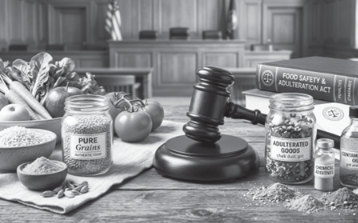
The sake of profit margins. Every morning, millions of Indian households gather around what they believe is a nourishing meal. We obsess over calorie counts, track glycaemic indices, and scan labels for added sugar, oblivious to a far uglier question: is the substance on our plates even food at all? The true disaster of adulteration is that it rarely announces itself with a dramatic emergency.
It does not hit like acute food poisoning with immediate cramps and fever. Instead, chemical adulterants wage an invisible war of attrition. Synthetic colours, heavy metals, and adulterated fats way out of this crisis with ritualistic festive-season crackdowns. Raiding sweet shops, the night before Diwali and parading seized khoya on local television is pure theatre, not public health governance.
We need a decisive leap from reactive firefighting to predictive deterrence. The analytical tools to break this cycle already exist. High-density consumer markets, vulnerable commodity corridors, and habitual offenders can be tracked using digital supply-chain surveillance. Portable, rapid test kits need to be placed not just in highend laboratories, but in local mandis, milk booths, and the baseline entitlement of every citizen.
We tutor our children from infancy never to take food from strangers. Yet every evening, we invite a faceless syndicate into our homes, hand over our hardearned wages, and set their toxic chemical experiments on the dinner table. No society can medicate its way out of an intentionally poisoned food supply. If the state cannot protect what goes into our pots and pans, it matters truly little what else it protects. The thief has had his fill. It is time we locked the kitchen door.
*The writer is a bilingual author with five published titles to his credit.