Ask anyone preparing for SSC, banking or railway exams what they do every week, and most will say they take mock tests. Yet plenty of candidates take forty or fifty mocks and see their scores barely move. Usually it comes down to how the tests are used.
Treat each mock as a practice session. Used well, one mock can teach you more than a week of reading.
Start with the exam pattern, not the mock
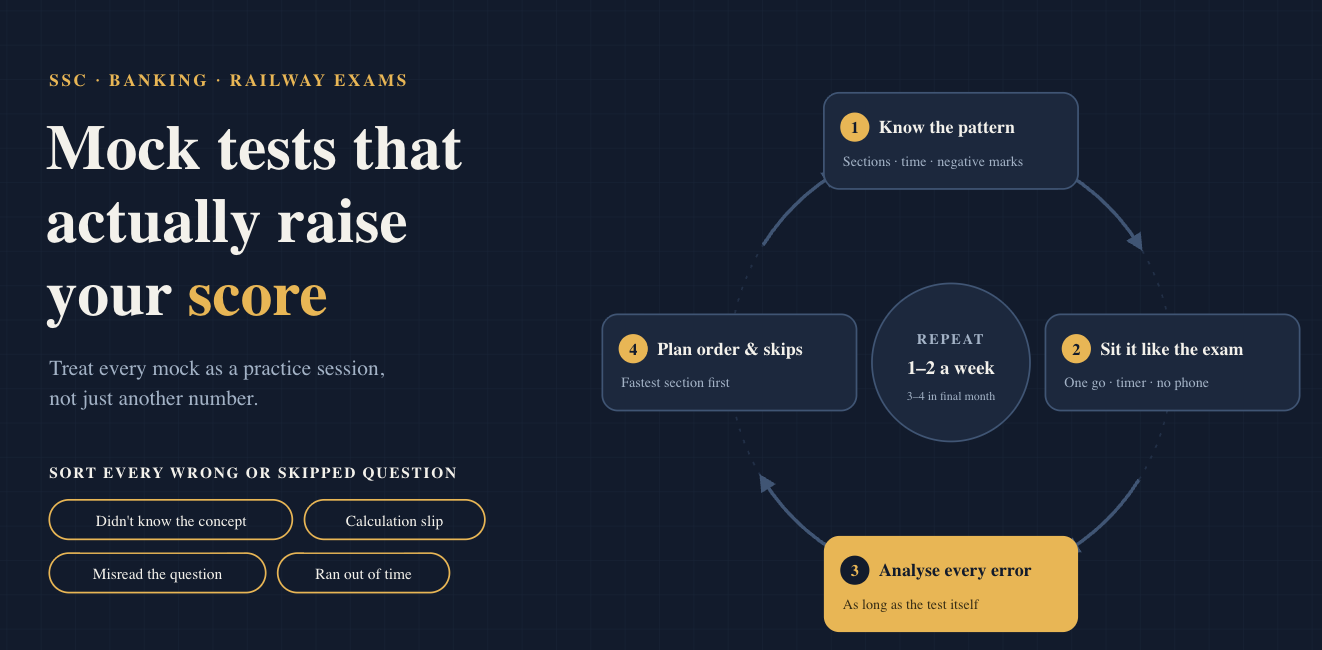
Before the first mock, read the official notification for your exam on the commission’s or recruiting body’s own website. Note four things: the sections, the time allowed, the marks per question and the negative marking. These decide your strategy.
An exam that takes marks off for wrong answers rewards accuracy over attempts. An exam with sectional time limits means you can’t borrow time from your strongest section. Mocks that don’t follow the current pattern train the wrong habits, so check that any mock you use matches it.
Take each mock like the real exam
Sit at a table, set a timer and finish in one go. No phone, no pausing to check a formula, no second attempt at a question you already answered. The point is to see how you perform under the same pressure as the exam hall, including how tired you get in the last section.
If you’re short of time on a weekday, take a single sectional test under its real time limit instead of a full mock in pieces.
Spend as long on the analysis as on the test
This is the step most candidates skip, and it’s where the improvement comes from. After each mock, go through every question you got wrong and every question you skipped, and put each one into one of four groups:
- Did not know the concept: go back to the chapter and practise ten questions on that topic.
- Knew it, made a calculation slip: practise the same type of question with a timer until the method is automatic.
- Misread the question: slow down on long questions and underline what is being asked.
- Ran out of time: decide in advance which question types you will leave for the end.
Keep a simple error log in a notebook. After five or six mocks, the same few topics will keep appearing. Those are worth more of your time than anything else.
Plan the order and the skips
A lot of marks go on time spent fighting hard questions. Decide before the exam which section you attempt first, usually the one where you are fastest and most accurate. Inside each section, do one quick pass for the questions you can answer immediately, then return to the rest.
With negative marking, a guess is only worth it if you can rule out at least one or two options. Your mock results will show you whether your guesses are paying off. If they aren’t, guess less.
How many mocks, and when
In the early months of preparation, one or two full mocks a week is enough, with plenty of topic practice in between. In the last month before the exam, increase to three or four a week, still with full analysis after each one. Taking a mock every day without analysing it mostly practises the same mistakes.
Where to find mocks
Start with the official sample papers and previous years’ question papers, since they show exactly how questions are framed. After that, use mock tests that follow the current pattern. The Work Gym is one free option: it has practice tests for exams such as SSC CGL, written to each exam’s published syllabus and timed like the real thing.
Whichever you use, the analysis afterwards is what moves your score.
On exam day
- Reach the centre early and carry every document the admit card asks for.
- Use the first minute to scan the paper and confirm the order you planned.
- Don’t change a planned skip because one section feels easy or hard.
- Keep an eye on the clock at fixed points, for example after every quarter of the time.