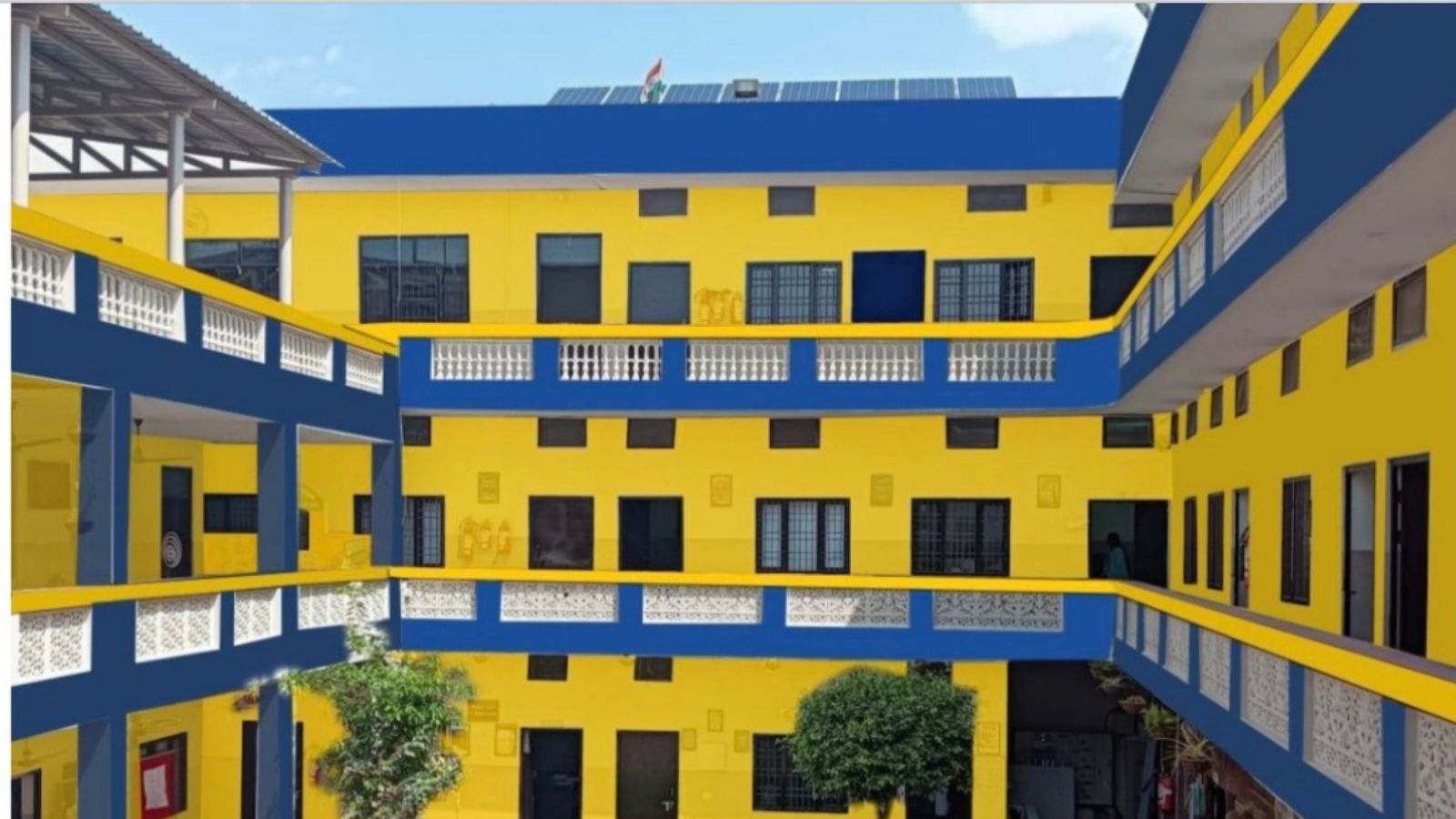
Chandigarh: With the 2027 Punjab Assembly elections less than six months away, the state government’s decision to paint 3,602 additional government schools in blue and yellow has triggered a fresh political confrontation, with the Opposition questioning whether public institutions are being given the colours associated with the ruling Aam Aadmi Party (AAP).
According to an October 1 order issued by the Director General of School Education, the painting and whitewashing exercise will be undertaken under the “Converting Govt Schools into Smart Schools” initiative, with a budget allocation of Rs 80.45 crore. The programme covers 1,895 primary schools, 764 high schools, 532 senior secondary schools and 411 middle schools. Amritsar accounts for 334 schools, followed by Patiala with 326 and Ludhiana with 261.
The decision has revived a controversy that first emerged in December 2025, when 852 government schools were included in a similar colour coding exercise. Opposition parties had then alleged that the selection of blue and yellow reflected the ruling party’s identity.
Pargat Singh questions the colour choice
Recently, PCC Chief MLA Pargat Singh has strongly criticised the use of colours resembling the AAP flag on government school buildings.
During the earlier controversy, Singh visited a government girls’ senior secondary school on Ladowali Road in Jalandhar East and alleged that the government was using public institutions to promote its political identity.
He warned that the exercise risked bringing partisan politics into schools and questioned the government’s education policy. Singh argued that public schools should serve children irrespective of political affiliation and should not become vehicles for promoting the identity of the party in power.
The criticism has returned to the centre of the debate following the latest order covering thousands more schools. The Opposition is asking why the same colour combination is being used across government institutions when it resembles the ruling party’s flag.
Education department rejects political interpretation
The education department has maintained that the painting work is part of routine renovation and the conversion of government schools into smart schools.
Director General of School Education Aravind Kumar MK confirmed that the October 1 order had been issued by his office. During the earlier controversy, he had maintained that there was “nothing political behind the choice of the colours” and that the work was part of routine renovation and whitewashing.
The government’s position is that painting and maintaining school buildings is an administrative exercise. However, the Opposition argues that the choice of colours deserves scrutiny because of its resemblance to the AAP flag and the timing of the decision before the Assembly elections.
The colour scheme alone does not establish political intent. The debate, however, has raised questions about whether the state should adopt a permanent, politically neutral design policy for public institutions.
Education debate widens beyond paint
The controversy comes amid a separate political row over teacher shortages and the functioning of government schools.
AAP MLA Sukhveer Singh Maiserkhana recently raised concerns about inadequate teaching staff and school facilities in his constituency. The party subsequently suspended him, citing anti party activities. The action prompted criticism from opposition leaders, who argued that the government should address the concerns rather than target the legislator who raised them.
Leader of Opposition Partap Singh Bajwa said the controversy over teacher shortages exposed a gap between the government’s “Sikhya Kranti” claims and conditions in classrooms. He argued that education reform required teachers and adequate facilities rather than slogans and publicity.
BJP leader Ravneet Singh Bittu also criticised the government, arguing that concerns raised by a ruling party MLA over teacher availability raised questions about the condition of government schools. SAD president Sukhbir Singh Badal similarly attacked the government’s education claims, questioning the focus on school branding when staffing and facilities remained contentious issues.
These are separate controversies, but together they have intensified the political debate over the government’s education record ahead of the elections.
Public institutions or political identity?
For the AAP government, the school painting initiative is part of its smart school programme. For the Opposition, the resemblance between the selected colours and the party flag raises questions about the separation between government administration and political identity.
The larger issue is whether public institutions should follow a consistent design policy that remains unchanged when governments change. Such a policy could prevent schools from becoming symbols of whichever party occupies power.
The Rs 80.45 crore allocation also places the focus on transparency. The expenditure, procurement process, painting specifications and implementation of the programme are matters that can be assessed through official records.
As Punjab approaches the 2027 Assembly elections, the dispute over school colours has become another test of the AAP government’s education narrative. The final assessment will depend not only on the appearance of school buildings, but also on whether students have adequate teachers, facilities and learning support.