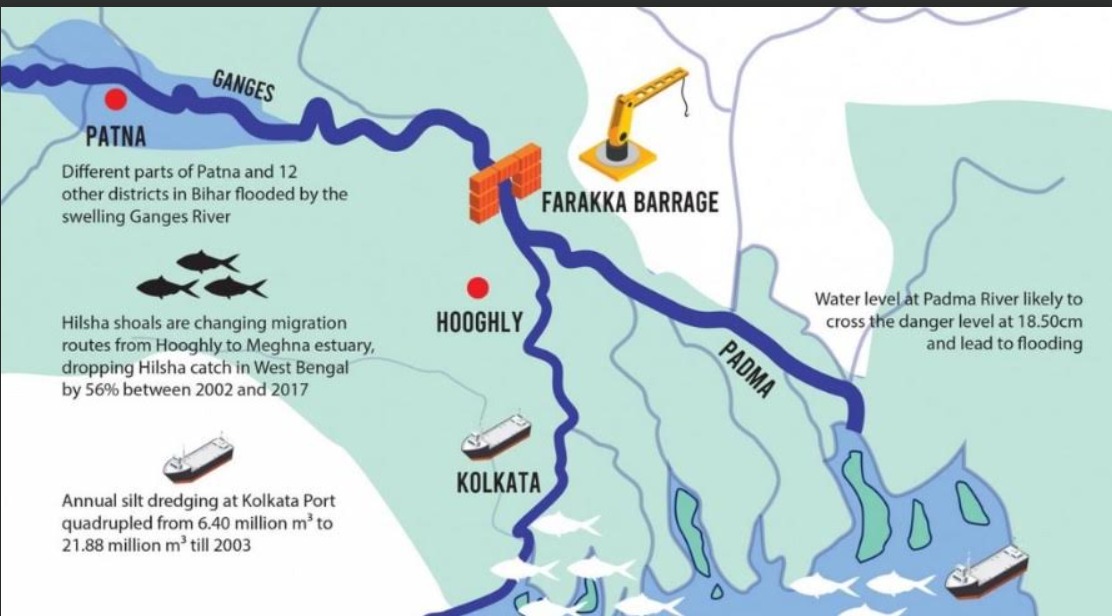
As the India-Bangladesh Ganga water treaty approaches its December 2026 expiry, Dhaka wants a fresh agreement with stronger safeguards. The dispute dates back to the Farakka Barrage, the 1977 breakthrough and a five-year water-sharing experiment that eventually led to the landmark 1996 treaty
For nearly five decades, the Ganga has been more than a river flowing across India and Bangladesh. Its waters have been at the centre of negotiations, agreements, diplomatic disagreements and competing demands over agriculture, navigation, ecology and livelihoods.
That history is coming back into focus as the 1996 India-Bangladesh Ganga Water Sharing Treaty approaches the end of its 30-year term on December 12, 2026. Bangladesh has said it wants a new treaty rather than simply extending the existing arrangement, with stronger guarantees for dry-season flows. India, meanwhile, has said Ganga treaty issues will continue to be discussed through the existing bilateral framework, including the Joint Rivers Commission and technical-level mechanisms.
The present debate cannot be understood without returning to Farakka, where the modern history of the dispute began.
The river dispute began at Farakka
The Farakka Barrage in West Bengal was conceived as an engineering intervention to divert Ganga water towards the Bhagirathi-Hooghly system. The objective was to improve the river regime and navigability of the Hooghly and help preserve Kolkata Port. The barrage was commissioned in May 1975. Its feeder canal was designed to divert water from the Ganga towards the Bhagirathi.
For India, the project was linked to the condition of the Hooghly and the need to maintain navigability and reduce salinity in the Kolkata region. For Bangladesh, located downstream, the dry-season diversion raised a different question: how much water would remain available after the Ganga crossed the border and became the Padma?
The disagreement was therefore not simply about an engineering structure. It was about how a shared river should be divided when its flow was at its lowest and demand was high on both sides. That question would dominate India-Bangladesh water diplomacy for years.
When a barrage became a bilateral dispute
Once Farakka became operational, the sharing of lean-season flows became increasingly contentious. Bangladesh argued that reduced downstream flows could affect agriculture, fisheries, navigation and other uses dependent on the river.
The dispute acquired an international dimension when Bangladesh raised the issue at the United Nations in 1976. The two countries subsequently returned to negotiations, seeking a formula that could address India’s requirements at Farakka while ensuring an assured flow for Bangladesh.
The result was a significant breakthrough in September 1977.
September 29, 1977 is an important date in the history of the dispute because India and Bangladesh reached a breakthrough on the sharing of Ganga waters after negotiations over the Farakka issue.
The formal agreement was signed later, on November 5, 1977, in Dacca. It established a five-year arrangement for sharing Ganga waters during the dry season, from January 1 to May 31. The distinction between the two dates is important: September 29 marked the breakthrough, while November 5 marked the formal signing of the agreement.
The agreement represented an attempt to move away from confrontation towards an agreed system based on measured river flows and specified allocations.
But the arrangement was more complicated than the familiar shorthand that describes it as a simple 60:40 division.
The first breakthrough came with a five-year pact
The 1977 agreement established a schedule for the distribution of water according to the flow available at Farakka. Rather than setting one fixed percentage for the entire dry season, it used 10-day periods and specified allocations based on the flow conditions.
Across the dry season, the arrangement is commonly described as providing roughly 59 per cent of the available water to Bangladesh and 41 per cent to India. But that overall description can obscure the details of the agreement.
One of the clearest examples came during the critical April 21-30 period. When the relevant flow was 55,500 cusecs, Bangladesh was allocated 34,700 cusecs and India 20,800 cusecs. That amounted to 62.5 per cent for Bangladesh and 37.5 per cent for India for that period.
The figures demonstrate why describing the 1977 arrangement simply as a permanent 60:40 split is misleading. The actual mechanism depended on flow levels and 10-day periods.
The 60:40 shorthand hides a more complex formula
The significance of the 1977 agreement lay not only in the quantities of water allocated but also in the attempt to create a mechanism for periods when the river carried unusually low flows.
The agreement recognised that a fixed allocation could become difficult to maintain when the Ganga itself did not provide enough water to meet the normal schedule.
That problem led to one of the most important features of the 1977 arrangement — a guarantee provision intended to provide Bangladesh with a minimum level of protection during exceptionally low flows.
The provision would later become an important point of comparison with the 1996 treaty.
A guarantee clause became central to the bargain
The 1977 agreement contained an 80 per cent guarantee clause. In periods of exceptionally low flow, Bangladesh was to receive at least 80 per cent of its scheduled share for the relevant 10-day period, subject to the agreement’s provisions.
The guarantee mattered because the central concern for Bangladesh was not simply the average amount of water it received over several months. The most difficult conditions arose when the river was at its lowest and the demand for water remained high.
That distinction remains relevant to the debate in 2026.
Bangladesh’s current water resources minister has said Dhaka wants a new treaty containing guarantee clauses to ensure its due share during the dry season. The minister has also said Bangladesh wants safeguards against excessive flows during the monsoon, which the government links to flooding and associated agricultural and economic losses.
In that sense, the present demand has a direct historical connection with the structure of the 1977 agreement.
The first pact expired, but the dispute remained
The 1977 agreement was never intended to be permanent. Its five-year term ended in 1982.
Instead of immediately producing a long-term settlement, the two countries subsequently entered into temporary arrangements, including understandings in 1982 and 1985. The search for a durable formula continued.
The difficulty was structural. The amount of water available at Farakka varied from season to season, while the requirements on both sides continued to grow. A formula had to account for a river whose flow could not simply be increased through negotiation.
The experience of the 1977 agreement nevertheless provided the basis for later negotiations. It demonstrated that water sharing could be organised through a formal mechanism rather than left entirely to political negotiations whenever the dry season arrived. That eventually led to the treaty of 1996.
The 1996 treaty changed the framework
On December 12, 1996, India and Bangladesh signed the Ganga Water Sharing Treaty in New Delhi. Unlike the earlier five-year agreement, the new treaty was designed to operate for 30 years. It has governed the sharing of Ganga waters during the lean season from January through May since 1997.
When the flow at Farakka is 70,000 cusecs or less, the two countries are to receive 50 per cent each.
When the flow is between 70,000 and 75,000 cusecs, Bangladesh receives 35,000 cusecs while India receives the balance.
When the flow is 75,000 cusecs or more, India receives 40,000 cusecs and Bangladesh receives the balance.
The treaty also contains a specific provision for the period from March 11 to May 10, under which India and Bangladesh are each to receive 35,000 cusecs in alternate three 10-day periods.
The formula therefore sought to combine fixed minimum quantities with a flow-based distribution mechanism.
Thirty years later, the water equation has changed
The treaty that emerged in 1996 was negotiated against the hydrological, agricultural and demographic circumstances of that period. Three decades later, the river basin faces a different set of pressures.
Water demand has increased across the region. Agriculture remains heavily dependent on river and groundwater resources, while cities and industries require greater quantities of water. At the same time, rainfall patterns and river flows are affected by increasing climatic variability.
This does not mean that climate change alone has altered the Ganga dispute. The river’s flow is influenced by several factors, including rainfall, upstream use, seasonal variation and withdrawals for different purposes.
But it does mean that a treaty negotiated three decades ago is now being examined against conditions that are not identical to those prevailing in 1996.
That is one reason the debate has moved beyond simply asking whether the existing treaty should be renewed.
Climate change adds a new variable to an old dispute
The fundamental difficulty of a water-sharing treaty is that the agreement can divide available water, but it cannot manufacture additional river flow.
For Bangladesh, the critical concern is particularly acute during the dry season, when river flows are lower and the need for dependable water remains high.
For India, the question involves the requirements of areas and communities dependent on the Ganga system, as well as the original purposes associated with the Farakka project. India’s Farakka Barrage Project continues to identify diversion towards the Bhagirathi-Hooghly system, navigation and water supply among the project’s functions.
The next agreement will therefore have to deal with a basic contradiction: both countries want greater certainty from a river whose flow is naturally variable.
The Ganga is more than a water-sharing formula
The Ganga-Padma system supports fisheries, agriculture, wetlands, navigation and communities whose livelihoods are tied to seasonal river flows. Changes in water availability can therefore have consequences beyond the amount of water recorded at a barrage.
The ecological dimension has become increasingly visible in recent years. The return of hilsa to parts of the upper Ganga has drawn attention to the river’s role as an interconnected ecological system, with the Farakka region historically affecting fish migration.
The development does not settle the broader water-sharing dispute, but it illustrates why future discussions cannot be limited entirely to allocations measured in cusecs.
A river is simultaneously a source of water, a transport route, an ecological corridor and a foundation for livelihoods.
Bangladesh wants stronger safeguards this time
The Bangladesh government has made clear that it wants a new agreement rather than simply carrying forward the existing treaty unchanged.
Water Resources Minister Shahiduddin Chowdhury Anee said on September 24 that Bangladesh wants guarantee clauses ensuring its due share during the dry season. He also said Dhaka wants provisions to address excessive monsoon flows.
Bangladesh has also publicly discussed the need for a higher share compared with the arrangements under earlier agreements. In August, State Minister for Water Resources Forhad Hossain Azad said Dhaka would seek a higher share when the treaty is renewed and pointed to the absence of a guarantee clause in the current treaty compared with the 1977 arrangement.
The demand therefore has two parts: the quantity of water Bangladesh receives and the certainty with which that quantity can be expected during critical periods.
India must balance downstream sharing with its own needs
India’s position is also shaped by its own requirements from the Ganga system.
The Farakka project was built for specific purposes associated with the Bhagirathi-Hooghly system, including maintaining navigability and improving conditions around Kolkata Port. The project also lists water supply and other uses among its functions.
India has said the Ganga treaty issue will be handled through existing bilateral mechanisms. MEA spokesperson Randhir Jaiswal said discussions on river-related issues form part of the agenda of the bilateral Joint Rivers Commission, while technical-level meetings of the Joint Committee of the Ganga Water Treaty have continued.
The negotiations will therefore have to reconcile Bangladesh’s demand for stronger assurances with India’s requirements and the actual availability of water in the river.
The politics of the river never stayed out of the water
The Ganga dispute has always operated at several levels simultaneously.
At one level, it is a technical question involving river discharge, seasonal flow and allocations. At another, it concerns agriculture, fisheries, navigation and livelihoods. At the diplomatic level, it is part of the broader relationship between India and Bangladesh.
The Farakka dispute itself became internationalised in the 1970s before returning to bilateral negotiations. The 1977 agreement then demonstrated that political negotiations could produce a concrete water-sharing mechanism. The 1996 treaty subsequently turned that experience into a longer-term framework.
The current negotiations again come at a politically important moment in bilateral relations, making the treaty more than a technical exercise while still requiring detailed technical negotiations over river flows.
What began at Farakka now enters a new phase
The approaching expiry of the 1996 treaty brings the history of the dispute full circle.
The question first became acute around Farakka because India needed to divert water towards the Bhagirathi-Hooghly system while Bangladesh needed dependable downstream flows. The 1977 agreement provided the first major negotiated framework. Its guarantee clause became an important feature of the arrangement, but the agreement expired after five years.
Temporary arrangements followed before the two sides reached the 1996 treaty.
That treaty has now itself reached the end of its 30-year term.
The difference is that the next negotiation begins with nearly five decades of accumulated experience. Both countries have the record of the 1977 arrangement, the temporary agreements of the 1980s and the three decades of the 1996 treaty to examine.
The next pact will inherit five decades of history
The central question in 2026 is therefore not simply whether India and Bangladesh can renew a treaty.
It is what kind of water-sharing framework can reflect the river as it exists today.
The 1977 agreement showed the importance of guarantees. The 1996 treaty demonstrated the possibility of a long-term formula based on measured flows. The years since then have added new pressures involving population, agriculture, environmental concerns and changing hydrological conditions.
Bangladesh is asking for stronger assurances and a new agreement. India has indicated that the issue will continue through bilateral mechanisms and technical discussions.
The history of the Ganga dispute suggests that no single number can settle the question permanently. The river’s flow changes, the demands on it change and the political relationship between the two countries changes.
That is why September 29, 1977 remains significant.
It marked the moment when a dispute over the waters of the Ganga moved towards a negotiated framework. Nearly half a century later, the same river is once again testing whether India and Bangladesh can turn competing water requirements into an agreement that can last.