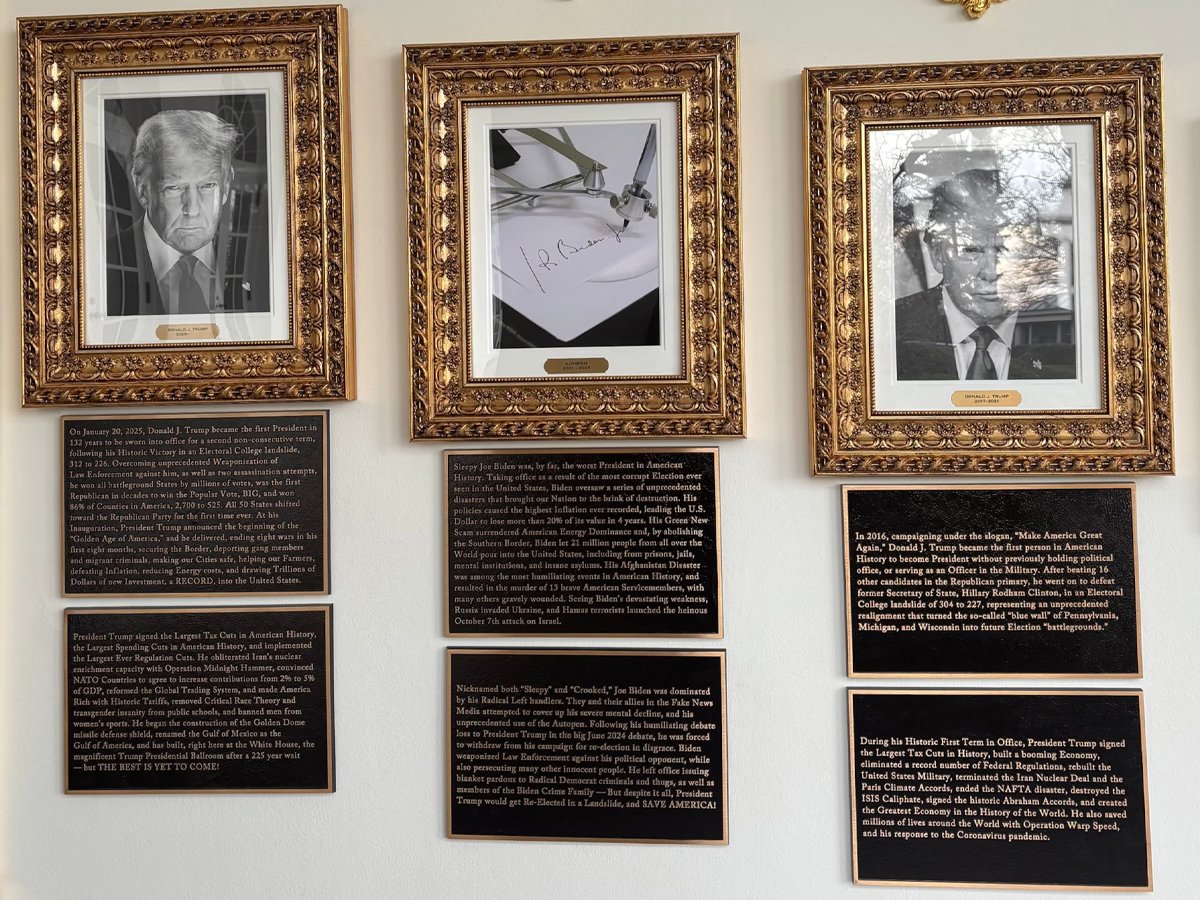
The White House has added a new and controversial feature under President Donald Trump. New plaques now hang beneath portraits of former U.S. presidents along a recently created display, known as the Presidential Walk of Fame. The plaques sharply criticise several of Trump’s predecessors, including Joe Biden and Barack Obama, and promote disputed claims about their presidencies.
The move has broken with long-standing White House tradition, where former presidents are usually presented neutrally and respectfully. Instead, the plaques use political language, personal attacks, and Trump’s own interpretations of recent history.
What Is the Presidential Walk of Fame?
The Presidential Walk of Fame runs along the White House colonnade, a space frequently seen by staff and visitors. It displays framed portraits of past U.S. presidents. Beneath many of these portraits, new plaques now describe each president’s legacy.
Unlike typical historical summaries, these descriptions adopt a strongly partisan tone. White House press secretary Karoline Leavitt confirmed that President Trump personally wrote much of the text.
The White House has added text to the Wall of Fame next to the Rose Garden. pic.twitter.com/FnoMYUhWXn
— Andrew Leyden (@PenguinSix) December 17, 2025
“The plaques are eloquently written descriptions of each President and the legacy they left behind. As a student of history, many were written directly by the President himself.”
“Sleepy Joe” Label Sparks Outrage
The plaque beneath Joe Biden’s portrait uses one of Trump’s most repeated nicknames. It refers to him as “Sleepy Joe Biden” and calls him “the worst President in American History.”
Instead of a standard photograph, Biden’s image is represented by an autopen, a device used to sign documents. The plaque accuses Biden of mental decline and claims he assumed office through “the most corrupt Election ever seen in the United States.”
It also criticises Biden’s handling of the economy, immigration, and foreign policy. The plaque links global conflicts to what it calls Biden’s “weakness” and references the 2021 Afghanistan withdrawal.
The text also states, “Following his humiliating debate loss to President Trump in the big June 2024 debate, he was forced to withdraw from his campaign for re-election in disgrace.”
Obama Described as “Divisive Figure”
Barack Obama’s plaque also draws attention for its wording. It uses his full name, “Barack Hussein Obama,” and labels him “one of the most divisive figures in American history.”
The plaque criticises his healthcare reforms, calling the Affordable Care Act ineffective. It also attacks international agreements signed during his presidency and claims Trump later reversed them.
The text repeats Trump’s long-standing allegation that Obama spied on his 2016 campaign and describes the Russia investigation as a political hoax.
How Other Presidents Are Portrayed
Not all former presidents face criticism. The plaques praising Trump’s own presidency describe his leadership in highly positive terms.
The plaque covering Trump’s first term highlights tax cuts, economic growth, military rebuilding, and foreign policy actions. Another plaque focusing on his second term praises tariffs, immigration crackdowns, and cultural policy decisions.
It also boasts of new projects and symbolic changes, ending with the line, “But THE BEST IS YET TO COME!”
Meanwhile, Bill Clinton’s plaque ends by referencing Trump’s victory over Hillary Clinton in the 2016 election.
Reaction From Lawmakers
The plaques have triggered mixed reactions on Capitol Hill. Some Republican lawmakers expressed discomfort with the tone and message.
Senator Lisa Murkowski said the move troubled her.
“These are individuals who served and were elected by people around this country. Whether I supported them or not, they were the country’s president. Let’s not have President Trump trying to redefine the contributions or lack of contributions of each. That’s inappropriate.”
Others dismissed the controversy. Senator Lindsey Graham said the plaques were not a priority.
“I don’t think that’s going to move the ball for us. There may be some amusement there.”
Why the Plaques Matter
The installation of these plaques marks a clear shift in how presidential history is presented inside the White House. Critics argue the move turns a national institution into a political messaging space. Supporters say it reflects Trump’s promise to challenge established narratives.
Questions also remain about how the plaques were funded and installed. The White House has not yet clarified whether government resources were used.
For now, the plaques remain in place, reshaping how visitors experience presidential history — and adding another chapter to the ongoing political divide in Washington.