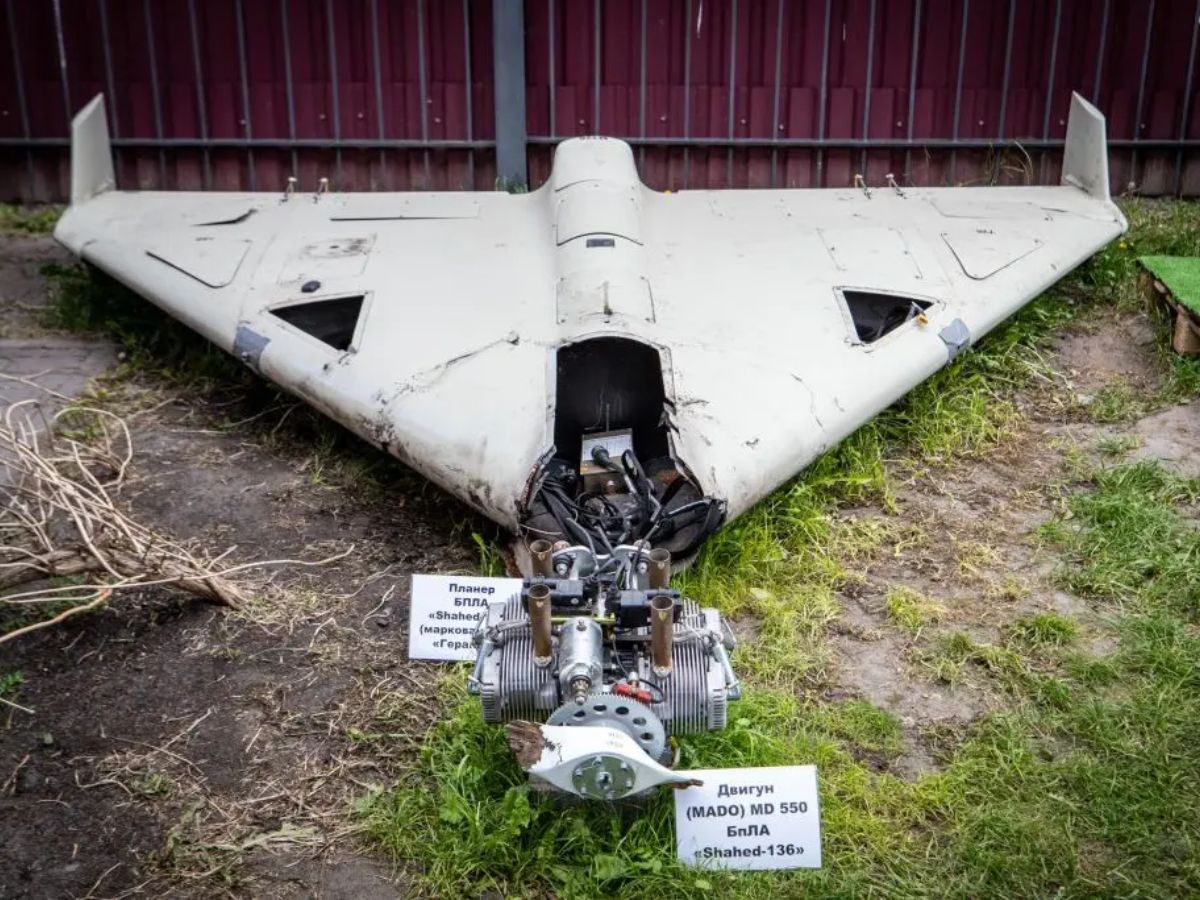
Ukraine has formally taken up with the Indian government and the European Union the discovery of Indian-made or, assembled electronic components in Shahed 136 drones—unmanned combat aerial vehicles (UCAVs) designed by Iran and deployed extensively by Russia against Ukrainian targets.
The development, though diplomatically sensitive, throws light on a troubling trend: globally traded dual-use technologies, legally exported, finding their way into war zones through convoluted third-party supply chains.
A Formal Red Flag from Kyiv
According to people familiar with the matter, Ukrainian authorities sent at least two formal diplomatic communications to India’s Ministry of External Affairs after discovering specific Indian-origin components in the Shahed drones. The issue was also brought up with EU Sanctions Envoy David O’Sullivan during his July visit to New Delhi.
Ukraine’s Defence Intelligence Directorate (HUR) even highlighted the matter publicly on their official Telegram and Facebook channels, though there was no comment from the Ukrainian embassy in New Delhi.
What Was Found: Indian Tech, Foreign War
Documents reviewed reveal that two components were traced to Indian manufacture or assembly:
-
A “Bridge Rectifier E300359” by Vishay Intertechnology, assembled in India, was found inside the drone’s voltage regulator.
-
An AU5426A PLL-based signal generator AU5426A chip from Aura Semiconductor, Bengaluru, was used in the drone’s satellite navigation system to shield it from jamming.
Both components fall under the category of dual-use—commercial items that can also serve military purposes. Importantly, no laws appear to have been broken during their export from India.
India Responds, Cautiously
External Affairs Ministry spokesperson Randhir Jaiswal issued a carefully worded response, affirming India’s commitment to non-proliferation norms:
“India’s exports of dual-use items are in keeping with its international obligations… Due diligence is conducted to ensure that such exports do not violate any of our laws.”
However, following the Ukrainian flag, Indian security agencies visited manufacturers in Delhi, Bengaluru, and Mumbai to raise awareness about international export restrictions.
Firms React: Denial, Concern, and Compliance
-
Vishay Intertechnology, a US-based chipmaker with Indian operations, has remained silent despite repeated requests.
-
Aura Semiconductor, in contrast, issued a statement expressing concern over unauthorized use of its chip. Co-founder Kishore Ganti emphasized compliance and ethical sourcing:
“We are deeply disturbed by the possibility that any of our components may have reached defence manufacturers through unauthorized third-party channels.”
Aura confirmed launching an internal audit, but the findings were inconclusive. The component in question, being a plug-and-play unit, could be used without any further manufacturer support—making traceability extremely difficult.
The West Asian Loop
Investigators believe the most plausible explanation lies in the grey maze of international trade: components legally exported to countries in West Asia were then diverted to either Iran or Russia.
Ajay Srivastava of the Global Trade Research Initiative (GTRI) elaborated:
“Once such goods are exported to legitimate third countries, tracing their end use becomes nearly impossible—a challenge every open economy faces.”
Also Read: Christie Blasts Trump as ‘Petulant Child’ After Firing of Jobs Official
Drone Warfare Meets Supply Chain Complexity
The Shahed 136, cheap and deadly, has been a game-changer in Russia’s drone arsenal. Ukraine claims that over 6,100 such drones were launched in July alone. Initially supplied directly by Iran, Russia is now believed to be assembling them using ready-made Iranian parts.
Worryingly, this isn’t an India-only affair. Ukrainian intelligence has also found US and Chinese-made components in other Russian weaponry. It highlights a global problem: even the most well-meaning exporters are vulnerable to end-use manipulations in an increasingly multipolar battlefield.
What Now?
While no legal violation by Indian firms is established, the diplomatic signals are unmistakable. Exporters must exercise caution, and regulatory bodies may need tighter end-use verification protocols. But as Srivastava warns, “Export compliance must be enforced, but blame must not be misdirected.”