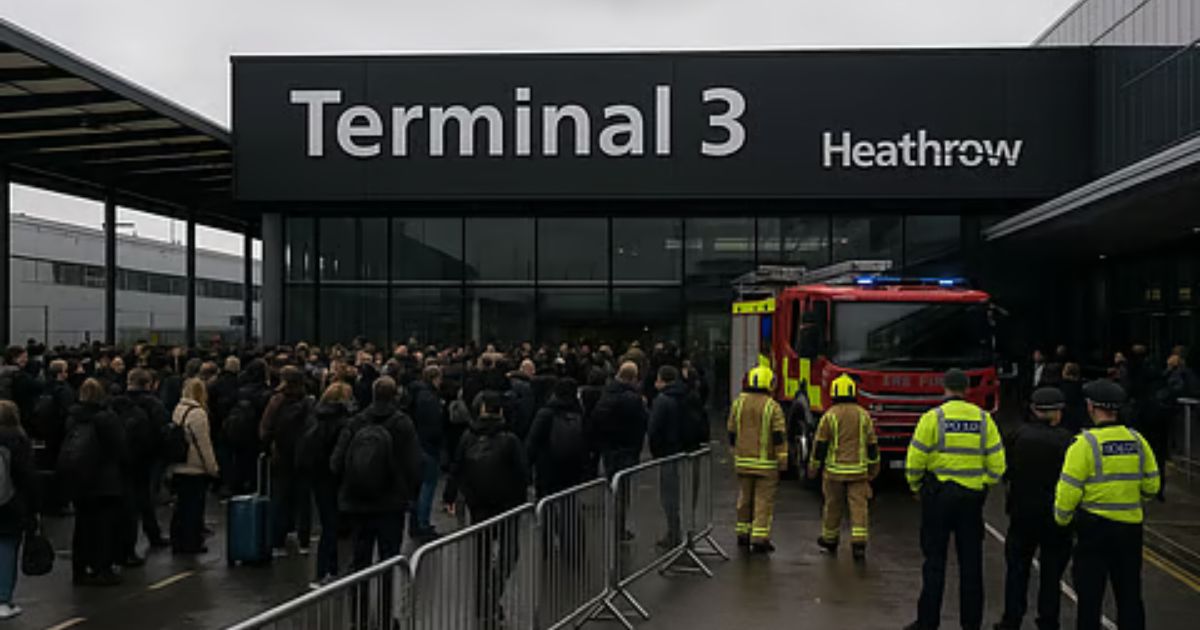
A terminal fire alarm at Heathrow Airport’s Terminal 3 caused a mass evacuation and halted passport control on Saturday morning. Passengers were left stranded in kilometre-long queues as baggage claim areas closed and immigration queues ground to a halt. The incident added to recent operational criticism at Europe’s busiest airport.
Although the issue has now gone back to normal, travellers expressed frustration at the absence of proper communication and contingency planning. The disruption occurs as Heathrow’s new multi-billion-pound expansion plan and an impending legal struggle over an earlier substation blaze that resulted in mass flight cancellations loom.
Evacuation Gridlocks Terminal 3
The event happened when a fire alarm was triggered within Terminal 3, causing emergency workers to respond. The airport tweeted on social media that “some areas of Terminal 3 have been temporarily evacuated” when fire authorities probed the alarm.
Passengers reported excessive delays in passport control and full corridors. One commenter posted on X, “Can someone explain to us why immigration lines at Heathrow are closed down? Been here an hour with nothing in sight.” Another commented, “Border closed down, waited here forever. Why is there no backup plan for a scenario like this?” The ordeal was eventually resolved, and operations resumed at the airport.
New Upgrade Plan Vows Expansion, Speedier Heathrow
Despite the mess on Saturday, Heathrow has unveiled ambitious redevelopment plans for 2027 to 2031. Heathrow aims to add more lounges, restaurants, and shops to existing terminals, developing equivalent new public areas to ten football pitches.
The strategy guarantees improved baggage handling, with 99% of bags moving along with passengers, and fewer delays to flights. Heathrow is seeking 80% of flights to leave on schedule and 95% of travellers to clear security in under five minutes. Completed, the new-look airport will handle 10 million additional passengers each year.
Proposals also cover the demolition of Terminal 1, the extension of Terminal 2, and the building of a new southern road tunnel to enhance access.
Airport Continues to Cope With Effects of March Power Outage
Heathrow earlier this month announced that it could sue the National Grid following a March substation fire that caused flights to be cancelled and disrupted 270,000 passengers.
The fire, which was due to moisture-induced failure at a transformer at North Hyde substation, suspended activities for 24 hours, and it cost Heathow millions of dollars. The National Energy System Operator report attributed faulty equipment for fire safety and delayed maintenance.
Energy regulator Ofgem has later initiated an investigation into National Grid. Heathrow, in the meantime, lashed out at antiquated regulations as well as inadequate infrastructure monitoring, stating measures were being made to make them more resilient.
As the most punctual of Europe’s major airports in 2024, Heathrow is now under increasing pressure to deliver on its promises without suffering more disruptions.