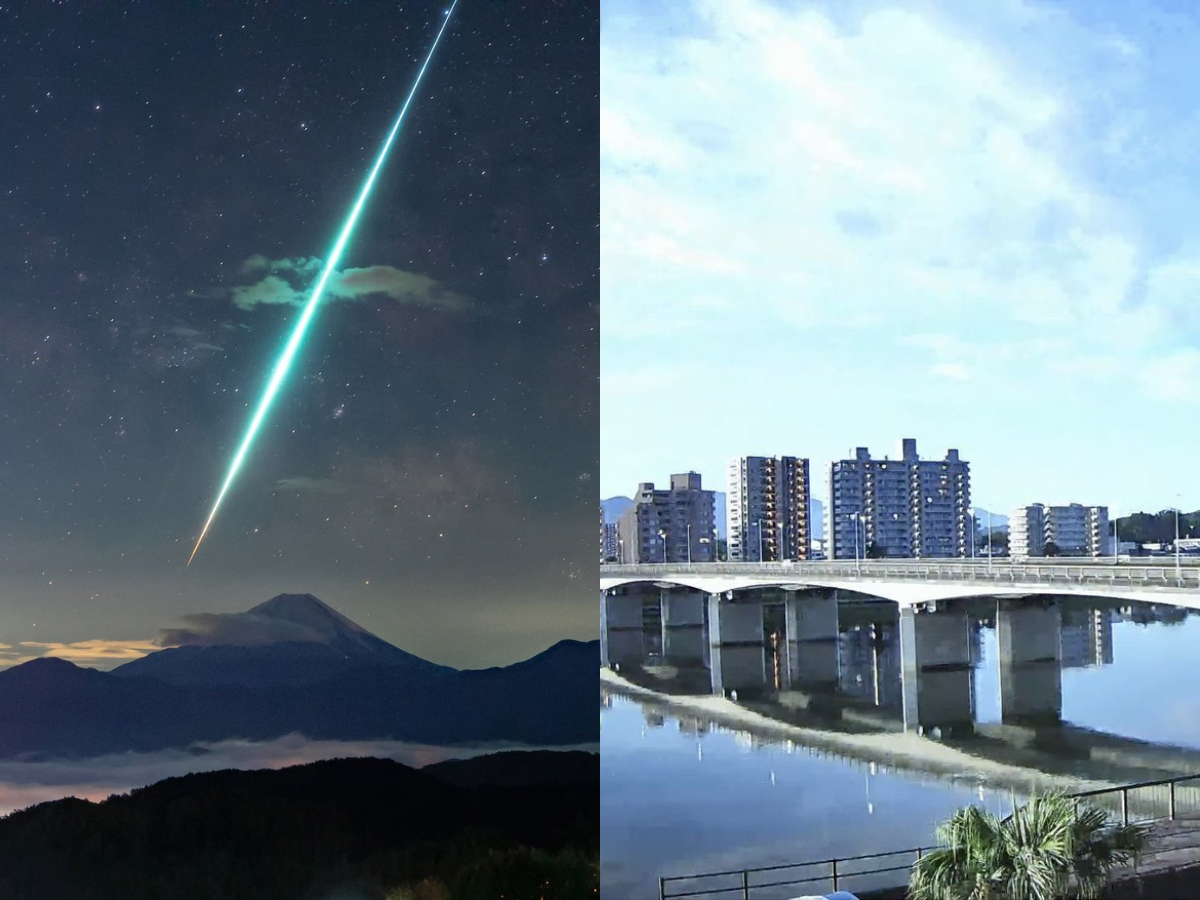
A stunning fireball meteor lit up the skies above Japan’s Shikoku and Kyushu, left locals awestruck, and made everyone a little bit excited on social media. The fleeting but breathtaking display was caught on camera by Fukuoka Airport, revealing the sky lighting up in bright blue before the meteor was gone in seconds.
Meteor Caught on Camera, Videos Go Viral
Quite a number of videos taken by residents went viral soon, capturing the fireball racing through the sky before extinguishing. The Japan Meteorological Agency is yet to verify if pieces of the meteor landed on earth, but experts believe such fireballs normally burn up completely in the atmosphere.
A bright meteor, often described as a fireball, was observed streaking across the sky over the Sakurajima volcano and the city of Kagoshima in southern Japan.
The dramatic event lit up the night sky, making it appear as if it were daytime for a brief moment. It was captured on… pic.twitter.com/BYh074Gnrw— T_CAS videos (@tecas2000) August 19, 2025
The sighting follows just one week after a unique “meteoroid cluster” phenomenon was seen in Aomori Prefecture, northeastern Japan. The event occurred at the same time as the peak of the Perseid meteor shower, one of the most looked-forward-to yearly celestial spectacles. Famous for producing swift, glowing fireballs, the Perseids appear when Earth crosses through debris shed by Comet Swift-Tuttle.
What Are Meteors?
As defined by NASA, meteoroids are space rocks that vary from small dust particles to asteroids. When they enter the Earth’s atmosphere at high velocities, they evaporate like vapor, leaving bright trajectories commonly referred to as “shooting stars.” Fireballs meteors, which are larger or traveling faster, can burn brightly in the nighttime sky like a star brighter than Venus.
On average, meteoritic material of about 44 tonnes falls on Earth every day. Virtually all of it vaporizes in transit, leaving streaks of light as a testament to its existence.
Annual Meteor Showers
Meteor showers happen as the Earth moves through the dusty paths created by comets. Meteor showers are normally named after the constellation from which they seem to come, like the Perseids. Together with the Geminids and Quadrantids, the Perseids rank as one of the three great meteor showers.
For Japanese sky observers, the fireball meteor was just another reminder of the unpredictability and power of the universe.