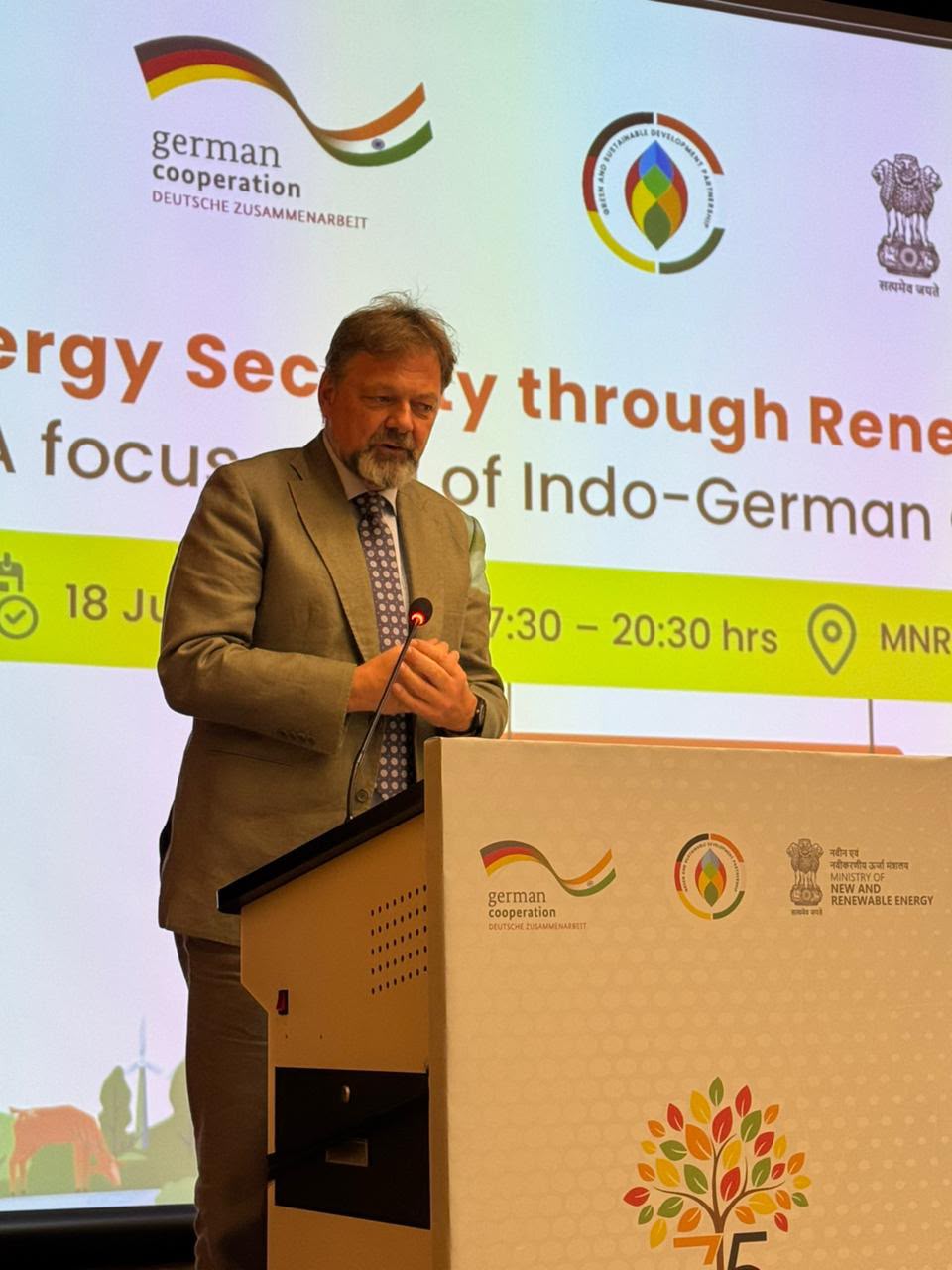
New Delhi, June 19: The Indo-German Partnership for Green and Sustainable Development (GSDP) hosted the tenth edition of GSDP Conversation Series in partnership with the Ministry of New & Renewable Energy (MNRE) under the theme ‘Energy Security through Renewable Energies’.
The high-level panel discussion brought together senior representatives from the Ministry of New and Renewable Energy, industry leaders, think tanks, private sector players and renewable energy experts to discuss how India can accelerate its renewable energy transition and to explore how renewable energy can strengthen the resilience of the Indian economy against
fossil-fuel-related price shocks.
“Renewable energy is no longer just a climate imperative, but also an economic and strategic necessity. India and Germany share a common challenge of reducing dependence on imported fossil fuels and increasing energy independence. Renewables create a powerful ‘trinity’ of climate action, economic opportunity, and energy security. India has made significant progress in renewable energy deployment with renewable sources now contributing around 26% of electricity generation. The GSDP partnership is particularly significant as India and Germany mark 75 years of diplomatic relations. India and Germany are celebrating 75 years of diplomatic relations. The longstanding bilateral development cooperation has evolved into a partnership addressing climate action and sustainable development for resilient economic growth,” said German Ambassador to India Dr. Philipp Ackermann.
Santosh Kumar Sarangi, Secretary, MNRE, talked about the relevance of energy security and expectations from international cooperation. “The recent crisis in West Asia has once again highlighted the critical importance of energy security. Renewable energy, including solar, wind, battery energy storage systems and green hydrogen – has immense potential to strengthen energy security while supporting sustainable development. India has made significant progress, with non-fossil fuel sources now
accounting for approximately 54 percent of the country’s installed electricity capacity, and we remain firmly committed to achieving 500 GW of non-fossil fuel capacity by 2030. As trusted partners in the global energy transition, India and Germany can continue to work together to drive innovation, mobilise investment, and advance our shared goals of energy security, sustainable development and climate action,” said Sarangi.
India has set an ambitious target of achieving 500 GWof non-fossil fuel capacity by 2030 and net zero emissions by 2070. Solar, wind and energy storage are the key technologies that will play a crucial role in reducing dependence on fossil fuels and supporting India’s transition towards a low- carbon economy.