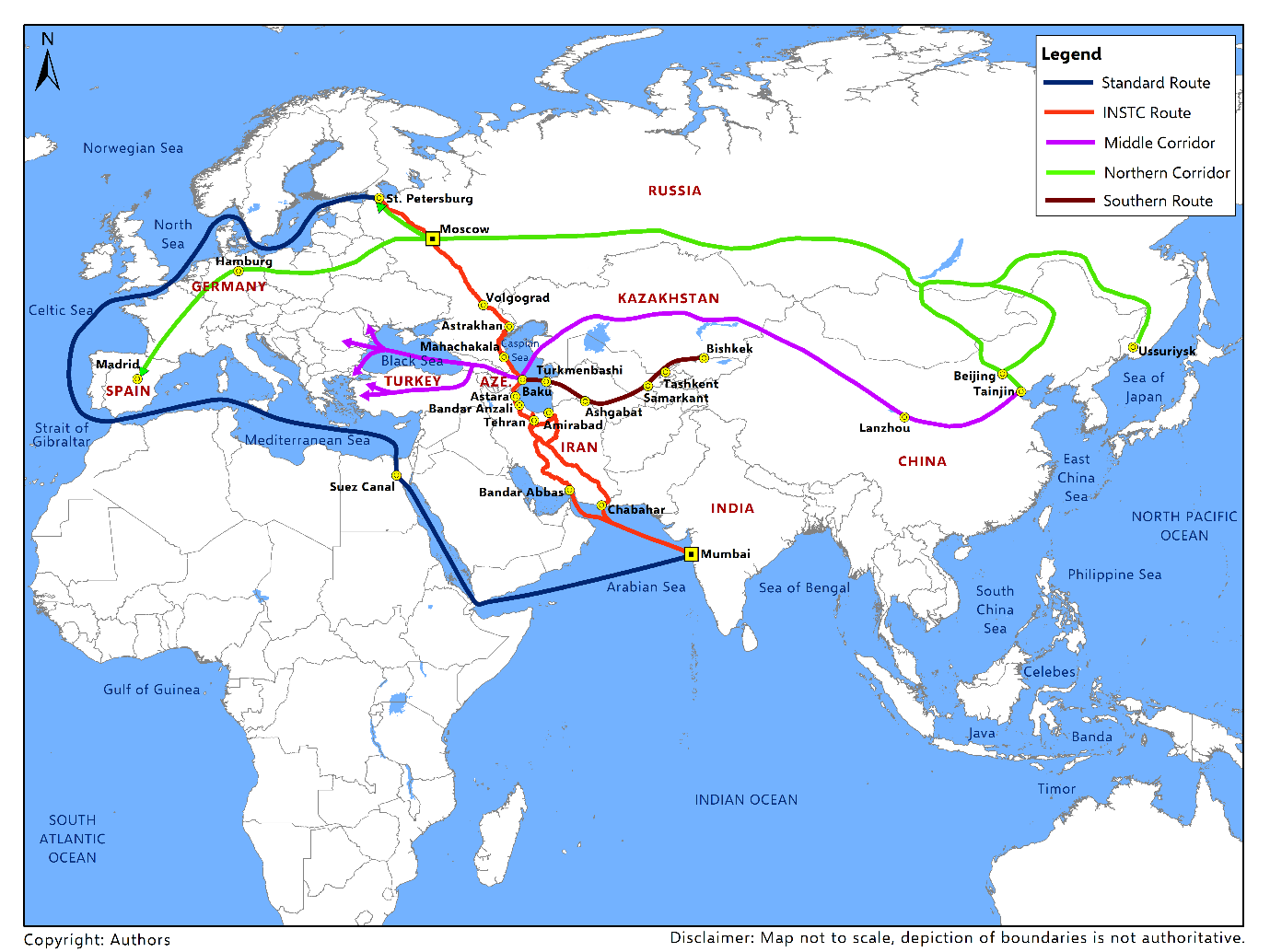
Central Eurasia is a concept increasingly used to describe the area of the Eurasian continent, stretching from the basins of the Volga and Yenisei to those of the Amu Darya and Syr Darya, as well as the Ganges, Indus and Yangtze rivers. This is a single region encompassing Russia, Mongolia, republics of Central Asia, the northern parts of India and Pakistan together with Afghanistan, and, in part, Iran and western China. It is precisely this broad space that may be viewed as a core zone of stability and peaceful interaction in Eurasia.
Historically, the region was linked by several overland routes of exchange, among which the Silk Road occupied an important, though not exclusive, place. Through these routes, goods, religions, ideas, and cultural practices circulated for centuries among different civilizations. In this sense, Central Eurasia functioned not merely as a transit corridor but as a contact zone where trade and cultural interaction reinforced one another . The Mongol Empire further strengthened this connective role: by securing vast stretches of overland trade routes, the Mongols made long-distance movement safer and expanded the geography of exchange across Eurasia.
Today, the states of the region – India, China, Russia, Pakistan, the countries of Central Asia, Mongolia, Iran, as well as Afghanistan and the Himalayan states in a broader geopolitical sense – are again investing in a cooperative model based on trade, science, and culture. The principal regional platform for this interaction is the Shanghai Cooperation Organisation (SCO), where India’s role is unique and large-scale.
The SCO brings together states with different status of participation, different cultural legacies and economic systems. Yet it operates on the basis of the principles of the mutual trust, mutual benefit, equality, consultation, respect for cultural diversity, and freedom of maneuver. One of its central objectives is to maintain regional stability and security while promoting confidence-building and soft diplomacy through humanitarian and cultural ties.
An equally important area of cooperation is the creation of conditions for long-term sustainable development. It’s essential because it helps reduce poverty and inequality, which often generate radicalism and cross-border banditry . In this sense, security in Central Eurasia depends not only on countering threats, but also on addressing their deeper social and economic causes. India fully shares this vision and makes significant contributions to cooperation in the fields of healthcare, computer technology2 , education, food security and climate change mitigation.
Pavel N. Malyutin, Higher School of Economics