

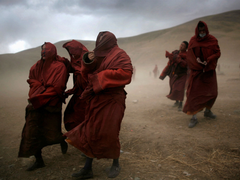
A Tibetan monk from eastern Tibet has reportedly been detained for a second time by Chinese authorities, raising fresh concerns over China’s continued suppression of religious freedom and dissent in Tibet.
Jamyang Tashi, a monk from the influential Labrang Tashikhyil Monastery in Amdo, was taken into custody by police in Sangchu County in early February, as reported by Tibet Watch and cited by Phayul.
According to the research outfit Tibet Watch, the detention reportedly occurred only two months after Jamyang had been released from a previous six-month period of arbitrary detention.
Chinese authorities have neither disclosed the reason for his latest detention nor provided any information regarding his current whereabouts or condition.
Jamyang was previously detained on allegations of maintaining contact with Tibetans living in exile. Such accusations are frequently used by Chinese authorities against Tibetan monks and laypersons suspected of engaging with exile communities or accessing information related to the Dalai Lama and Tibetan institutions outside China.
The latest detention has been shrouded in secrecy.
Jamyang’s family has received no official information about his case. Authorities are also alleged to have warned relatives against making inquiries, further deepening concerns about his safety and well-being.
Fears of reprisals against family members have limited efforts to independently verify details surrounding the monk’s detention.
Jamyang was initially detained alongside fellow monk Jigme Sangpo, who is also affiliated with Labrang Tashikhyil Monastery and whose whereabouts remain unknown.
Rights groups say the disappearances reflect a broader pattern of intimidation and enforced secrecy used by Chinese authorities in Tibetan regions, as highlighted by Phayul.
Labrang Tashikhyil Monastery, one of the most prominent centres of the Gelug school of Tibetan Buddhism, has long been subjected to heightened surveillance and political scrutiny due to its religious influence and cultural significance in the Amdo region, as reported by Phayul. (ANI)
(The article has been published through a syndicated feed. Except for the headline, the content has been published verbatim. Liability lies with original publisher.)






