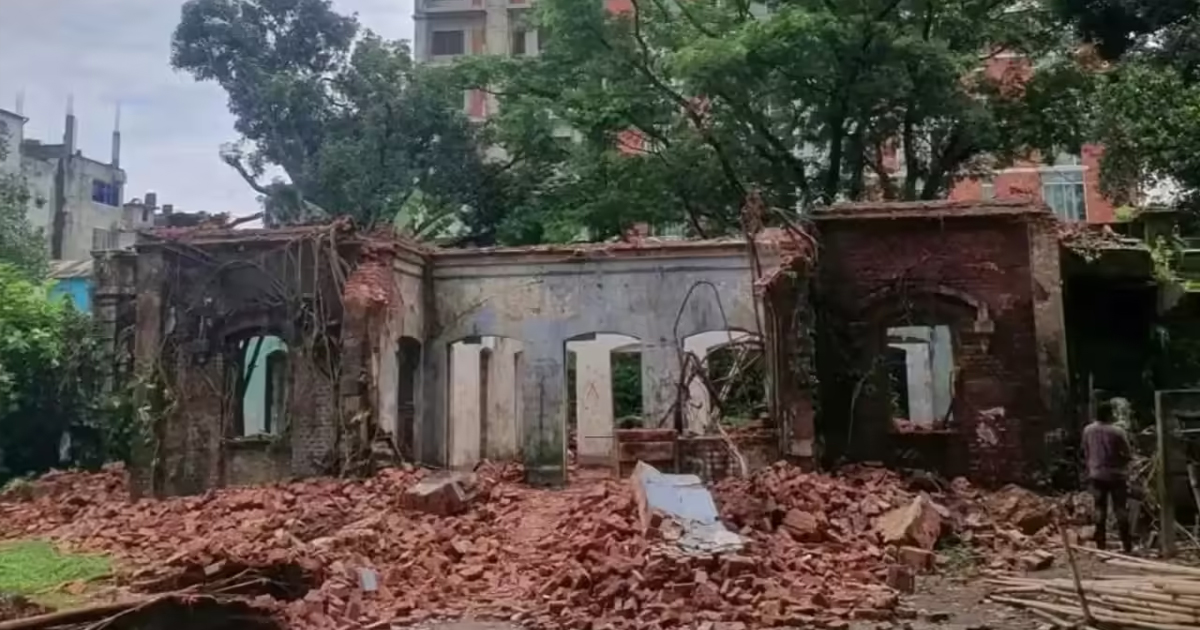
On Tuesday, West Bengal Chief Minister Mamata Banerjee sounded alarm over demolition of legendary director Satyajit Ray’s ancestral house in Mymensingh, Bangladesh. She called the act “heartbreaking” and asked both the Bangladesh and Indian governments to save the historic building. The Government of India has replied, stating that it is ready to join hands with Bangladesh to restore and rebuild the building.
The building, in Horikishore Ray Chowdhury Road of Dhaka, was owned by Ray’s paternal grandfather, Upendra Kishore Ray Chowdhury—a renowned writer and editor. Constructed more than a century ago, the building has been lying vacant since the past decade and was once utilized as the Mymensingh Children’s Academy. Authorities claim that it had long fallen into disrepair.
“News reports indicate that in Bangladesh’s Mymensingh city, the birthplace of Satyajit Ray’s grandfather, the celebrated writer-editor Upendrakishore Ray Chowdhury, immersed in his memories, is being demolished. It is learnt that work had already started on demolishing the building. The news is very upsetting. The Ray family is the most important bearer and carrier of Bengali culture,” Banerjee wrote on X.
The demolition process is already underway to accommodate a new semi-concrete structure intended for educational purposes. Md Mehedi Zaman, Dhaka’s Children Affairs Officer, informed Daily Star, “The house was left vacant for 10 years,” stating that the new building will have some rooms for conducting educational activities. He added that the project obtained required approvals and that the previous structure was not safe for kids.
India Appeals for Conservation, Exposes Cooperation
In response to the events, the Indian Government highlighted the historical and cultural value of the site. “It would be better to reconsider demolition and explore possibilities for its repair and reconstruction as a museum of literature and symbol of the common culture of India and Bangladesh,” the communiqué stated.
“The Government of India would be ready to provide cooperation for this,” it further said, suggesting that the house could be a shared cultural heritage place.”