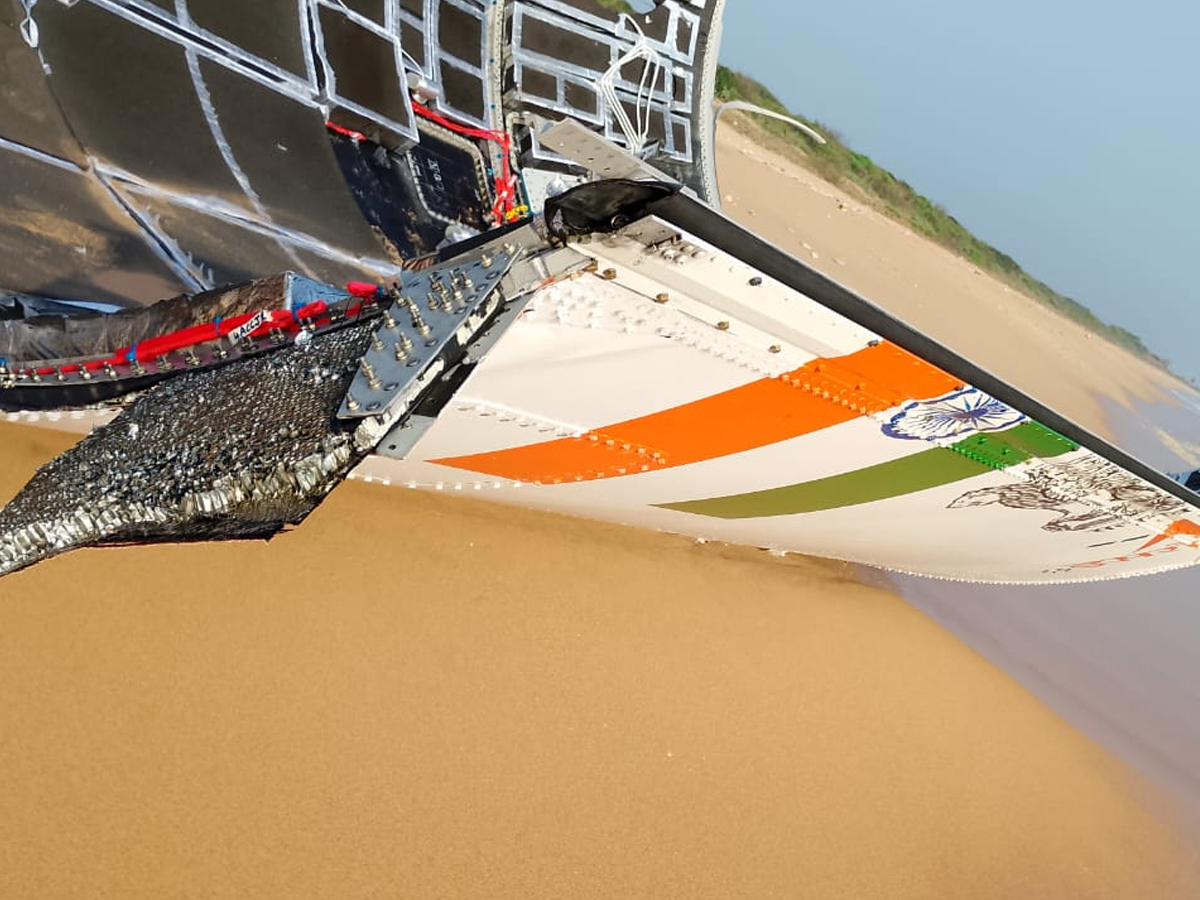
A large metallic object believed to be debris from an Indian rocket has been found along Sri Lanka’s eastern coastline. The discovery comes only days after India launched its heaviest payload into Low Earth Orbit using the LVM3 heavy-lift rocket. The incident has triggered security checks and sparked public interest across the region.
The object was spotted near the Malai Munthal sea stretch close to Sampur, near Trincomalee. Residents alerted authorities after noticing the unusual structure washed ashore. Soon after, security forces moved in to secure the area and prevent public access.
What Experts Say About the Debris
Preliminary assessments suggest the debris may be part of a payload fairing. This component acts as a protective shell for satellites during launch and usually separates from the rocket once it exits Earth’s atmosphere.
Rockets are designed to discard such parts mid-flight to reduce weight. These components normally fall into designated ocean drop zones. However, strong sea currents and winds can cause them to drift toward land over time.
Seems like one half of the payload fairing from the LVM3-M6 mission has reached the shores of Sri Lanka. It is 5m in diameter, ~10m long.
I presume it will be kept in their museum, similar to the PSLV PS3 motor casing, which was kept by Australia.
Source: https://t.co/j1quglKC1M pic.twitter.com/Gs7eEs5rxQ
— Lokesh KR (@Lokeshkr73) December 29, 2025
Officials say the size and shape of the recovered object match rocket hardware used in heavy-lift missions.
Possible Link to Recent LVM3 Mission
The timing of the discovery has drawn attention to India’s recent LVM3 mission, which successfully placed BlueBird Block-2 communication satellites into orbit. The LVM3, India’s most powerful launch vehicle, completed the mission after a flight lasting roughly 15 minutes.
The rocket follows a three-stage design. It uses solid fuel boosters for liftoff, a liquid core stage for mid-flight propulsion, and a cryogenic upper stage for precise satellite placement.
Experts believe the debris could be from this mission, though no official confirmation has been issued yet.
Security Response and Local Reaction
Sri Lankan naval and police teams quickly secured the site following the discovery. Authorities are inspecting the debris to confirm its origin and ensure there is no threat to public safety or the environment.
Residents in nearby coastal villages expressed curiosity and concern. Many gathered near the area before officials restricted entry. No injuries or damage have been reported so far.
Not an Isolated Incident
This is not the first time rocket debris linked to space launches has appeared in the Indian Ocean region. Similar incidents have occurred in the past, with fragments washing up along coastlines due to natural ocean movement.
As global space activity increases, experts stress the importance of international coordination to track and manage falling rocket components.
Why Space Debris Awareness Is Growing
With more countries and private firms launching satellites, managing space debris has become a growing challenge. Even controlled launches can leave behind components that travel long distances after re-entering Earth’s atmosphere.
The Sri Lanka discovery highlights the need for better debris tracking and transparent communication between space-faring nations.