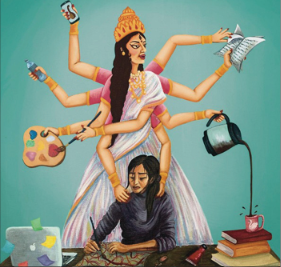
There is a familiar scene in many Indian homes during Navratri. Nine young girls arrive at the house, their feet are washed, their foreheads are marked with vermilion, food is served with reverence and gifts are placed before them. For a few moments, the child sitting in front of the family is no longer simply a daughter, granddaughter, neighbour or student. She is treated as a manifestation of the divine feminine. The tradition of Kanya Puja, generally observed on Ashtami or Navami, reflects an idea deeply embedded in Indian religious and cultural traditions — that the feminine carries a form of divine power.
Young girls are honoured as manifestations of the Goddess, with nine girls often symbolising the nine forms of Durga. The larger celebration of Navratri similarly places feminine energy, strength and power at the centre of worship. There is something beautiful about that idea. There is also something unsettling about the distance between that symbolism and the reality many women and girls continue to experience. need to be called a goddess to deserve dignity. A girl does not need to have her feet washed during a festival to deserve safety for the rest of the year.
If society truly believes that the feminine represents strength, then that belief must extend beyond temples, rituals and ceremonies into streets, classrooms, workplaces, public transport and every ordinary space in which women live their lives. The same little girl who is welcomed into a home as a form of the Goddess can grow up in a world where she has to think twice before walking alone after dark. She may learn to share her location before travelling, keep emergency numbers ready, avoid certain roads and constantly assess whether a public space feels safe. The woman she eventually becomes may be a student, journalist, police officer, professional, mother or public servant, yet the expectation to protect herself from other people’s behaviour can continue to follow her. This is the contradiction that deserves attention.
India has never lacked a vocabulary of reverence for women. Its mythology and traditions are filled with powerful female figures. Navratri celebrates feminine strength in its many manifestations, while rituals surrounding the festival reinforce the idea that the girl child deserves honour. The worship of the feminine is neither new nor marginal to Indian culture; it is deeply woven into it. But reverence is not the same as respect. A woman does not The question becomes more urgent every time another incident of harassment or sexual violence comes to light.
When the contradiction enters everyday life
Recent incidents have once again shown how little age, profession or circumstance can protect a woman from becoming a target. In one recent case, a woman police sub-inspector, while performing routine patrol duties as part of a unit intended to assist women and girls, was allegedly subjected to inappropriate behaviour by a group of young men. The confrontation reportedly escalated, with one of the youths allegedly slapping her. Police arrested one person and continued efforts to identify others. The incident was particularly disturbing because the woman involved was herself serving in a role associated with protecting women in public spaces. In another case, a teenage girl and her male companion were allegedly harassed and assaulted by a group of youths.
The episode was recorded and circulated online before police action followed, leading to arrests. The incident brought attention once again to the vulnerability of young girls in ordinary public spaces and the speed with which an act of humiliation can become digital content for others to consume. Another recent case involved a teenage girl who was allegedly sexually assaulted by men who posed as police personnel. The alleged offenders used the appearance and authority associated with law enforcement to intimidate the young victims before the assault. The case was investigated under provisions of the Bharatiya Nyaya Sanhita and the Protection of Children from Sexual Offences Act.
The details of these incidents differ, but the question they raise is remarkably similar: how free can women and girls be if ordinary activities — travelling, studying, working or simply being outside — can carry the possibility of harassment and violence? The problem is not confined to one age group. A woman journalist recently alleged sexual harassment by a police officer during a period of public demonstrations. The allegation and the subsequent response became part of a wider debate about the treatment of women who speak publicly about harassment and seek institutional action. The matter was taken up for investigation, once again raising questions about whether women who report misconduct can expect to be heard without being made to bear another burden for speaking out. These are not stories that can comfortably be placed into one category. They involve different places, professions and circumstances.
They involve different ages and different forms of alleged misconduct. Yet their accumulation produces a larger picture — one in which women continue to encounter behaviour that limits their sense of security even while society publicly celebrates their strength. That contradiction should concern everyone. It should not become an argument about men against women. Nor should every man be treated as responsible for the actions of an individual offender. The issue is much larger than that. It is about the standards a society establishes, the behaviour it tolerates, the institutions it trusts and the responsibility it accepts when women are denied dignity.
Women deserve safety, not shrinking spaces
Women should certainly be protected from violence but protection cannot mean shrinking their lives. Safety cannot be achieved by continually reducing the spaces in which women are allowed to exist. A public road should be safe because it is public, not because women have been told to avoid it. A college campus should be safe because institutions have a responsibility towards their students, not because students are asked to stop attending activities after sunset.
A workplace should be safe because professional boundaries are respected and complaints are taken seriously, not because women are expected to tolerate inappropriate behaviour to protect their careers. The real objective cannot be to teach women how to live smaller lives.
The shame belongs to the act, not the victim
There is another burden that women have historically been forced to carry: silence. The fear of being judged can be almost as powerful as the fear of the original incident. Women and girls can worry about what their families will say, how colleagues will react, whether society will question them and whether speaking about what happened will create more humiliation. That is why every woman who speaks deserves to be heard carefully. Reporting an incident is not an invitation to examine the victim’s character. Seeking justice is not an attack on society.
Raising one’s voice is not an act of disobedience. The shame belongs to the act of harassment or violence, not to the person who experienced it. This is particularly important for girls. A child should not have to understand the politics of reputation before she can speak about something that has frightened or harmed her. She should know that adults, institutions and the law exist to protect her rights, and that asking for help will not make her responsible for the consequences faced by the person accused of harming her. This does not mean abandoning due process or declaring guilt before an investigation is completed. It means creating an environment in which complaints are taken seriously while facts are established through the law. A just society must be capable of doing both.
She is not waiting, She is leading
Identities can be meaningful, but none of them captures the full range of women’s lives. The woman of today is also an entrepreneur, scientist, lawyer, journalist, athlete, administrator, police officer, researcher, teacher, artist, elected representative, student and community organiser. She is not simply contributing to society after someone gives her permission to participate. She is helping shape the institutions and conversations around her. That is why the idea of empowerment must move beyond generic celebrations. Empowerment is not simply a photograph of a woman occupying a powerful position.
It is the ability to make decisions, to speak without fear, to earn, to learn, to travel, to participate in public life and to challenge an institution when it fails. It is also the ability to stand alongside someone else. The young woman joining a public demonstration may be there because another girl was hurt. The professional raising her voice may be doing so because she does not want the next woman to experience what she did. The student documenting an incident may be creating evidence that can prevent a future case from being dismissed.
From protection to participation
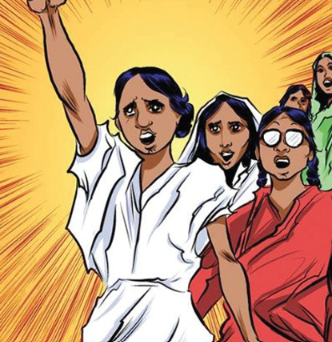
The story of women today cannot end with violence. If it does, society risks reducing women to the incidents that happen to them rather than recognising everything they are doing in response. Because the woman of today is not simply waiting for someone else to solve these problems. She is increasingly becoming part of the response. She is in classrooms, workplaces, newsrooms, courts, laboratories, police stations, public institutions and community organisations. She is participating in public discussions and social movements, documenting what she sees, demanding accountability and questioning rules that previous generations may have accepted without challenge. Her participation in public demonstrations is particularly significant. When women and girls walk together to demand safety and justice, they are not merely expressing anger.
They are claiming public space. They are saying that fear cannot determine whether they have the right to be there. That distinction matters. The woman who marches is not weak because she has had to protest. She demonstrates strength because she has decided that silence is no longer sufficient. The student who challenges an unsafe environment is not demanding privilege. She is demanding the ordinary freedom to pursue her education without having to calculate the risk attached to it. The journalist who continues reporting after facing intimidation is not simply performing a professional duty. She is asserting that the right to question, investigate and report does not disappear because the journalist happens to be a woman. The police officer who returns to duty after facing harassment refuses to allow someone else’s actions to determine the boundaries of her career.
What Shakti means now
The idea of Shakti can be understood differently in the present. Power is not necessarily loud. It can be the decision to remain standing after something has tried to silence you. It can be the courage to report what happened, the determination to return to work, the willingness to question an institution or the decision to stand beside another woman who is afraid. It is the group of women who step into a public space and refuse to leave simply because fear has been created around it.
None of this requires hostility towards men. In fact, a safer society requires men to be part of the answer. Fathers, brothers, teachers, colleagues, friends and citizens all have a role in challenging behaviour that humiliates or threatens women. Respect for women cannot be treated as a responsibility that belongs only to women.

The girl who will grow beyond the ritual
The little girl sitting before a family during Kanya Puja is a cynosure. She may be welcomed as a manifestation of the Goddess. Her feet may be washed, she may be offered food and gifts, and the family may seek her blessings. But the more meaningful question is what happens to her after the ritual ends. Will she be taught only how to protect herself, or will society also learn how to respect her? Will she be taught which roads to avoid, or will those roads become safer? Will she be taught to lower her voice, or will institutions learn to listen?
Will she be told that the world is dangerous, or will the world accept some responsibility for becoming better? She can stand in a crowd and give voice to people who have not yet found theirs. The women appearing in public movements today are already demonstrating this transformation. Their presence is not limited to demanding answers about their own safety. Increasingly ly, they are becoming part of wider civic conversations and carrying concerns that affect entire communities. They are not simply surviving the society around them. They are participating in deciding what that society should become.
Beyond worship, women rise to claim their rightful place
The coming Navratri will once again bring the feminine divine into homes and temples. Girls will be welcomed and honoured. Families will perform rituals that have survived across generations. There is no need to discard that tradition. Perhaps it simply needs to right to grow into a woman without fear. be understood more deeply. If the girl is worthy of reverence during a ritual, she is worthy of respect every day. If the feminine is powerful in mythology, women should not be made to feel powerless in reality. If society sees divinity in the innocence of a child, it must also defend that child’s And if women are being celebrated as embodiments of Shakti, their strength should not be romanticised while their safety is neglected. The real measure of respect is not how beautifully society worships women.
It is how seriously society treats their freedom. That means safer public spaces, responsive institutions, responsible communities and a culture in which reporting harassment is not itself treated as a source of shame. It also means recognising that women are already doing more than demanding protection. They are becoming participants, organisers, professionals, leaders and voices of change. They are stepping into public spaces, challenging institutions and standing beside one another. Their growing presence in social movements is a reminder that women are not merely asking for a better society; they are helping build one. That may be the most important transformation of all. The girl who is worshipped as a Goddess today may become the woman who speaks for someone tomorrow.
She may lead a classroom, a courtroom, a newsroom, a laboratory, a police station, an organisation or a movement. She may carry responsibilities that affect hundreds or thousands of people. The question is no longer whether women are strong enough to carry those responsibilities. They already are. The question is whether society is ready to stop placing limits on the strength it claims to worship. Navratri celebrates Shakti. The women and girls of today are showing what that power can look like beyond the temple — in classrooms, workplaces, public spaces, institutions and streets. They are not asking to be placed on a pedestal.