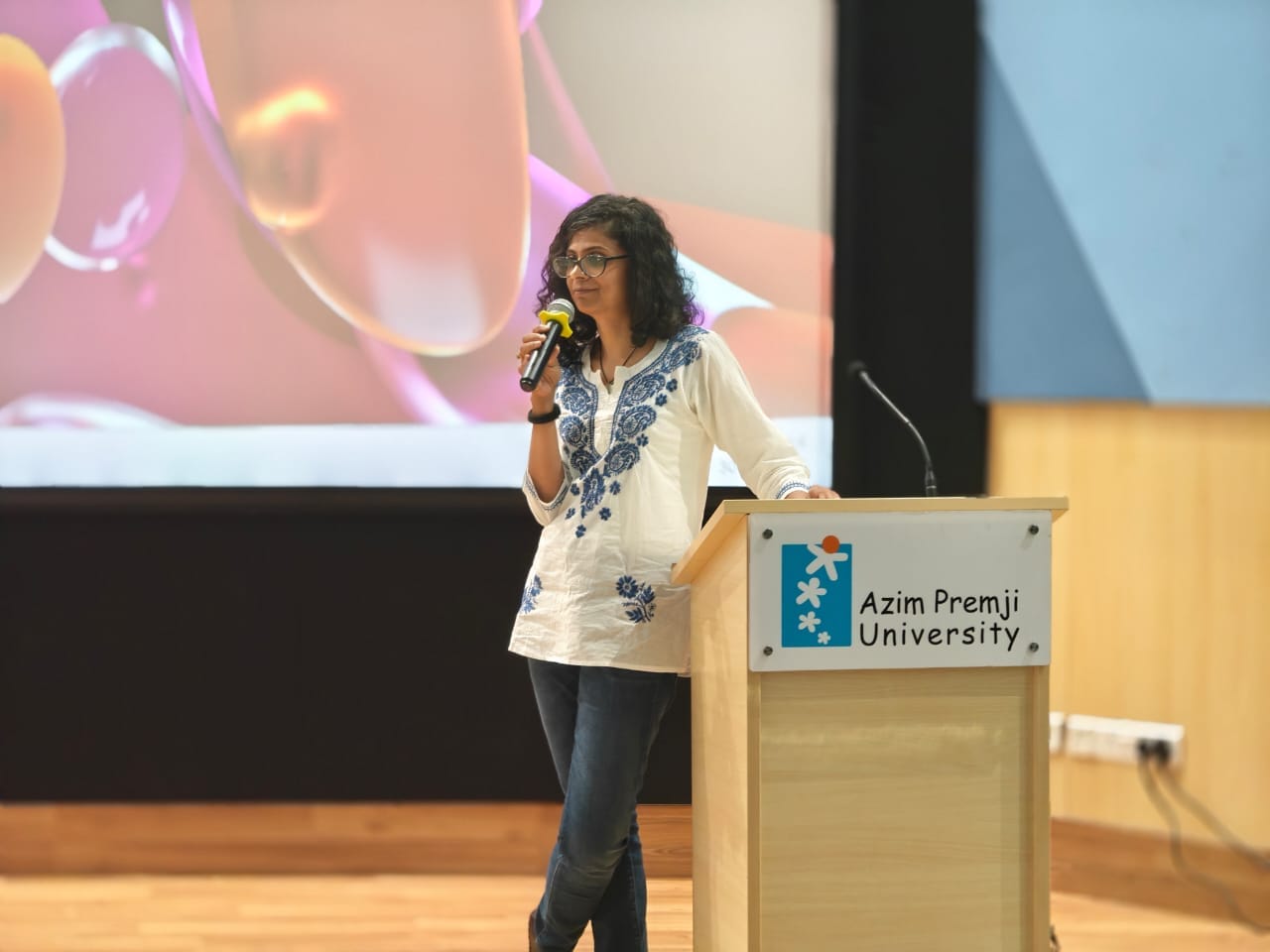
Samreen Farooqui, Creative Head, Video, Round Glass Sustain, is redefining sustainability storytelling through compelling visual narratives that connect audiences with nature. In an exclusive conversation with *The Daily Guardian*, she explores storytelling’s power to inspire meaningful environmental action.
Q. Can a film save a forest?
Samreen Farooqui: Yes, a film can save many forests. At a simple level, I can say that while a film may not physically stop the bulldozers, it can amplify voices of local communities, conservation groups, and scientists that tirelessly work on the ground to save nature.
But there’s a deeper role at play here. Films or stories at large shape the ecosystem of our thoughts and perceptions. Stories are how we make sense of ourselves, our world. A film is not just communication but a framework that shapes our reality. It has the ability to evoke in us the impulse to protect what we are inherently a part of — a forest, a wetland, a beehive in our apartment buildings or a snake passing through our garden.Stories force us to question our apathy, our disconnection to the forest, to nature itself.
At Sustain, our stories serve a long-term purpose, creating messaging that consistently shapes and deepens the connection between people and the natural world. A connection that can save our forests, which in turn can save us.
Q. What’s India’s most misunderstood conservation issue?
Samreen Farooqui: Oh, there are many but there is one that has been striking us the most in the course of our work.
Historically, India’s inherent conservation model is entrenched in deep-rooted tradition of collective care for the environment. Officially protected land in India covers roughly only 5% of the total geographical area and yet, we are one of the most biodiverse countries in the world. And that is because of the communities that have embedded traditional systems to protect species and habitats. Practices such as rotational hunting, taboos, seasonal bans and sacred groves have played a key role.
However, this model has been widely misunderstood and replaced by a top-down, fortress conservation approach that makes sweeping assumptions about local people, viewing them as threats to conservation rather than autonomous stewards and decision-makers.
At Sustain, we soon realised the myth of ‘the pristine’. There is no forest, waterbody, grassland in India that is ‘untouched’ by humans. This realisation has pushed us to work with communities and bring out their stories in our narratives.
Q. Are emotions stronger than facts in documentaries?
Samreen Farooqui: They go hand in hand. Emotions are what move people to cultivate facts, they make us care and remember. Good documentaries balance the two. But having said that, it’s important to constantly ask whose story is being told and who is getting erased in the process.
Q. Which species tells India’s best story?
Samreen Farooqui: For me, the species that tells India’s conservation story right now is a bird that was about to become our national bird in the early 1960s but is today at the edge of extinction.
The Great Indian Bustard is one of the rarest and heaviest flying birds on Earth and has been listed as Critically Endangered on the IUCN Red List. Its current status is closely linked to our neglect of the open natural ecosystems it calls home. These grasslands are also our commons shared by many other species and communities.
Today these ecosystems are considered wastelands, constantly threatened by industrialisation, real estate development, power lines and green energy projects dotting the landscape.
At Sustain we are committed to amplify stories about the Great Indian Bustard. Apart from work that we’ve already done, there’s a documentary on the way as well as a few narrative essays.
Q. Has climate change become harder to film than explain?
Samreen Farooqui: Yes, it is harder to show climate change visually without relying on graphs, data visualization or explicit fact-driven commentary. How does one show a change that is everywhere but nowhere?
One can film extreme weather events but how does one visually render a slow, consistent and interconnected crisis in tangible ways? I think, somehow filmmakers need to stop relying on showing spectacle and catastrophe to talk about climate and bring the everyday changes to our ecosystems and lives into the narrative.
Q. What’s the one environmental truth we keep ignoring?
Samreen Farooqui: That we are not separate from nature. And environmental destruction outside affects our inside, our lives, our wellbeing.
We may think that we can restore what we are destroying — replace one cut forest by afforesting a patch 3,000 kms away or reintroduce captive-bred critically endangered species in the wild. But what was truly ‘wild’ is gone. We cannot truly recreate what we have lost and there’s no going back in many cases.
Q. If you could change one habit in every Indian, what would it be?
Samreen Farooqui: It’s difficult to generalise, and there are many kinds of Indians. However, if I look at the section of society that has benefited from India’s economic development, essentially people like us who have the purchasing power to buy cars and take flights, I will say that the habit to attach economic value to nature is what needs to change.
It is the mindset that looks at nature through the lens of ‘ecosystem services’, focusing on what every tree, waterbody or insect has to offer humankind.
Why can’t we think of the inherent value, the right for nature to just be? And changing this mindset should be especially easy for us, since our traditional ethos is rooted in reverence for nature and a philosophy of coexistence.
A lot of the messaging we do at Roundglass Sustain is also geared towards that behaviour change. Our films show the inherent right for a river to flow, a forest to buzz with life not because they give us XYZ but because they have a value and place of their own in the web of life.