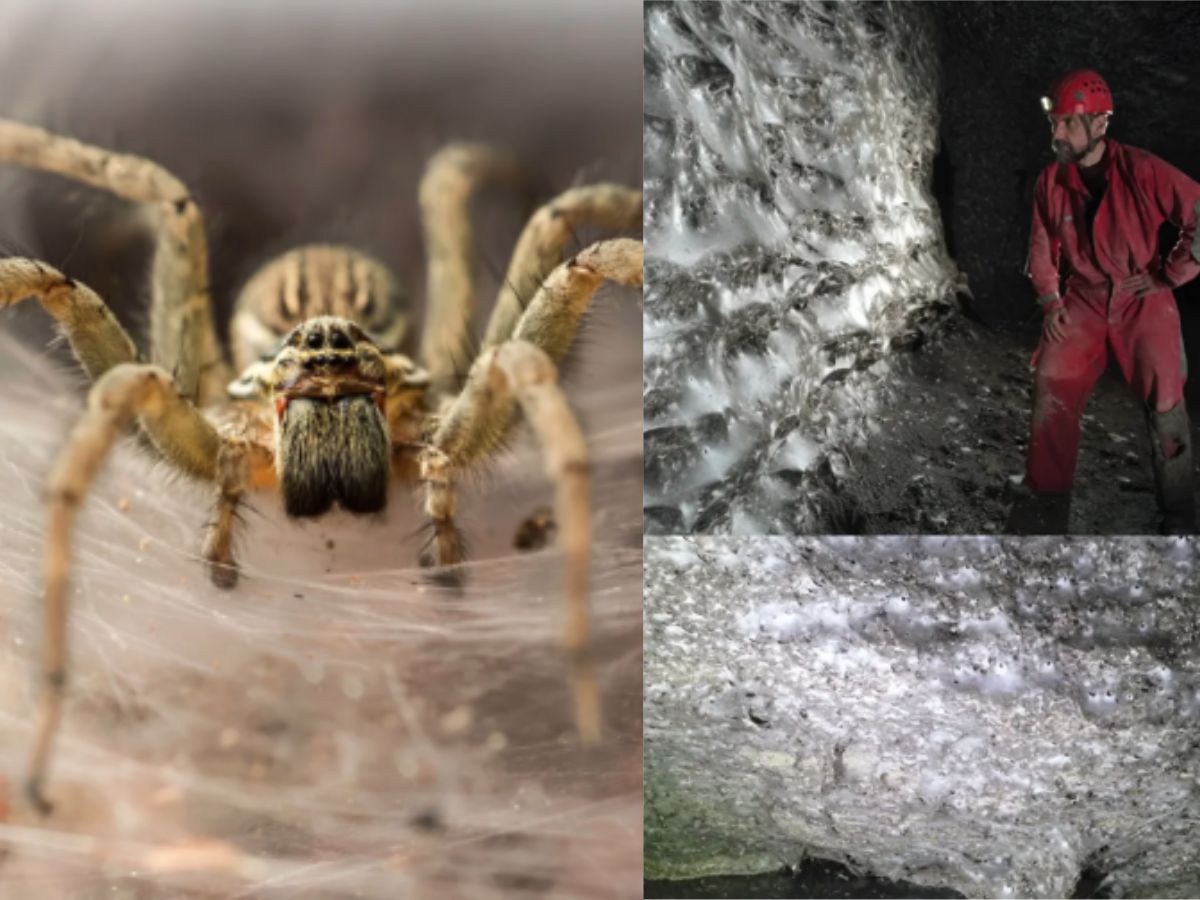
In a groundbreaking discovery, scientists have identified what could be the world’s largest spiderweb inside Sulfur Cave, located along the Greece–Albania border. Spanning an area of about 106 square meters, the vast web is home to an estimated 111,000 spiders, all living together in an unusually cooperative colony deep within the dark cave system.
Discovered by Czech Cavers, Studied by Experts
The enormous web was first noticed in 2022 by a team of Czech cavers exploring Vromoner Canyon. Later, a scientific team led by István Urák from the Sapientia Hungarian University of Transylvania conducted a detailed study of the phenomenon. The researchers identified two main species inhabiting the web—around 69,000 barn funnel weavers (Tegenaria domestica) and 42,000 sheet weavers (Prinerigone vagans). This is the first documented case of these species showing cooperative behavior instead of living solitary lives.
A Unique Sulfur-Based Ecosystem
Sulfur Cave hosts a rare sulfur-powered ecosystem, supported by hydrogen sulfide seeping from an underground stream. The gas nourishes microbial biofilms, which in turn sustain non-biting midges—the primary food source for the spiders. According to the study, the absence of sunlight and the cave’s chemical environment have altered the spiders’ natural instincts, allowing thousands of them to live peacefully side by side.
Evolutionary Adaptations in Isolation
Genetic and gut analyses reveal that these spiders have evolved separately from their surface-dwelling relatives, adapting over time to survive in the toxic, low-light conditions of Sulfur Cave. Female spiders lay hundreds of eggs in overlapping webs, contributing to the colony’s rapid growth and survival.
Scientists Call It a Landmark Discovery
Lead researcher István Urák described the finding as “a moment of admiration and gratitude”, highlighting its significance in understanding evolution, cooperation, and biodiversity in extreme environments. Scientists believe this discovery could reshape how we view social behavior in typically solitary species.
Also Read: Will Elon Musk Become the World’s First Trillionaire After Tesla Approves a $1 Trillion Pay Package?