Across Asia this year, waters swelled in sudden haste and so did the hunger for dire explanations. In Pakistan’s Punjab, rivers overflowed their banks and inundated thousands of villages, displacing well more than two million and crippling fields that feed the country’s export economy. Evacuations reached the hundreds of thousands as rescuers deployed by boat and drone in one of the country’s biggest relief efforts in history.
Easting further, Bangladesh has suffered a months-long flood crisis from mid-May on, fueled by heavy monsoon rainfall and upstream runoff; schools, houses, and essential infrastructure have been hit again and again. Regional reports threaten permanent humanitarian requirements. Sudden torrents in China’s Gansu province caused flash floods and landslides. Japan’s southern island of Kyushu experienced torrents driving mud through communities. Even India’s capital area switched to flood warning as the Yamuna overflowed past danger marks. Combined, the season painted a familiar picture of hazard populated river basins, sprawling cities, and drainage networks no match for cloudbursts. As images of roofs little more than water ricocheted online, two ancient narratives bubbled back to the surface.
Also Read: 32 Bodies Unearthed In Kenya: Is Kwa Binzaro Hiding Another Doomsday Cult Horror?
Return of Baba Vanga’s Prophecies
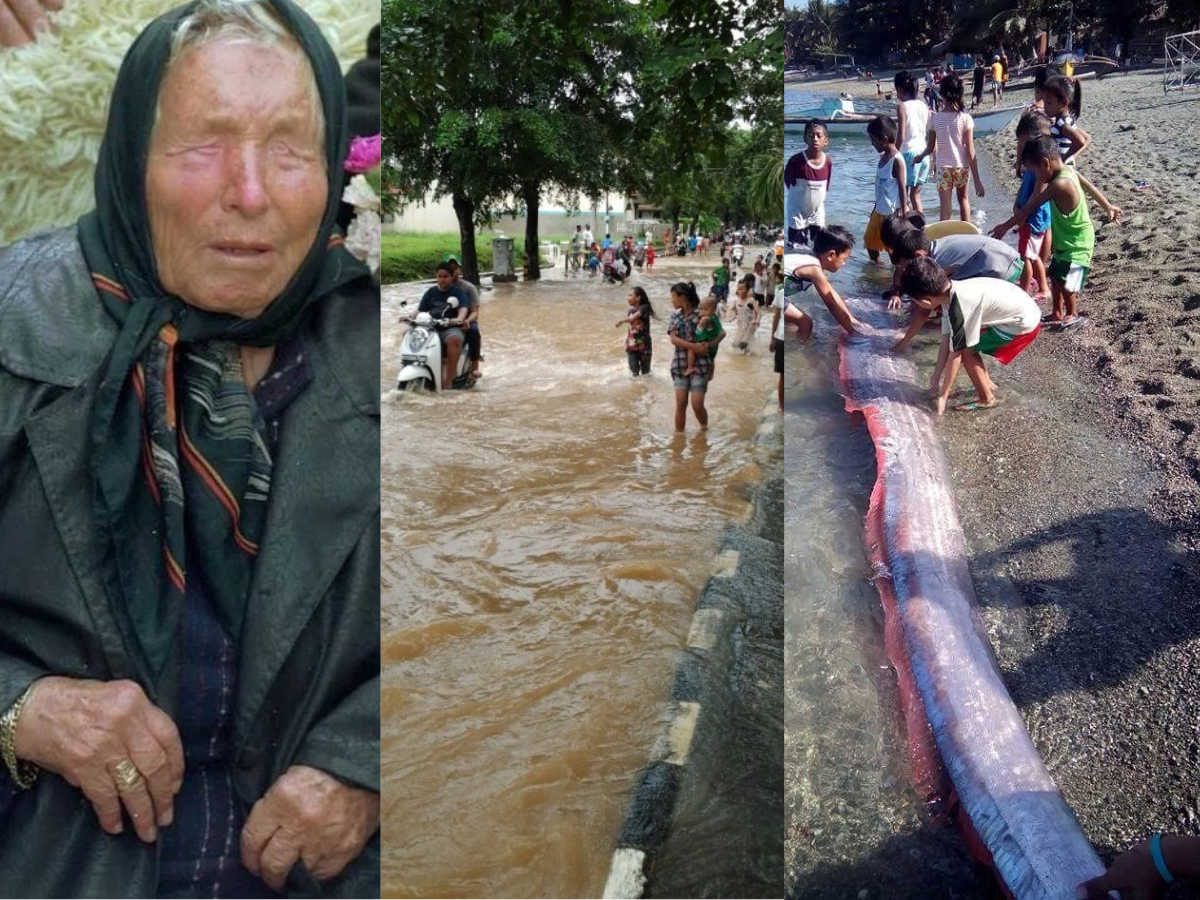
The first was the long-standing folklore surrounding late Bulgarian clairvoyant Baba Vanga. Social media feeds revived allegations that she had predicted apocalyptic disruptions in 2025, mixing genuine disasters with sweeping, often inaccurately assigned prophecies. Fact-checkers note that viral posts consistently exaggerate or misrepresent her history; still, the stories spread quickly in times of crisis.
The second was the legend of the “doomsday fish”—the oarfish.
When a gleaming oarfish washed up on Mexico’s Baja California Sur in February, it renewed the belief (common in some areas of Japan and elsewhere) that strange oarfish appearances forecast great earthquakes or tsunamis. The science is much less sensational: oarfish live deep, surface from time to time through sickness or currents, and there is no strong evidence that sightings can be linked to forthcoming seismic events. Nevertheless, the symbolism is too enticing in a time of extremes. What binds these stories together is not truth but psychology. During times of cascading danger sirens, overflowing rivers, night skies illuminated by rescue helicopters individuals grasp for patterns that create order out of chaos.
Prophecies and omens are mental shortcuts; they translate randomness into narratives that seem understandable. But floods are not omens. They are physical phenomena determined by air pressure intensity, terrain, river control, land use, and the power of early warning. During July and early August, meteorological offices highlighted how warnings make a difference to people’s lives when they are credible, timely, and actually delivered to those at risk. The forecast-action gap is still a matter of assigning life-and-death priority. World Meteorological Organization Judged in that light, 2025’s floods are a diagnosis, not an enigma. Pakistan’s catastrophe this year didn’t have to wait for a prediction; it trailed weeks of intense monsoon rains and cross-border river floods that overflowed the Chenab, Ravi, and Sutlej. Bangladesh’s extended flooding follows familiar weaknesses in low-lying hoar areas and transboundary flows.
Also Read: Baba Vanga 2025 Predictions: Full List of Prophecies That Shook the World
Practical Action Over Prediction in the Age of Flood
China’s and Japan’s events show familiar flash-flood dynamics steep land, waterlogged soils, and short-fuse storms. And Delhi’s alerts map onto a well-documented chokepoint in the Yamuna floodplain where releases upstream can rapidly tip the balance. Each case rewards the unglamorous work of hydrology, drainage, governance, and preparedness more than it does superstition. None of this negates the cultural value of stories. Folklore can be a gateway to risk awareness; it gets people talking. If the cost of attention is a viral thread for some Balkan mystic or a fish-long ribbon, so be it as long as the talk ends up on practical action. That involves shoring up embankments where they are most vulnerable, shielding wetlands that absorb floods, fixing storm drains, and putting money into last-mile warning delivery so the warnings arrive at farmers, shopkeepers, and households before they must go.
Also Read: SCO Summit 2025: Modi-Xi Meeting Featured on China Daily’s Front Page as Partnership Highlighted