New Delhi:
The difference lies in engineering, not chance.
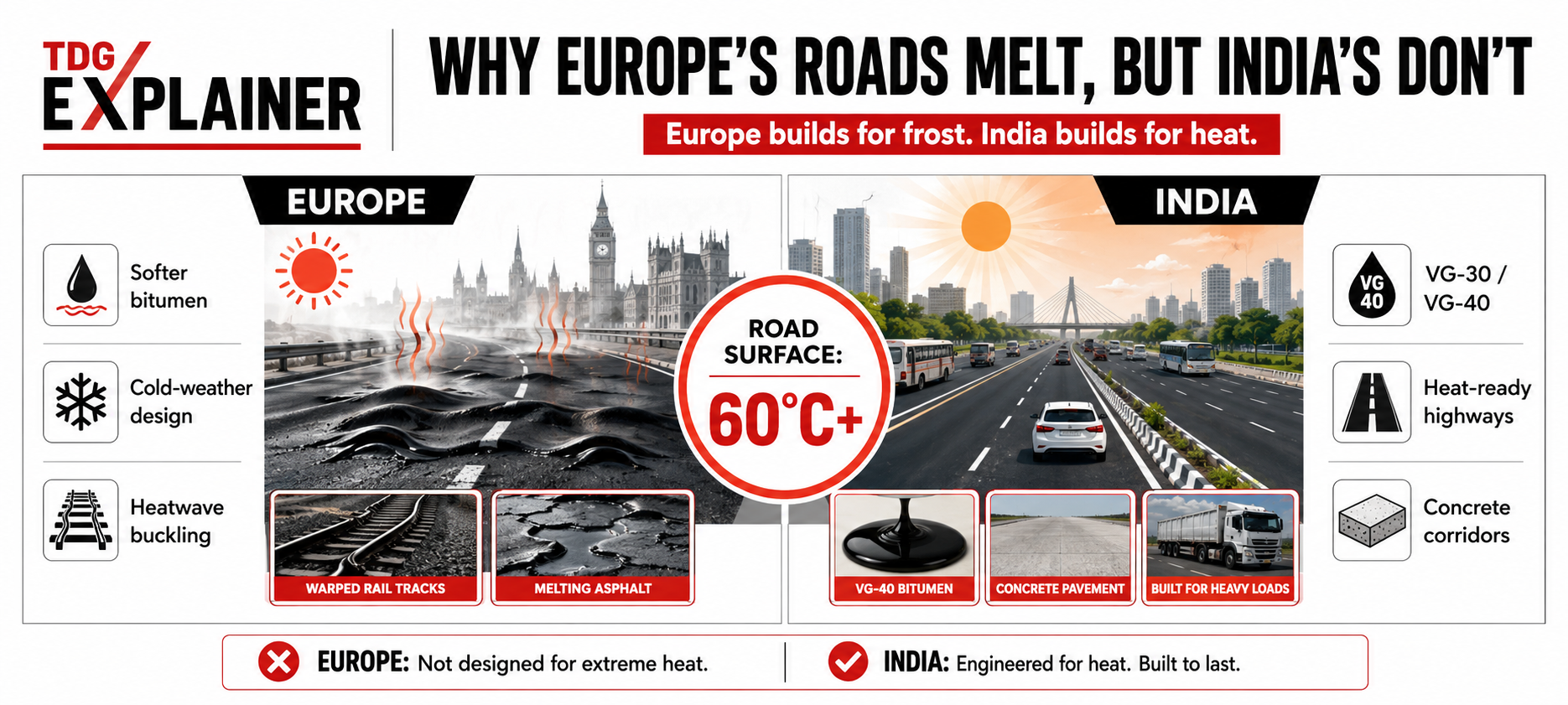
At the centre of the contrast is bitumen, the binder that holds asphalt together. Bitumen softens in heat and hardens in cold weather, so countries choose grades according to local climate. India’s highways are designed for prolonged extreme heat and heavy traffic. The National Highways Authority of India primarily uses Viscosity Grade bitumen, including VG-30 and VG-40, which remains stable even when pavement temperatures exceed 60°C, according to the Ministry of Road Transport and Highways’ 2024 Bitumen Circular.
For premium expressways, the guidelines also recommend Polymer Modified Bitumen and Crumb Rubber Modified Bitumen, which offer greater resistance to heat-related deformation. Newer corridors, including sections of the Delhi-Mumbai Expressway and the Mumbai-Nagpur Samruddhi Expressway, also use rigid concrete pavements, which are less vulnerable to melting and rutting.
Europe’s roads, by contrast, have traditionally used softer penetration-grade bitumen designed to remain flexible during freezing winters and prevent frost-related cracking. During prolonged heatwaves, however, these softer binders can deform, bleed bitumen and reduce tyre grip.
The impact is already visible. Denmark recorded its hottest day since records began in 1874, with temperatures touching 37°C in Ødum. Switzerland reached 38.8°C in Basel, the Czech Republic recorded 40.8°C in Doksany, and the UK saw its hottest June day on record at 37.3°C.
In Germany, tram services in Leipzig and Nuremberg were suspended after bituminous sealant around tracks softened, flowed into rails and switches, and later hardened, making sections unsafe. In France, roads and pavements have also softened as surface temperatures climbed above 60°C, causing rutting, rippling and bleeding under heavy traffic.
The heatwave is also straining Europe’s healthcare systems. France and the UK have reported rising heat-related illnesses and excess deaths, with older adults and people with underlying health conditions among the worst affected. Hospitals are dealing with more cases of heatstroke, dehydration and worsening cardiovascular and respiratory conditions, while some facilities are struggling with overheated wards and heat-sensitive medical equipment.
As extreme heat becomes more frequent, Europe’s challenge is clear: infrastructure built for the climate of the past must now be redesigned for the climate of the future.