Washington/Tehran:
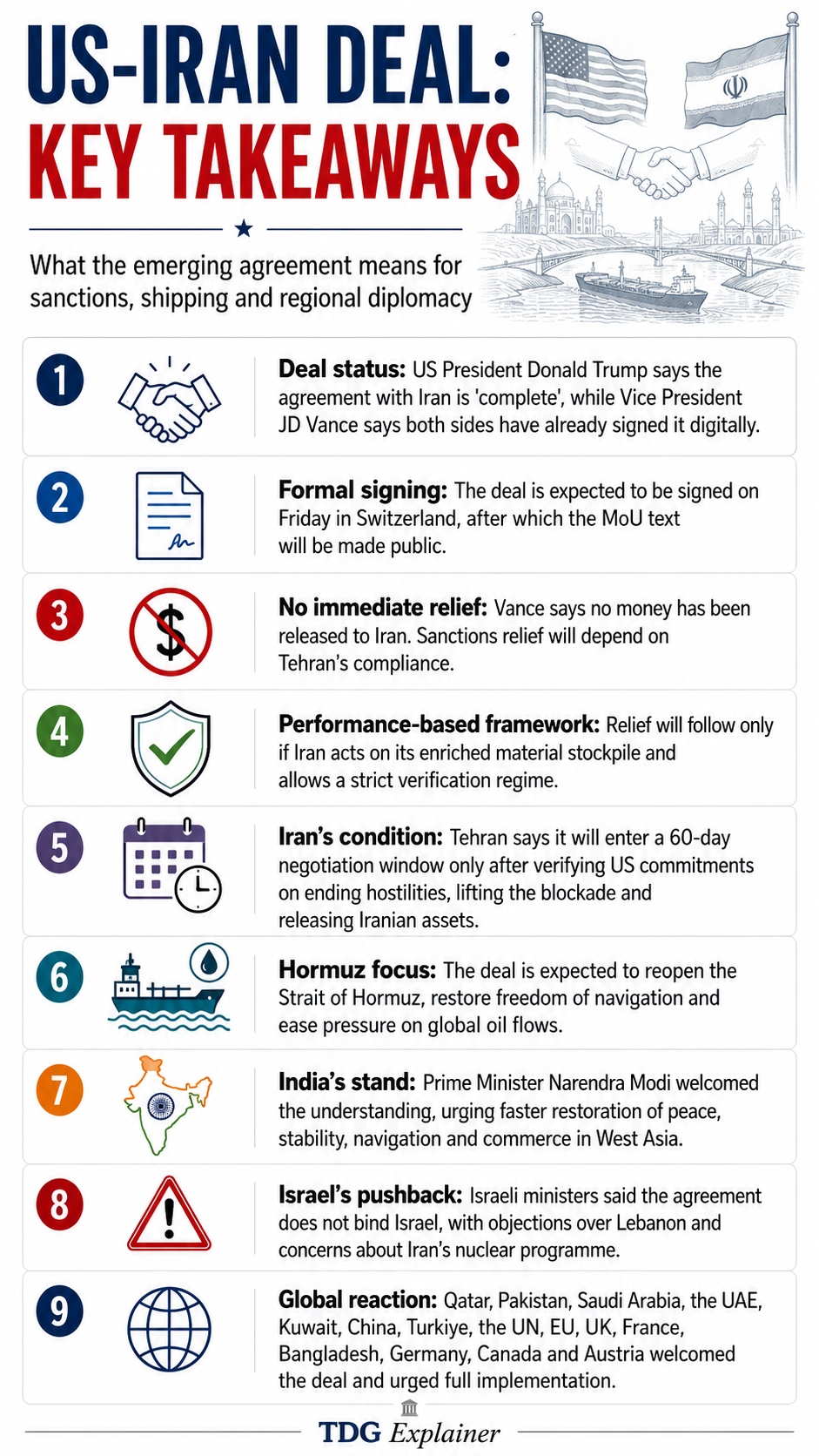
Speaking to ABC’s Good Morning America, Vance said no financial concessions had been made to Iran and stressed that any sanctions relief would depend entirely on Tehran meeting its commitments under the agreement.
“We already signed the deal digitally yesterday, and there’s been no money released, and that won’t change,” Vance said, responding to a question on whether Iran would receive access to frozen assets or sanctions relief after the signing.
Vance described the agreement as “performance-based”, saying sanctions relief would follow only after Iran takes verifiable steps, including action on its stockpile of enriched material and allowing a verification regime to ensure it does not build a nuclear weapon.
“This is really about walking down a pathway here where the Iranians will be welcomed into the world economy if they do the right thing,” he said.
The remarks came after Trump said on Truth Social that the “Great Deal” would bring “Peace and Security” to the region and allow the Strait of Hormuz to reopen after the signing on Friday, paving the way for oil flows to resume fully.
Iran’s Deputy Foreign Minister for Legal and International Affairs, Kazem Gharibabadi, confirmed that the official signing ceremony would take place on Friday in Switzerland, after which the text of the Memorandum of Understanding would be made public. He said Iran would enter a proposed 60-day negotiation period for a final agreement only after verifying that the US had fulfilled commitments related to ending hostilities, lifting the blockade and releasing Iranian assets.
Prime Minister Narendra Modi welcomed the understanding between the US and Iran, saying the conflict had caused serious economic disruption globally and led to loss of life in many countries. He expressed hope that the implementation of the understanding would help restore peace and stability in West Asia and ensure freedom of navigation and commerce.
“India hopes that the implementation of this understanding will help restore peace and stability in the region and ensure the freedom of navigation and commerce. We look forward to deliberations on the remaining issues reaching a sustainable final agreement,” Modi said in a post on X.
However, Israel signalled reservations over the deal. National Security Minister Itamar Ben-Gvir said Israel was not bound by the agreement, stressing that the country remained an independent and sovereign nation. Defence Minister Israel Katz also said Israel would not withdraw from land it occupies in Lebanon, while Finance Minister Bezalel Smotrich called the agreement “bad for Israel and for the entire free world”.
Asked whether Israel’s position could complicate implementation, Vance acknowledged the difficulty of securing lasting peace in the region but said the agreement could still benefit Israel, Gulf countries, the US and Iran.
World leaders largely welcomed the breakthrough, calling it a rare diplomatic opening to end hostilities, restore freedom of navigation through the Strait of Hormuz and ease pressure on global energy markets.
Qatar praised both Washington and Tehran for their commitment to resolving differences through negotiations, while Pakistan Prime Minister Shehbaz Sharif congratulated the two sides and thanked Qatar, Saudi Arabia and Turkiye for their role in securing the agreement.
Saudi Arabia welcomed the move to end military operations and begin detailed talks over a 60-day period, while the UAE called for full compliance with the agreement and an immediate halt to hostile actions. Kuwait, China and Bangladesh also welcomed the development.
UN Secretary-General Antonio Guterres described the deal as a critical step towards a peaceful settlement. European Commission President Ursula von der Leyen called for swift and full implementation, saying freedom of navigation was essential for regional stability and the global economy.
UK Prime Minister Keir Starmer called the agreement a “hugely important” step and said commitments related to Iran’s nuclear programme must be robust, verifiable and fully implemented. French President Emmanuel Macron called for the urgent and unconditional reopening of the Strait of Hormuz, while Germany, Canada and Austria also urged full implementation of the memorandum.
The agreement is being seen as a major diplomatic breakthrough after months of conflict in West Asia, with attention now turning to Friday’s signing in Switzerland and the proposed 60-day negotiation window for a final settlement.