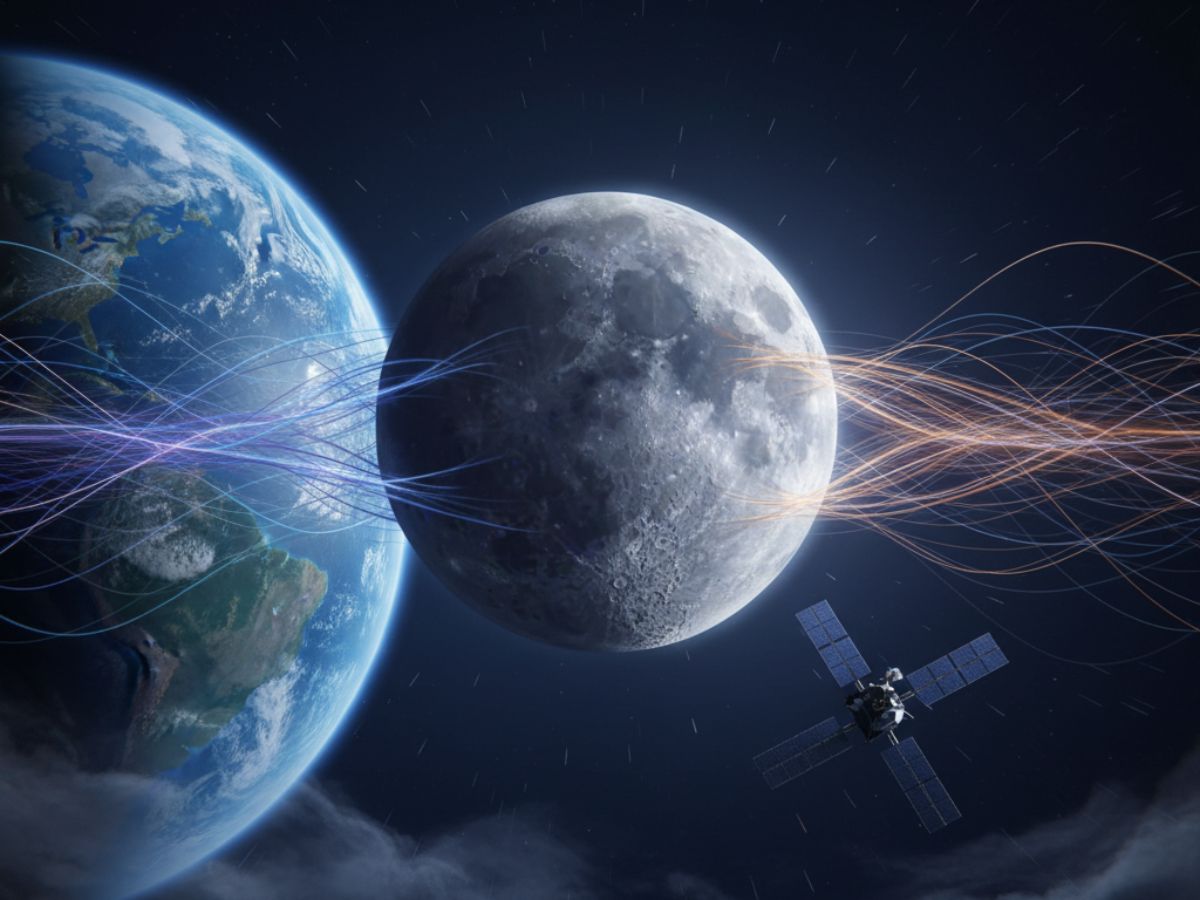
In a slow-motion cosmic dance, our planet is losing its closest companion. Scientists have confirmed that the Moon is steadily moving away from Earth, increasing its distance by about 1.5 inches (3.8 centimetres) every single year. Earth’s connection with its only natural satellite is changing fundamentally and continuously, as evidenced by this amazing measurement made by bouncing laser rays off mirrors astronauts left on the lunar surface.
How Do We Know the Moon is Moving Away?
A remarkable feat of engineering and accuracy provides the proof. Special mirrors were positioned on the Moon by astronauts during the Apollo missions. Today, researchers on Earth shoot laser beams at these mirrors and measure the time it takes for the light to bounce back. The accuracy of this technique, known as Lunar Laser Ranging, allows it to measure the changing distance to within a millimeter. They have verified that the Moon’s orbit is continuously expanding by monitoring this over
It’s important to know that the Moon’s distance also changes slightly each month. Its orbit isn’t a perfect circle, which is why we sometimes see a “supermoon” that looks bigger and brighter. But the 1.5-inch drift is a separate, steady trend that happens year after year.
What is Causing the Moon to Drift Away?
Our own oceans contain the unexpected force responsible for the Moon’s retreat. It all boils down to tides and gravity.
The Moon’s gravity pulls on the Earth, but it doesn’t pull equally. The side of Earth facing the Moon feels a stronger tug than the side facing away. Two water bulges are formed by this difference in gravity, one on the side nearest to the Moon and one on the far side, stretching the Earth and, most obviously, its seas. These bulges feel like high tides to us.
However, Earth rotates on its axis much faster than the Moon orbits us. Earth’s fast rotation causes it to rotate through these tidal bulges, pulling them marginally ahead of the Moon.
How Do Ocean Bulges Push the Moon?
This is where the magic happens. Dragged ahead of the Moon, the tidal bulge does more than simply sit there. It pulls the Moon back with its own gravitational force.
Imagine this: The Moon receives a little gravitational “kick” forward in its orbit due to the closer, forward-shifted bulge of water. This additional energy makes the Moon slightly faster.
According to orbital mechanics, an object is forced into a larger, higher orbit as it accelerates. The Moon is gradually but steadily moving in a broader orbit around our planet due to the steady, mild “kicking” action of Earth’s tidal bulges.
Is This Something We Should Worry About?
Although the idea of the Moon vanishing seems frightening, it happens very slowly. It will take millions of years for the change to become noticeable to humans at a rate of 1.5 inches annually. On whatever period we encounter in our daily lives, the impact is minimal.
A natural component of the Earth-Moon system is this gravitational interaction. The Earth’s rotation is actually slowing down very gradually as the Moon draws away, lengthening our days by roughly one second every 50,000 years. This cosmic trade-off has been going on for billions of years and will go on for a very long time.