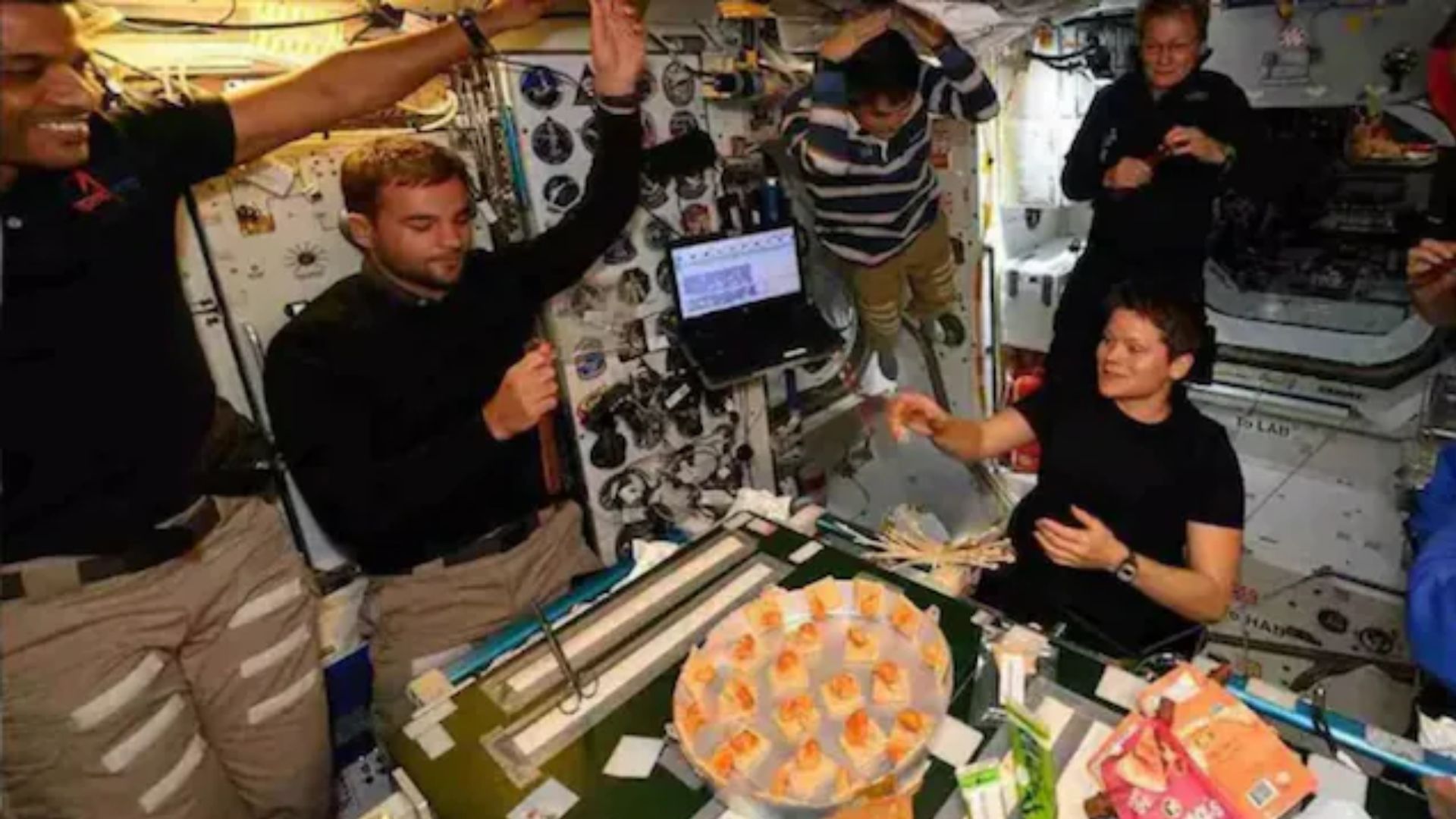
When you hear the word ‘farewell’, visions of music, great food, maybe a toast or two, and affectionate goodbyes probably spring up. But it is a very different scene when the farewell is 400 kilometers high on Earth such as the recent farewell ceremony organized on board the International Space Station (ISS) to bid adieu to Indian astronaut Shubhanshu Shukla. There are no champagne glasses, buffet tables, or even vegetarian goodies.
Shukla and a few of his fellow astronauts were treated to a small, highly organized farewell on the ISS, broadcast live back to Earth. The ceremony quickly piqued people’s interest online, with the questions: What in the world does a space farewell look like? Do astronauts have cake? Can they listen to music or talk to their families?
Here’s a glimpse at how it really works.
Tight Protocols Govern Every ISS Gathering
In spite of pictures demonstrating astronauts gliding around in T-shirts, smiling in microgravity, life on the ISS is regulated by strict rules. These were made by NASA and other space agencies under the 1998 Intergovernmental Agreement and the Crew Code of Conduct (CCOC), treaties signed by agencies such as NASA, Roscosmos, ESA, JAXA, and CSA.
All onboard parties, even departures, are scripted with mission control units in Houston and Moscow. They’re not parties. Rather, they are short, highly formalized affairs in which departing astronauts thank colleagues, reminisce about the mission, and officially transfer duties to the arriving crew.
So What’s Really On The ‘Menu’?
Forget wine glasses and sizzling steaks. On the ISS, NASA has strict prohibitions against alcohol, non-vegetarian food, and any sort of intoxicant. Meals are only made up of pre-approved dehydrated or thermostabilized foodstuffs, sealed well in advance to accommodate zero-gravity conditions. If astronauts do celebrate, it’s with something like rehydrated mac and cheese or a small chocolate bar.
Nothing, no utensils may be brought out unless it has been pre-cleared. With air on the station recycled continually, even pungent-smelling food is forbidden, in order to keep from disturbing the communal atmosphere.
What About Music?
Music is permitted but only with strict limits: it may not interrupt important communications or disrupt experiments in progress. That is, no surprise karaoke, sing-alongs at top volume. All sound and movement aboard the ISS is tracked and recorded by mission control on the ground.
Family Goodbyes On-Screen
Arguably the most poignant moment in any ISS farewell is the video conference with family and friends. Accompanied by mission control, astronauts float in space, waving and saying their goodbyes before leaving. These are often very moving moments, illustrating the camaraderie and vast risks involved in space exploration.
For Shubhanshu Shukla, this farewell was more than just personal—it stood as a proud milestone for India’s growing role in space, showing an Indian astronaut taking part in these traditions at humanity’s orbiting laboratory.