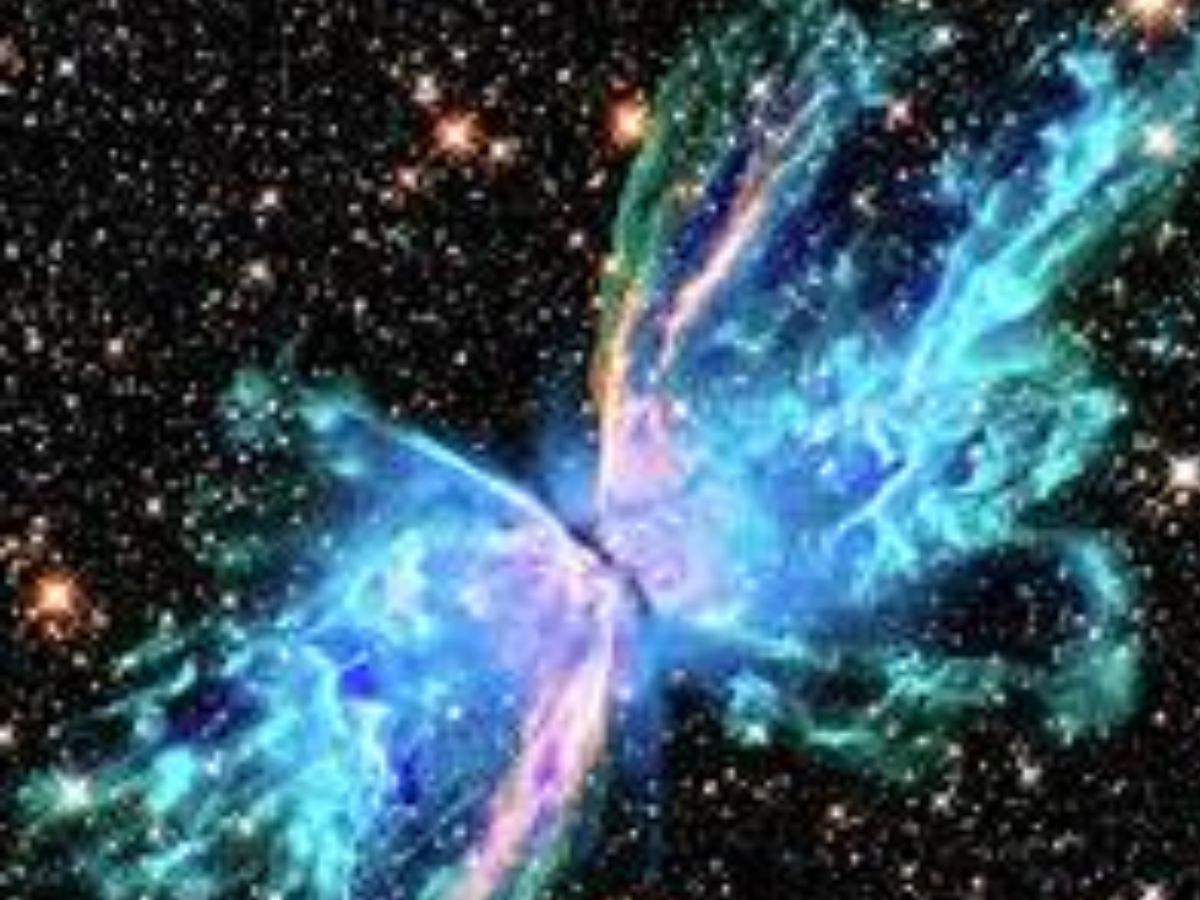
NASA has unveiled astonishing facts regarding NGC 6302, a giant planetary nebula that has a wing-like formation extending over three light-years. Its center is a dying star with a record surface temperature of almost 250,000°C, which is one of the hottest stellar remains. Even though this central star is emitting intense ultraviolet radiation, it is invisible to us because it is hidden by a dense ring of dust around it. In 2009, NASA’s Hubble Space Telescope, employing the Wide Field Camera 3, took a sharply clear and colorful close-up photo of NGC 6302. The image reveals:
- A cavity of ionized gas glowing
- A dense torus of dust (ring) cutting through the nebula
- The ring lying nearly edge-on from Earth’s perspective
Scientists have also found molecular hydrogen in this dusty shroud, implying complex chemistry still occurring around the aging star.
Located in the Constellation Scorpius
NGC 6302 lies approximately 4,000 light-years from us in the constellation Scorpius (The Scorpion). With its bright colors, spectacular shape, and far-reaching temperatures, it is one of the most intriguing and visually striking planetary nebulae ever seen a spectacular look at the end of a star’s life.
Also Read: AI data centre boom spurs robot maker ABB’s US sales