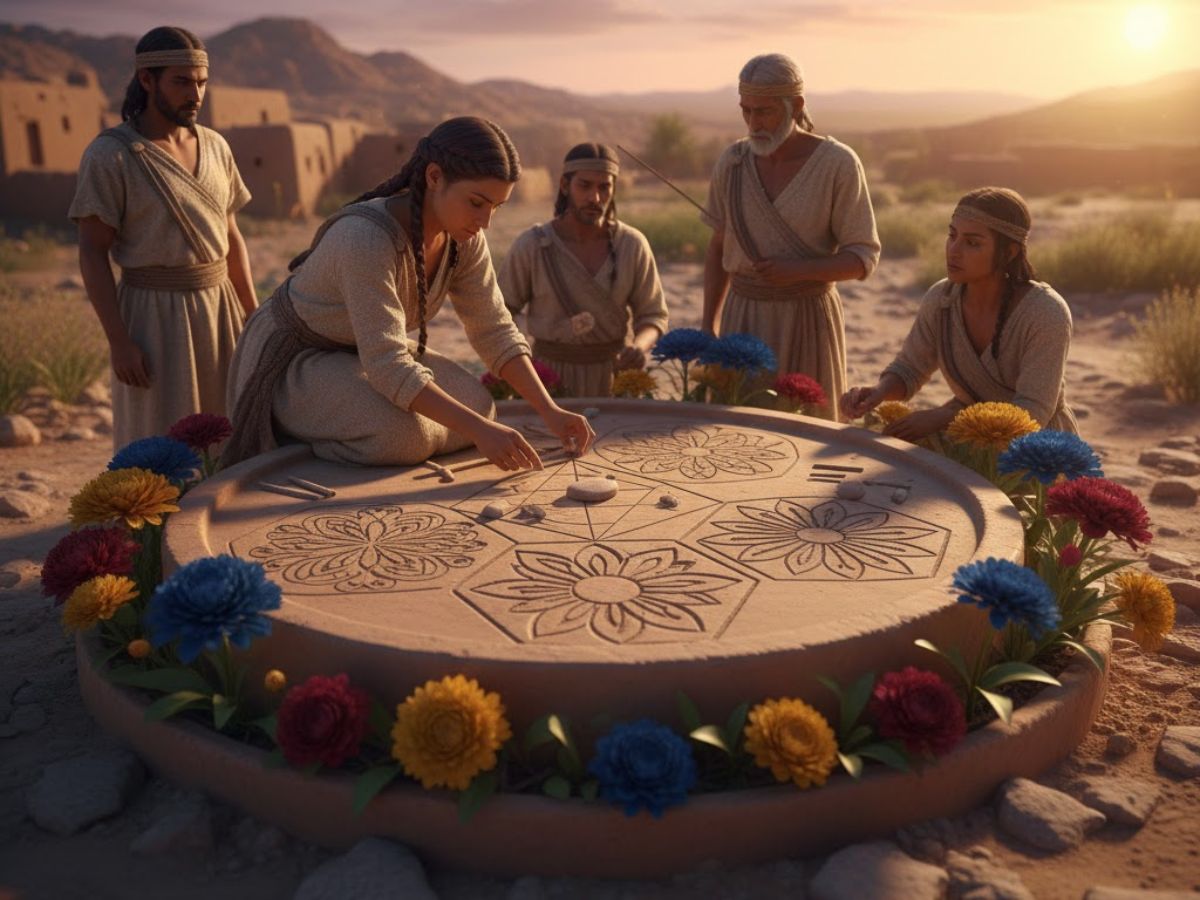
Scientists have discovered that a prehistoric society possessed a sophisticated understanding of mathematics at least 3,000 years before the invention of formal numbers. Evidence comes from floral patterns on ancient pottery that deliberately use geometry, symmetry, and a concept akin to long division.
Who Were the Halafian People?
The discovery centers on the Halafian culture, which thrived in northern Mesopotamia from approximately 6200 to 5500 BCE. Archaeologists from the Hebrew University of Jerusalem analyzed around 700 pottery fragments from this era. While art from this period typically featured animals and humans, these fragments stood out for their intricate vegetal and floral designs.
What Did the Patterns Prove?
A careful scan of the pottery revealed the patterns were not random. Researchers Yosef Garfinkel and Sarah Krulwich found the petals were placed in a precise geometric sequence: 4, 8, 16, 32, and 64. This shows how the potters organised space methodically, doubling the number of sections in each layer. They carried out “spatial long division” without the use of written number system.
Also Read: Vance Defends H-1B Visa Crackdown as ‘True Christian Politics’ Putting Americans First
Why Is This Discovery So Significant?
This finding radically alters the accepted timeline of mathematical history. The Halafian pottery, nearly 8,200 years old, predates the earliest known written mathematical texts of the Sumerian civilisation by millennia. It proves that complex mathematical ideas existed well before formal records. Mathematical relationships were embedded within the art itself clearly shown.
How Did They Use Math Without Numbers?
The study authors explain that without written records, it’s hard to gauge the full extent of prehistoric math. However, these patterns are clear evidence of abstract mathematical thinking. “People visualised divisions, sequences, and balance through their art,” said Krulwich.
Garfinkel suggests these concepts were likely applied in daily life, perhaps for practical tasks like fair division of harvests or land.
What Does This Say About Human Art and Thought?
Beyond mathematics, the pottery signals a broader cultural shift. The steady use of flowers shows one of the earliest known examples of plant life appearing in human artistic expression. This suggests a culture that was highly aware of and connected to its natural surroundings, in addition to mathematical thinking.
Immediate FAQs
Q: How old is this pottery?
A: The Halafian pottery fragments are between 8,200 and 7,500 years old (6200-5500 BCE).
Q: What mathematical concepts did they use?
A: The patterns—such as doubling sequences of 4, 8, 16, etc.—show a mastery of geometry, symmetry, and spatial division.
Q: Didn’t math start with the Sumerians?
A: Written math did. This discovery shows the concepts of advanced math were understood and applied visually millennia earlier.
Q: What does “spatial long division” mean?
A: It underlines the capacity to consistently and uniformly split a physical area (such as a pot’s surface) into symmetrical sections without the need for mathematical computation.
Also Read: Bangladesh Will Hold Polls on Time Despite Unrest, Says Chief Adviser Yunus