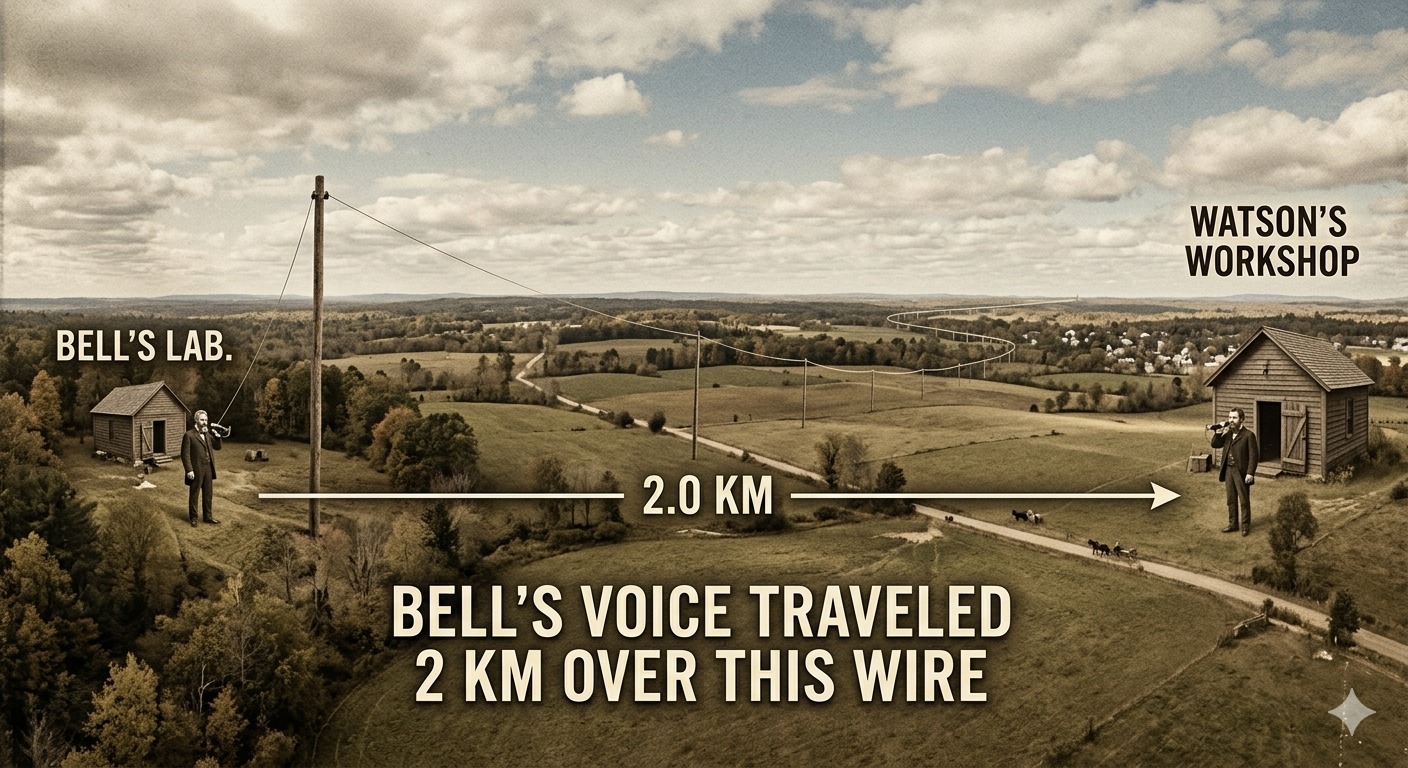
On October 9, 1876, Alexander Graham Bell and Thomas Watson conducted a two-way telephone conversation between Boston and Cambridge port, demonstrating that speech could travel over a real outdoor telegraph line
In October 1876, the telephone was still an experimental invention whose practical possibilities were far from certain. Alexander Graham Bell had received his US patent for the device only seven months earlier, and his experiments with Thomas A. Watson had already demonstrated that human speech could be transmitted electrically over short distances. The next challenge was to establish whether the new invention could work beyond the controlled environment of a laboratory and carry an intelligible conversation between people separated by a substantial stretch of wire.
On October 9, Bell and Watson attempted precisely that. Bell remained in Boston while Watson went to Cambridge port, Massachusetts, where the two men connected their telephone instruments to an outdoor telegraph line belonging to the Walworth Manufacturing Company. The line stretched for roughly two miles between the two locations, although Bell later recalled the distance as approximately two and a half miles. After encountering problems and making adjustments to the equipment, the two men succeeded in speaking with each other through the telephone. The Smithsonian Institution identifies the experiment as the first two-way telephone conversation between Bell and Watson.
The importance of the experiment lay not simply in the distance covered but in what it demonstrated about the future of communication. Bell and Watson had already shown that speech could be transmitted electrically in a laboratory, but the October test established that the telephone could operate over an actual outdoor communications line. Their success suggested that existing telegraph infrastructure could potentially be used for a new form of communication in which people could hear one another’s voices rather than exchange coded electrical messages.
From telegraphy to the human voice
The telephone emerged during a period when electrical communication was already changing the relationship between distance and information. The telegraph had made it possible to transmit messages rapidly between distant locations, but the system required messages to be converted into electrical codes and interpreted by trained operators. Communication could be much faster than sending a letter by road, railway or ship, but the people communicating were still separated by the machinery and procedures of the telegraph system.
Bell was interested in going beyond that limitation. His background had given him a particular interest in speech, sound and the mechanics of human communication. His father, Alexander Melville Bell, had developed Visible Speech, a system designed to represent the sounds of spoken language, while Bell himself worked as a teacher of speech and became increasingly interested in the possibility of transmitting sound electrically.
Bell’s work formed part of a much wider effort by nineteenth-century inventors to improve electrical communication. Several researchers were investigating ways to transmit multiple telegraph messages over a single wire, and others had experimented with devices intended to reproduce or transmit sound. The Library of Congress notes that the history of the telephone involved several inventors and competing claims, although Bell’s work produced the patented system that successfully transmitted vocal sounds and developed into a practical telephone technology.
Bell became particularly interested in the idea of a “harmonic telegraph”, which attempted to use different electrical frequencies to send multiple messages over one wire. His experiments gradually led him toward a more ambitious possibility. If electrical variations could be made to correspond closely enough to the vibrations produced by the human voice, it might be possible to transmit speech through a wire and reproduce it as sound at the other end.
The technical problem was considerable because human speech is continuously changing. A telephone could not simply switch an electrical current on and off in the manner of a simple telegraph signal. It needed to respond to the complicated vibrations of the speaker’s voice and reproduce those variations accurately enough for another person to recognise words and sentences.
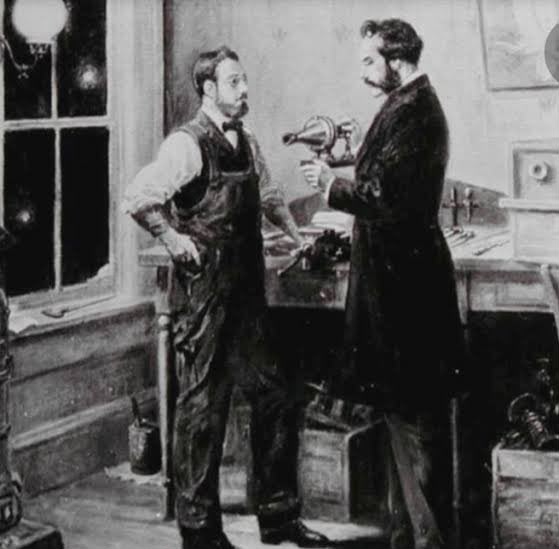
Thomas Watson became an important part of this effort. A skilled mechanic and electrical worker, Watson helped Bell construct and modify the experimental apparatus needed to test his ideas. Their collaboration involved repeated experiments, failures and adjustments as they tried to turn the theoretical possibility of electrical speech transmission into a working machine.
The breakthrough in March
Bell’s telephone patent was granted on March 7, 1876. Three days later, Bell and Watson conducted the experiment that would become one of the most famous episodes in the history of the invention.
Bell was working in one part of his Boston laboratory while Watson was in another. Bell spoke into his transmitting apparatus, and Watson heard the sound through the receiving instrument. Bell’s laboratory notebook recorded the words traditionally associated with the experiment: “Mr. Watson, come here, I want to see you.” The Library of Congress preserves the notebook in the Alexander Graham Bell Family Papers, while also noting that historians have examined the precise circumstances and wording of the famous exchange.
The March experiment demonstrated that intelligible speech could be transmitted electrically, but it did not establish that the telephone was ready for long-distance communication. The two men were still operating within their laboratory, and the distance separating the transmitter and receiver was relatively short.
For Bell and Watson, the next question was therefore whether the telephone could function over a genuine outdoor communications line. The answer would determine whether their invention could become more than an experimental device.
The October 9 test was designed to provide that answer.
Taking the telephone outdoors
Watson later described the October experiment as the first time the “baby” telephone was taken outdoors. He travelled to Cambridge port with one of the telephone instruments while Bell remained in Boston. The two locations were connected by a telegraph line operated by the Walworth Manufacturing Company.
The line provided an unusually useful testing ground because it had already been constructed for electrical communication. Bell and Watson did not have to build a completely new circuit to test their invention. Instead, they could determine whether their telephone could use an existing telegraph wire to carry the human voice.
The experiment initially encountered difficulties. Watson later recalled that he could not hear Bell when the first attempt was made. The problem required the equipment to be examined and adjusted before the experiment could proceed successfully.
After the adjustment, the situation changed. Watson recalled that Bell’s voice became louder and clearer through the telephone, allowing the two men to communicate. His later account is preserved in the Library of Congress among the papers of Bell and provides an important first-hand recollection of the experiment.
The crucial difference from some of the earlier demonstrations was that Bell and Watson could communicate in both directions. Each man could speak and hear the other, making it a genuine conversation rather than simply a demonstration in which one person transmitted speech to a listener.
The Smithsonian Institution records October 9, 1876, as a milestone in the history of the telephone and identifies the Boston-Cambridge port experiment as the first two-way telephone conversation between Bell and Watson.
A conversation across two miles
The distance involved in the October experiment was modest by modern standards, but it represented an important technical challenge in 1876. Bell and Watson were no longer relying on the short connection between two rooms in a laboratory. Their voices had to travel along an outdoor telegraph line and remain intelligible at the receiving end.
The exact distance has been described differently in historical accounts. Contemporary descriptions placed the line at about two miles, while Bell later recalled it as approximately two and a half miles. The difference reflects the measurements used in different accounts rather than a disagreement about the basic nature of the event. In either case, the experiment clearly involved a genuine outdoor line extending for several miles.
Bell and Watson also attempted to document what they heard at the two ends of the connection. Their records provided a means of comparing what one man said with what the other man understood. The contemporary account of the experiment, later reproduced in historical material about Watson and Bell, included records from both ends of the line and demonstrated that intelligible conversation had taken place.
The sound quality was obviously far removed from that of a modern telephone. The early instrument produced relatively weak and imperfect sound, and the success of the experiment depended on careful adjustment of the equipment. Nevertheless, the essential requirement had been met because the two men could understand one another sufficiently to converse.
The experiment therefore answered one of the most important questions facing Bell and Watson. The human voice could travel through an outdoor electrical line for miles and remain recognisable at the other end.
Why the achievement mattered
The significance of the October experiment becomes clearer when the telephone is compared with the telegraph. The telegraph had already demonstrated that electrical signals could travel over great distances, but it transmitted information through a coded system. A sender had to convert words into electrical signals, and a receiving operator had to interpret those signals and reconstruct the message.
The telephone offered a fundamentally different experience. Instead of converting speech into a separate code, it attempted to reproduce the sound of the speaker’s voice itself. A person could therefore communicate through the system without knowing Morse code or depending on a telegraph operator to translate the message.
The October experiment showed that this form of communication could work beyond the laboratory. If speech could travel over an outdoor telegraph line for several miles, then existing electrical infrastructure could potentially be adapted or expanded to create telephone networks.
That possibility was particularly important because building entirely new infrastructure would have been expensive and difficult. The telegraph had already created a network of wires connecting towns, businesses and institutions. Bell’s experiments suggested that some of those lines could become part of a new communications system based on voice.
The implications extended beyond engineering. A telephone network could change the way businesses operated, allow institutions to communicate more quickly and eventually give private individuals a way to speak directly with people living or working at a distance.
The technology would take years to mature, but the October experiment provided evidence that such a future was technically possible.
Watson’s contribution to the breakthrough
The history of the telephone is frequently told as the story of Bell’s invention, but Watson’s contribution to the experimental process was substantial. He was responsible for much of the practical mechanical work required to construct and modify Bell’s devices, and he participated in the repeated testing that eventually produced a functioning telephone.
Watson’s role was particularly important because Bell’s ideas required physical experimentation before their practicality could be established. Components had to be constructed, electrical connections had to be tested and instruments had to be adjusted when they failed to produce satisfactory results.
The October 9 experiment illustrates this collaborative process clearly. Watson was the person who travelled to Cambridge port with the instrument, while Bell remained at the other end of the line. When the initial attempt did not work properly, Watson participated in the adjustments that eventually allowed the voice signal to be heard.
His later recollections also became an important historical source. Because Watson was directly involved in the experiments, his accounts provide details about the practical difficulties that Bell’s laboratory notebooks and later historical summaries do not always capture.
The development of the telephone was therefore not simply the result of a single inventor working alone. It involved sustained collaboration between Bell, Watson and a wider community of scientists, mechanics, engineers and entrepreneurs who would later contribute to the development of telephone technology.
From two miles to longer distances
The October experiment did not end Bell and Watson’s attempts to increase the range of the telephone. Instead, it encouraged further testing.
On November 26, 1876, Bell conducted another important long-distance experiment between Boston and Salem, Massachusetts. The demonstration covered a considerably greater distance than the October test and provided additional evidence that speech could be transmitted through electrical lines over increasingly large distances.
The sequence of experiments is important because it shows how the telephone developed through incremental advances. Bell and Watson first had to establish that speech could be transmitted at all. They then had to demonstrate that two people could communicate in both directions. After that, they could begin testing how far the system could carry a conversation.
The National Museum of American History preserves an early Bell telephone associated with these experiments and documents the rapid development of the technology during the late nineteenth century. The museum’s collections show how the simple instruments used during the experimental period eventually gave way to increasingly sophisticated telephone equipment.
The progression also demonstrated the difference between inventing a device and developing a technology. Bell had created a working telephone, but turning it into a reliable system required improvements in transmission, sound quality, network construction and switching.
The telephone becomes a network
A telephone connecting two locations has obvious value, but the technology became far more significant when large numbers of people could be connected to one another.
That development began soon after Bell’s early demonstrations. Telephone companies were established, exchanges were created and operators began connecting subscribers who did not have direct wires between them.
The emergence of exchanges transformed the telephone from a point-to-point experiment into a network technology. A subscriber no longer needed a dedicated line to every person they might want to contact. Instead, an exchange could connect different users as required.
The Smithsonian’s history of its own telephone system provides an early example of how quickly the technology entered institutional life. By 1878, the Smithsonian Institution had installed a system connecting different rooms and offices within the Smithsonian Castle, allowing staff members to communicate quickly without physically travelling between locations.
Such developments demonstrated how rapidly the telephone moved from experimental demonstrations into practical use. The same basic principle that Bell and Watson had tested between Boston and Cambridge port could now be incorporated into larger systems serving organisations and eventually entire communities.
The limitations of the first telephone
Despite the importance of the October experiment, the telephone of 1876 was a long way from the technology people would eventually take for granted. The sound was weak, the equipment was delicate and communication depended heavily on the quality of the electrical line and the condition of the instruments.
The experiment itself demonstrated these limitations because Watson initially could not hear Bell. The two men had to adjust the equipment before the conversation became successful.
This was typical of early electrical technology. The basic scientific principle could be demonstrated before engineers had developed the materials, components and infrastructure needed to make the technology reliable and affordable on a large scale.
Bell’s telephone therefore required years of further development. Improvements to transmitters and receivers made speech clearer, while advances in electrical engineering allowed signals to travel greater distances. Telephone exchanges and switching systems made large-scale networks possible.
The transformation was gradual, but the principle established by the early experiments remained at its centre. The voice had to be converted into an electrical signal, carried through a communications system and reproduced as sound for the listener.
Bell and Watson witness the transformation
The significance of the October experiment became even clearer to Bell and Watson as they watched telephone technology develop during their lifetimes.
In the decades after 1876, telephone networks expanded across American cities and eventually connected increasingly distant locations. Long-distance communication became more reliable, and engineers developed methods for transmitting voices over hundreds and then thousands of miles.
Bell and Watson later reflected on the extraordinary change that had taken place since their first experiments. In their later accounts, they compared the approximately two-mile Boston-Cambridge port conversation with the much longer telephone connections that had become possible by the early twentieth century.
The contrast was especially striking because both men had experienced the limitations of the earliest instruments themselves. Watson had struggled to hear Bell clearly across the two-mile line, yet several decades later telephone technology could carry their voices across the United States.
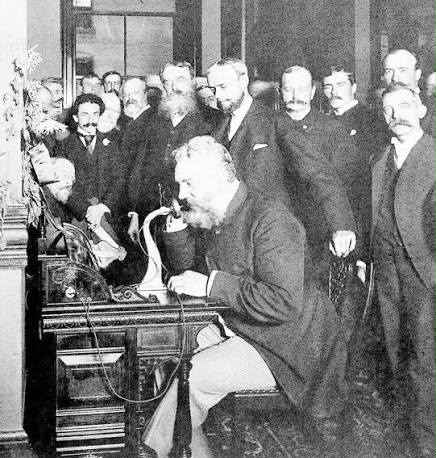
Bell participated in the ceremonial opening of the transcontinental telephone line in 1915, when he and Watson spoke to each other across a distance of roughly 3,400 miles. The Library of Congress preserves Watson’s recollections of that event and his comparison between the transcontinental call and the much shorter experiments of 1876.
The comparison demonstrated how quickly the technology had evolved. The first long-distance telephone conversation had covered only a few miles, while the later system could carry voices across an entire continent.
A new meaning of distance
The development of the telephone changed the meaning of physical distance in a way that the telegraph had begun but could not fully accomplish.
Letters had allowed people to communicate across great distances, but the physical message had to travel from sender to recipient. The telegraph dramatically reduced the time required for written communication, but the message still had to be converted into a coded electrical form.
The telephone allowed the human voice itself to travel through the electrical network. The speaker did not need to translate the message into code, and the listener did not need to reconstruct it from a series of symbols.
The October 9 experiment demonstrated this principle in a practical setting. Bell and Watson were separated by miles, yet they could communicate as participants in the same conversation.
The technology did not eliminate distance, but it reduced one of its most important consequences. Physical separation no longer necessarily prevented immediate spoken communication.
That change would eventually affect nearly every area of modern life. Businesses could coordinate activities across different locations, newspapers could gather information more quickly, government offices could communicate with distant officials, and families could remain in contact despite geographical separation.
The telephone would eventually become an ordinary household technology, but its origins lay in experiments that were anything but ordinary for their time.
Why October 9 remains significant
October 9, 1876, should not be described as the day the telephone was invented. Bell’s patent had already been granted, and the successful transmission of speech had already been demonstrated during the March experiment.
The date is significant for a more specific reason. It marks an early and important demonstration that Bell’s telephone could support a two-way conversation over a real outdoor communications line connecting locations several miles apart.
That distinction is important when reconstructing the history of the invention because the telephone did not emerge fully formed from one experiment. Its development involved a series of demonstrations, each addressing a different technical problem.
The March experiment established that intelligible speech could be transmitted.
The October experiment demonstrated that two-way communication could take place over an outdoor line several miles long.
The later experiments extended the distance further and helped establish the basis for commercial telephone networks.
Each stage contributed to the transformation of Bell’s experimental apparatus into a practical communications technology.
From a two-mile line to a connected world
The Boston-Cambridge port experiment may appear modest when viewed from the perspective of the modern communications world. A two-mile telephone call is now so ordinary that it requires no special technology or infrastructure visible to the person making the call. Modern mobile and internet communications can connect people separated by thousands of kilometres almost instantly.
Bell and Watson, however, were working at the beginning of that transformation. Their equipment was primitive compared with modern communications systems, and the successful conversation required careful experimentation and adjustment.
What they demonstrated was nevertheless fundamental. The human voice could be transformed into an electrical signal, transmitted through a wire over a significant distance and reproduced as intelligible speech at another location.
That achievement opened the way for a communications revolution that would continue for generations. Telephone exchanges expanded, long-distance lines multiplied, and increasingly sophisticated networks eventually connected cities, countries and continents.
The experiment also illustrated an important characteristic of technological progress. A major transformation does not always begin with a spectacular demonstration. Sometimes it begins when two people establish that something previously considered impractical can actually work.
On October 9, 1876, Bell and Watson established that they could speak to one another across miles of wire. Their conversation did not immediately create the global telephone system that would eventually emerge, but it provided an important demonstration that such a system could be built.
The distance between Boston and Cambridge port was small compared with the distances later conquered by telephone technology, but it represented a major step for an invention that was only months old. Bell and Watson had shown that the telephone could leave the laboratory, use an outdoor communications line and carry a conversation between two people who were physically separated.
The experiment therefore occupies an important place in the history of communication. It marked one of the early moments when the human voice successfully crossed a meaningful physical distance through an electrical network, helping to establish the principle that would eventually allow people around the world to speak across cities, countries and oceans.