The Quiet Redevelopment of Delhi
There is a particular sound that tells you a Delhi neighbourhood is being rebuilt: the drilling begins early in the morning. First, it is a modest renovation. A wall comes down. Tiles are replaced. A staircase is altered. Then, almost imperceptibly, the building begins to acquire a new life.
A family house becomes a PG. A balcony becomes a room. A terrace gets covered. The basement finds a new purpose. Another set of tenants arrives. In Delhi, buildings rarely announce that they have changed. They simply keep changing until the structure outside bears little resemblance to the building that exists on paper.
I have watched this happen across the city for years. In neighbourhood after neighbourhood, the most important redevelopment is not the one with a glossy hoarding announcing a new tower. It is the quiet, incremental redevelopment taking place behind ordinary gates and above ordinary shops.
The Question Satya Niketan Raises
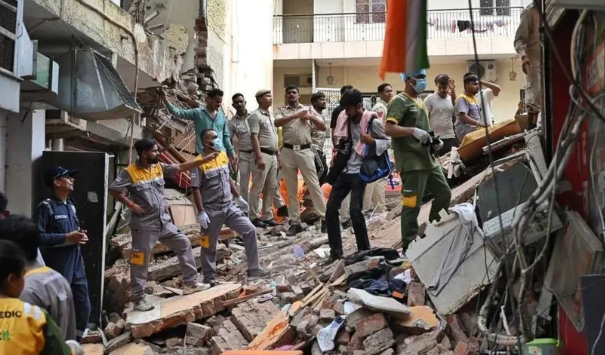
That is why the Satya Niketan collapse should worry Delhi far beyond the immediate tragedy. A five-storey building came down, killing seven people, including five Delhi University students. The immediate investigation will rightly examine the structural alterations, construction work and the responsibilities of those involved.
But there is a larger question that cannot be answered by arresting an owner or issuing a demolition notice:
How does Delhi safely rebuild buildings that have already been changing for years?
A Familiar Transformation
Satya Niketan is an uncomfortable place to ask that question because its transformation is familiar to anyone who has spent time around Delhi University’s South Campus.
A residential neighbourhood became a student neighbourhood. Houses became paying guest accommodations. Rents rose. Rooms multiplied. A property that once housed one family could suddenly be accommodating several dozen young people.
This did not happen through one dramatic act of redevelopment. It happened room by room. And that is precisely where Delhi’s planning system struggles.
The city’s laws are reasonably elaborate. The Unified Building Bye-Laws, 2016, prescribe requirements for construction, structural safety and professional responsibility. Architects, structural engineers and supervisors have defined roles. Municipal law gives authorities powers to deal with dangerous buildings and require them to be vacated where necessary.
The problem is not that Delhi has no rules. The problem is that Delhi’s buildings often change faster than its records do.
A building approved twenty years ago may today have another floor, a different occupancy pattern, a modified basement, altered internal walls and twice the number of residents.
Student Housing as a Case Study
Delhi University brings students from across the country. They need affordable rooms near their colleges. Formal student housing is limited. Private property owners respond to demand with remarkable speed.
The market does not wait for a Master Plan. It converts the spare room into a source of income.
The difficulty begins when a building designed for one pattern of occupation is asked to accommodate another without a corresponding assessment of its structural capacity, fire safety, exits, electrical load and infrastructure.
There is nothing inherently wrong with an old building acquiring a new use. Cities survive by adapting their buildings. The danger begins when adaptation takes place without accountability.
That is why Delhi needs to stop treating redevelopment as a choice between demolition and regularisation. Neither is enough.
Demolition without rehabilitation simply displaces the problem. Regularisation without structural correction can turn an unsafe building into a legally documented unsafe building.
What Delhi needs is a middle path: inspect, assess, retrofit where possible, reconstruct where necessary, and demolish where the structure genuinely cannot be made safe.
Buildings Must Remain Under Continuous Oversight
The law already contains much of the architecture required for such a system. What is missing is the habit of using it continuously.
A building should not receive a certificate once and then disappear from regulatory attention for decades. Concrete deteriorates. Plumbing fails. Wiring is overloaded. Foundations are affected by nearby excavation. Occupancy changes. Walls are removed. Floors are added.
A building is not a document. It is a living piece of infrastructure.
For high-occupancy buildings such as PGs and hostels, Delhi should therefore move towards periodic structural and safety certification. Major interventions additional floors, basement excavation, removal of structural elements or significant changes in useshould trigger fresh structural assessment.
And the responsibility should be traceable.
Who designed the work?
Who approved it?
Who certified the structure?
Who supervised the construction?
Who inspected it?
Who permitted people to occupy it?
The Problem of Institutional Responsibility
Delhi too often creates a strange institutional fog in which every agency has part of the responsibility but no one appears to have the whole picture.
The owner deals with the municipal authority. The municipal authority deals with the building plan. The fire department deals with fire safety. The planning authority deals with land use. The tenant deals with the landlord.
And the building sits in the middle, quietly carrying all of it.
Until it cannot.
What Inspections Reveal
The reported findings from inspections of PG buildings following the Satya Niketan tragedy make this problem difficult to dismiss as an isolated case.
Significant gaps were found in sanctioned plans, fire clearances and structural-stability certification.
The sensible response is not simply to produce a longer list of violators. It is to ask what the list is telling us.
It is telling us that Delhi has created a large housing economy that exists partly outside the formal planning system.
That does not absolve property owners of responsibility. But it does mean that enforcement alone will not solve the problem.
If hundreds of buildings are unsafe, the government needs a mechanism for bringing them into compliance. If some can be repaired, let them be repaired. If some need reconstruction, create a workable legal route. If some must be demolished, provide a transition for their occupants.
Planning the Neighbourhood, Not Just the Plot
If Satya Niketan is now a dense student-housing district, then the entire area has to be planned accordingly.
Can a fire tender enter the lane?
Can an ambulance reach a building?
Are there adequate evacuation routes?
Can the sewerage and electricity systems support the density?
Are there open spaces?
Are basements being used for purposes for which they were never designed?
These are not questions for the day after a disaster. They are questions for the day before construction begins.
That is why redevelopment should increasingly be neighbourhood-based rather than plot-based.
Delhi is going to become denser. There is no realistic way around that. Old buildings will be replaced. New floors will be added. Families will subdivide properties. Rental housing will expand.
The choice is not between redevelopment and no redevelopment. The choice is between planned redevelopment and accidental redevelopment.
The Reality of “Renovation”
We have had too much of the second.
Delhi’s official language often speaks of redevelopment as though it means replacing an old structure with a new one. But anyone who has lived in this city knows that redevelopment is much messier.
It is the builder’s truck blocking the lane at 7 a.m. It is the sudden appearance of another floor. It is the house next door becoming a PG. It is the staircase getting narrower because another room has been carved out.
It is the neighbour saying, almost casually, “Bas renovation hi toh hai.”
That phrase—bas renovation hi toh hai—may be one of the most dangerous sentences in Delhi’s urban vocabulary.
Because sometimes renovation is only renovation.
When Renovation Becomes Redevelopment
And sometimes renovation is redevelopment in everything but name.
The law must know the difference.
The Satya Niketan tragedy should therefore produce something more enduring than another inspection drive.
Delhi needs transparent building records, periodic structural audits for high-occupancy buildings, mandatory professional certification for major structural alterations, better coordination between agencies and clear legal pathways for safe reconstruction.
And where demolition is unavoidable, redevelopment must include the people who will be displaced by it.
The objective should not be to make Delhi look newer. It should be to make Delhi safer while allowing it to remain liveable and affordable.
The Successes We Do Not See
That distinction matters.
There will be no ribboncutting ceremony for the building that did not collapse because an engineer identified a problem two years earlier. No television channel will run a primetime debate about a structural audit that quietly prevented a tragedy.
But that is the measure of good regulation. Its greatest successes are invisible.
The building remains standing. The student goes back to her room after class. The family sleeps without thinking about the ceiling. The renovation finishes without weakening the structure.
And nobody makes the evening news.
The Real Reconstruction
The rubble at Satya Niketan will eventually disappear. The investigations will proceed. The courts will determine responsibility on the basis of evidence.
But Delhi should not wait for another collapse to discover that redevelopment is not merely about concrete. It is about memory, regulation and responsibility.
A city must remember what was approved. It must know what was changed. It must understand what exists today. And, most importantly, it must know whether that building can safely carry the people it now contains.
Delhi does not need to stop rebuilding. It needs to stop pretending that rebuilding begins only when the rubble arrives.
The real reconstruction must begin while the building is still standing.