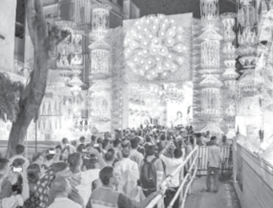
In earlier times, Garba used to be about people gathering in circles around a light source in a village courtyard. Being present was more important than paying for the ticket. The situation has definitely changed. Today, one can observe Garba almost exclusively in venues where tickets are sold and elaborate lighting, VIP boxes, and corporate banners abound. In the past few decades, festivals occurring in different locations in India, such as Navratri, Durga Puja, or Ganesh Utsav have become businesses. The transformation has made it easier for people to make a living and helped improve the infrastructure of the events. However, it also raises an important question: when cultural festivities become businesses, who has the right to participate, who gains, and who suffers losses? The economic benefits cannot be overlooked. Craftsmen, idol-makers, decorators, lighting specialists, musicians, caterers, costume merchants, and event planners rely on festival-related demand for their livelihoods.
Their activities commence several weeks or even months before the festival and ensure a supply chain that reaches far beyond the actual festival. Commercial demand can also support traditional crafts, as it allows for the transmission of crafts such vate areas, the festival will become less open to the people who are supposed to add value to it. as clay craft and idol-making, embroidery, and mirror works. Those who visit will also derive some gain out of the organization used for the event since the facility will avail the opportunity to enjoy superior lighting, clean drinking water and better sanitation and health facilities. With an ample amount of sponsorship and ticket revenues received from the festival tourism, the venues will also generate some business for the hotels, restaurants and retail business operators. Hence, commercialism does not necessarily seem to contradict cultural preservation. The question is whether the benefits are more than the human costs and if these communities benefit from such commercialism.
Durga Puja is a clear example of how immense an economic opportunity can be. One study commissioned by the British Council in 2019 calculated the value of creative industries related to Durga Puja at ₹32,377 crore, or about 2.58 percent of the GDP of West Bengal. It should be noted that this is a historical estimate covering creative activity exclusively linked to the festival and not increased tax revenues or economic growth brought about by it. But it still tangentially shows how large the potential economic ecosystem might be around the festival.
Governments also find this transformation valuable for them. Festivals are potential tourist attractions that make possibilities for employment and taxable economic activity. As a result, international acknowledgment could serve the purpose of improving cultural diplomacy and tourism of India. In 2021, the UN’s cultural wing, UNESCO, included Kolkata’s Durga Puja into the list of Intangible Cultural Heritage. In 2023 the Garba of Gujarat joined this list too. The difference is significant since it is precisely the factor that gives these events social value that would be compromised through their commercialisation. As explained by UNESCO in its definition of Garba, it is participation and community life which takes place among homes, temples, on streets and in public spaces. In situations when the access to the event becomes dependent upon expensive tickets, VIP zones and priTicketed events are not automatically exclusionary.
Organisers assume real costs for putting on their event. Charging for admission can often help recover those costs. The problem is that when commercialised spaces for the event take over and the less well-off end up with fewer options of participation. VIP areas are not helping equity either, while the focus on spectacle, sponsorship and celebrity often turns participants into mere observers. Costs are incurred by the community which are not necessarily reflected in ticket sales. Big festivals bring about power, crowd control, public safety measures, health regulations, incineration, medical and other clearance procedures. When profit goes to the private sector while cities deal with the infrastructure establishment and garbage collection, expenses may be distributed unevenly. It is important for the community to monitor development of culture activities with regard to responsibilities, regulations and community benefits.
There is a growing concern over safety. Events can turn into disasters due to overcrowding, blocked exits, ineffective emergency preparedness, and temporally built structures. Different research done on stampedes in India from 1954 to 2012 shows that 79% of studied cases were due to religious events. This research shows how much danger is associated with mass gatherings. The National Disaster Management Authority released its guidelines on crowd-management in 2014. The scope of these guidelines is to be used for effective planning, management of crowds and execution of emergency response. The only issue left behind is the implementation of the guidelines. Paperwork can’t stop a disaster if the capacity is not checked, emergency exits are impaired, and employees endorse actions without validating.
Four specific changes can help to overcome the problem of implementation. The first one is to make sure that the permits for big events depend on verification of compliance with fire-proof structural safety and electrical safety requirements. The temporary structures must undergo the necessary inspections, with independent safety audits conducted for threatened venues. The second reform was about the responsibility of organisers to limit the number of participants at the events within the venue, with the help of trained marshals, clear signs, and the provision of medical assistance in case of emergencies. The third point is that local authorities should allow opportunities for free local community participation.
They may decide to introduce some free-of-charge time slots, help local neighbourhood events with grants, and take measures to avoid overcrowding of public spaces with commercial events. Fourthly, protecting employees must be a fundamental component of responsible festival management. Workers, such as scaffolders, electricians, decorators, sanitation workers, etc. often have to work against time limits and in hazardous working conditions. Organizers of the festival should keep the work environment safe, pay their employees in time, and provide them with accident insurance and social security. Licensing and contracts can provide a legal basis for these obligations. This implies that none of these issues require the festival to cease functioning. On the contrary, forecasting the safety requirements and mode of functioning makes it possible to confirm the credibility of the festival in the public eye, ensuring the safety of the workers at the same time.
The authorities are already on the stage, having influence over the situation through their approvals, distribution of public grounds, and following safety regulations. India cannot be expected to be faced with a choice between its development and preservation of its cultural heritage. There should not be allowed one to negate the other. Local festivals are able to attract visitors and create jobs while being local in nature. The crucial point is not how profitable the festival is but whether it is secure and accessible. Culture can bring benefits, however, the money measure of culture is not the essential aspect of culture which is worth taking into consideration.
*Saurabh Pandey is a Young Professional at the Ministry of Cooperation, Government of India. He holds postgraduate degrees in Public Administration and Political Science and has qualified the UGC-NET examination. Janvi Singhi is a Research Fellow at India Forth and Research Associate at Asia-Pacific Bureau of Organization for Threat Assessment and Peacebuilding (OTAP). She holds a Master’s degree in Political Science and is a Gold Medalist in International Relations.