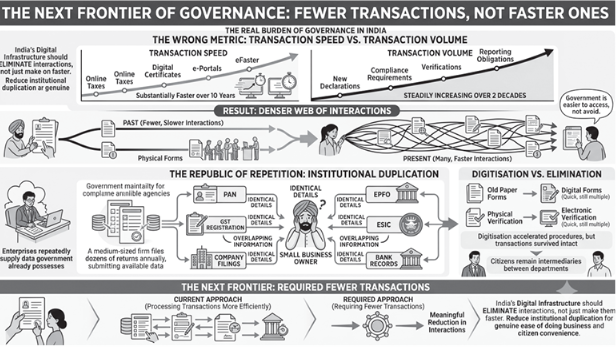
India has made government transactions faster, cheaper and more accessible. Yet the real burden on citizens lies not in the time each interaction takes, but in the growing number of interactions the state demands. The next frontier of governance is not processing transactions more efficiently. It is requiring fewer of them.
The Wrong Metric
Taxes can be paid online, certificates downloaded electronically and applications processed through digital portals. Measured by transaction speed, the Indian state is substantially more efficient than it was a decade ago. Yet transaction speed is only one measure of administrative performance. Equally important is transaction volume: the number of times citizens must interact with the state in the first place. On that measure, the trend has moved in the opposite direction. Over the past two decades, governments have become more efficient at processing transactions while steadily increasing the number of transactions citizens are required to undertake. New declarations, certifications, verifications, reporting obligations and compliance requirements have accumulated far more rapidly than older ones have disappeared. The result is that citizens now navigate a denser web of interactions with the state. Individual transactions may take less time than they once did, but there are often more of them. Government has become easier to access. It has not become easier to avoid.
The republic of repetition
Modern states require information, records and safeguards against fraud. The problem arises when citizens repeatedly supply information government already possesses because institutions struggle to share, trust or use it effectively. Consider a small manufacturing business. Its PAN, GST registration, EPFO registration, ESIC registration, company filings and bank records contain overlapping information. Yet the same enterprise continues to provide identical details across multiple agencies and compliance systems. A medium-sized firm may file dozens of GST, tax and labour compliance returns each year, often submitting information already available elsewhere within government. The problem is no longer information scarcity. It is institutional duplication. Businesses spend less time standing in queues and more time navigating an expanding calendar of filings, declarations and verifications. India’s digital public infrastructure was expected to address this challenge. Aadhaar, DigiLocker and other digital platforms have transformed service delivery. Yet digitisation has often accelerated existing procedures rather than eliminating them. Paper forms became digital forms. Physical verification became electronic verification. Transactions became quicker, but the transactions themselves survived intact. Citizens therefore remain intermediaries between departments with sophisticated databases but limited coordination. Information already available within government continues to be collected, verified and transmitted through the individual. The success of digital governance has been measured largely by the speed of interactions rather than any meaningful reduction in their number.
The hidden cost of frequency
Governments measure collections, disbursements and service delivery. Citizens measure government differently. They experience it through the frequency with which it enters their lives. Every renewal, declaration, filing and verification is not merely a transaction. It is an interruption. As the number of required transactions rises, so does the probability of missing one. A forgotten renewal can generate penalties. A missed filing can trigger notices. A delayed response can produce additional rounds of documentation and verification. Administrative obligations rarely arrive alone; they often generate chains of subsequent obligations, each requiring further attention and increasing the likelihood of additional mistakes. The burden extends beyond money. Citizens pay in time, attention and mental bandwidth. Government increasingly competes for a finite resource: the ability of individuals to track, remember and respond to an expanding list of obligations. Governments carefully measure transaction speed but rarely question whether those transactions are necessary. A citizen required to complete ten forms efficiently may appear successful in official statistics. A citizen required to complete only one form has experienced better governance. The first outcome improves administrative efficiency. The second improves quality of life.
When distrust becomes design
The growth in transactions is not accidental. It reflects the incentives under which bureaucracies operate. When a new risk emerges, institutions frequently respond by creating an additional declaration, certification, reporting obligation or verification requirement. Individually reasonable, they collectively create an expanding web of interactions. Institutional distrust reinforces the trend. Agencies often seek their own proofs because they do not fully trust information collected elsewhere. New requirements are added more easily than old requirements are removed. Over time, this creates a system in which transaction volume rises almost by default. Every new safeguard produces another interaction, another deadline and another opportunity for oversight, while the benefits of removing obsolete requirements are rarely visible to any individual department.
Digitisation can unintentionally accelerate the process. When transactions become cheaper to administer, governments become more willing to create additional reporting requirements. Technology lowers the cost of collection without necessarily reducing the demand for collection. The result is a state that becomes progressively more efficient at generating interactions without becoming more selective about which interactions are genuinely necessary.
The state against itself
Citizens are not the only ones paying the price. Every duplicate form processed, every repetitive verification conducted and every unnecessary renewal reviewed consumes administrative capacity. Governments that repeatedly collect information must also repeatedly process it. Resources devoted to administering transactions cannot simultaneously be devoted to improving outcomes. This creates a tension rarely acknowledged in discussions of governance. Administrative capacity is finite. Time spent verifying information that already exists elsewhere is time unavailable for improving schools, monitoring infrastructure, strengthening public health systems or resolving citizen grievances. A state that asks too many questions eventually burdens itself as much as it burdens citizens. Citizens spend time complying. Officials spend time processing compliance. Neither side becomes proportionately more productive because the underlying volume of transactions remains largely unchanged.
Counting What Matters. The next reform is not to make compliance faster. It is to make it rarer. India does not lack the technological foundations for a more coordinated state. The larger challenge is institutional. Several countries focus on reducing the number of transactions citizens must undertake. Estonia’s Once-Only Principle prohibits public agencies from requesting information that another agency already holds. Singapore increasingly relies on pre-filled data, automatic verification, and proactive service delivery to minimise citizen interaction with the state. The United Kingdom’s “Tell Us Once” programme follows the same logic. The burden of coordination falls on the state rather than on the citizen. India’s digital reforms have dramatically reduced the time taken for many transactions. The next frontier is reducing the number of transactions themselves.
That principle suggests a different way of evaluating governance. Governments measure tax collections, welfare transfers and service delivery. They should also measure something simpler: the cumulative number of interactions they require citizens to undertake each year merely to remain compliant. That figure may reveal more about state capability than any processing-time dashboard. A rising transaction count often signals duplication across departments, weak data sharing and a tendency to add new requirements without removing old ones. Reducing transaction volume, rather than merely accelerating transaction speed, should become an explicit objective of administrative reform. Most importantly, this shifts attention from the speed of transactions to their necessity. India’s digital reforms have made interactions with government faster and cheaper. The next stage of reform should be judged by a different standard: whether those interactions become less frequent. India’s next governance challenge is not digitisation. It is restraint. The most citizen-friendly government is not the one that responds fastest. It is the one that asks least. A capable state is not one that processes the most transactions. It is one that requires the fewest.
Prof. Vikas Singh is an economist covering India’s political economy, growth, finance and public policy.