
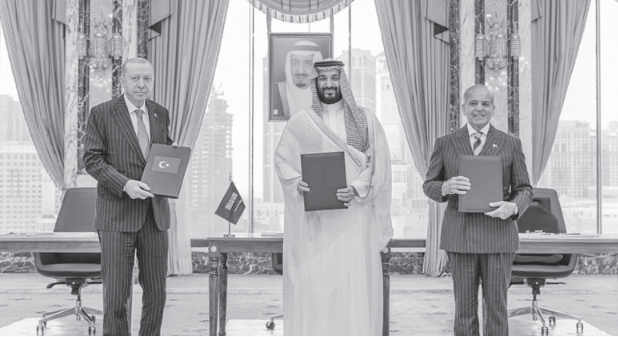
The security framework of West Asia is evolving amidst rising tensions involving the United States and Iran. Nations in the region are beginning to assert more control over their security arrangements. The Mecca Joint Defence Agreement was signed by Saudi Arabia, Türkiye and Pakistan on August 7, 2026, stating that if one member gets attacked, it will be considered an attack on all three members. By August 31 of the same year, the three nations had resolved to set up a secretariat in Saudi Arabia in order to formalize the agreement. For India, the key question is not only whether Pakistan is getting broader strategic room, but whether West Asia is developing a new model of delivering security and its own place in that model. Pakistan’s deepening ties with Türkiye in defence matters and the new role assumed in the Saudi security architecture are noteworthy from India’s vantage point. However, interpreting the Mecca Pact as merely “anti Indian” is missing a larger change.
India’s ties with the US, Iran, Israel and the Gulf countries bring both advantages in terms of strategy and limitations. The vulnerabilities around the Strait of Hormuz, limitations affecting use of Chahbahar and India’s neutral position during the US-Israel-Iran standoff show that there are limitations in an approach based on building relationships. The lesson is not to choose sides, but to preserve enough capabilities and partnerships to retain strategic choice. First of all, India has to transit from being mainly a buyer and seller of defence systems to being a long term partner in the area of security. Various platforms like the Indian Ocean Naval Symposium and Indian Ocean Rim Association can help achieve this by using maritime-domain awareness, information sharing, naval exercises and training. India’s geographical position in the Indian Ocean provides it with comparative advantage, and access to ports like Duqm can enhance the maritime functionality of India in the Arabian Sea.
Secondly, India needs to view connectivity as an instrument of statecraft, rather than as simply trade. Various initiatives like India-Middle East-Europe Economic Corridor and International North-South Transport Corridor can promote regional connectivity. Hence, New Delhi should identify commercially viable projects that could be quickly implemented and have stabilised the economy even in the context of changes in the political situation. Thirdly, India must connect atmanirbhar Bharat with the needs of the security interests of West Asia. Although defence exports like the Brah Mos system provide chances, merely relying on weapons exports does not generate any strategic influence. Thus, New Delhi should work to increase training, logistics, maintenance, technology collaboration and partnerships in industries related to defence. The space and navigation capabilities that the country possesses can further serve as an opening for collaboration with the UAE and regional states. Fourthly, focus should be on increasing the crisis management potential of New Delhi.
The experience making an overt counterbloc. It should benefit from its ability to have relations with various opposing geopolitical groups. For example, the partnership with Saudi Arabia, the UAE, Israel, and Greece can coexist with relations with Iran as well. Forcing countries in the Gulf to make a binary choice only deprives India of the strategic flexibility that it possesses. This also gives better insight into the “Islamic NATO” debate. However, this term should be used The most important factor is the fact that the pact has started facing its first operational trial. The Houthi acts against Saudi Arabia have raised the question of what collective defence means in a practical sense. Pakistan’s defence minister pointed out that if the attacks are aggressive towards Saudi Arabia, the pact may be put in operation. While Türkiye has already indicated its willingness to support Saudi Arabia, particularly in the realm of technical needs. This shows that there ment. New Delhi requires its own West Asia security cooperation framework encompassing maritime security, defence technology, connectivity, crisis management and strategic communication.
This will necessitate greater coordination amongst the Ministry of External Affairs, Ministry of defence, armed forces and economic organisations, making sure that diplomacy, trade and security bolster each other. The Mecca Pact is an essential event in the strate with caution. Aside from the fact that the bloc does not include important regional players such as Egypt, the UAE, and Oman, the bloc’s members have incompatible strategic interests, while the command and military structure of the bloc is not as developed as NATO’s. the country has in engaging competitive powers provides it with an opportunity to realise the process of evacuation, humanitarian assistance, maritime coordination and diplomacy in case of any disruption of trading, energy and other processes due to a crisis. For instance, Operation Dost, which provided search-andrescue, medical and humanitarian assistance to Türkiye after the 2023 earthquakes, created strategic goodwill beyond conventional diplomacy. India has to steer clear of Nevertheless, it will also not be right to dismiss this bloc altogether, as the three countries have already started institutionalizing their cooperation, and the agreement provides for broader cooperation in the sphere of defence. is a difference between political solidarity and military cooperation.
Consequently, the question is not whether there is an “Islamic NATO,” but whether the Mecca Pact will evolve into a framework for ensuring regional security. In case of any joint military drills, intelligence exchange, and defence technology cooperation, it may become significant for more states than just the three signatories. India must avoid being either dismissive or overreacting to this developgic agenda, but calling it an anti-Indian alliance is premature. Pakistan’s growing role in the region is a strategic threat, however India’s relations with the countries of the region, its diaspora, connectivity and growing military capabilities are the means for engaging with the region. Girish M is currently a Research Intern at Politics for Impact in Karnataka. Janvi Singhi is an Independent Researcher and Gold Medalist in International Relations based in Hyderabad.