

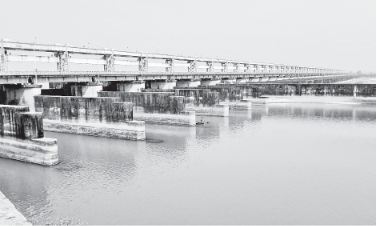
For three decades, the Ganga Water Sharing Treaty has provided an important framework for managing one of the most politically sensitive issues between India and Bangladesh. Signed in December 1996, the agreement brought a degree of predictability to the sharing of dry-season flows at Farakka barrage after decades of disagreement. Therefore, its expiry on December 12, 2026 is not simply another diplomatic deadline; it offers the two neighbours an opportunity to rethink how they manage a river system that is becoming increasingly difficult to govern through allocation formulas alone. Water will inevitably remain a sensitive issue in India–Bangladesh relations. Geography has created deep hydrological interdependence between the two countries, which share 54 transboundary rivers. At the same time, differences over water availability have long been shaped by competing developmental requirements, domestic needs and perceptions of equitable access. But the circumstances confronting the Ganga basin today are markedly different from those in which the 1996 treaty was negotiated. The existing agreement relies substantially on historical hydrological data from 1949 to 1988. Since then, climate change, population growth, urbanisation, agricultural expansion and industrial demand have altered both the availability and demand for freshwater. Rainfall patterns are becoming less predictable, dry spells can be prolonged, and extreme floods are increasingly difficult to manage using assumptions based primarily on past river behaviour. Hence, this changing hydrological reality should shape the next stage of negotiations.
Beyond the Arithmetic of Farakka
The central question should no longer be only how many cusecs of water India or Bangladesh receives during a particular period. Allocation will remain important, particularly during the dry season, but focusing exclusively on dividing available water risks overlooking the more fundamental problem: how to ensure that sufficient water remains available within a changing river system. The Ganga is not simply a volume of water to be divided at Farakka. Its health is connected to sediment flows, groundwater, agriculture, navigation, fisheries, wetlands and the ecological stability of the wider delta. Reduced freshwater flows can contribute to salinity intrusion and stress aquatic ecosystems, while insufficient dry-season water has consequences for agriculture, irrigation and livelihoods. The Sundarbans, shared by India and Bangladesh, makes the ecological interdependence particularly evident. Protecting the river must therefore become as important as dividing it. This is also why India’s own domestic concerns cannot be treated as secondary to the negotiations. Bihar and West Bengal have significant interests in the Ganga system. Questions relating to irrigation, drinking water, sedimentation, flooding and the operation of Farakka affect communities upstream as well as downstream. Any sustainable agreement with Bangladesh will ultimately require greater coordination between New Delhi and India’s eastern states. The challenge, therefore, is not to choose between India’s requirements and those of Bangladesh; it is to design an arrangement flexible enough to accommodate changing requirements on both sides.
Make the treaty Adaptive
One way forward would be to move away from the assumption that renewal must reproduce another rigid 30-year arrangement. A future agreement could incorporate scheduled reviews based on updated river-flow data, rainfall trends, climate projections, discussion over allocation. Water quality, for instance, offers an area where Indian and Bangladeshi interests substantially converge. Pollution, untreated sewage and industrial discharge affect both sides of the border. groundwater conditions, sedimentation, agricultural and industrial demand, and ecological requirements. Such an adaptive approach would allow the treaty to respond periodically to changes in the river rather than forcing changing hydrological realities into a formula negotiated decades earlier. This would not require India and Bangladesh to construct an entirely new institutional architecture. The Joint Rivers Commission and the mechanisms established under the existing treaty already provide a foundation for this. What is required is a stronger technical role for these institutions, supported by better data sharing, more regular interaction and specialised cooperation on sedimentation, ecology, pollution and flood management. Such mechanisms could also help insulate practical water cooperation from periodic changes in the broader political relationship.
Find cooperation where interests converge
Not every element of water diplomacy needs to begin with a politically difficult Bangladesh faces serious concerns over salinity intrusion, while sedimentation and water quality are also major issues for India. Joint water-quality monitoring stations, regular publication of shared data, common pollution-reduction targets and cooperation on sewage treatment infrastructure could therefore produce benefits that are both measurable and visible. Flood management presents another practical opportunity. Rivers do not recognise political boundaries, and neither do floods. Realtime hydrological information, advance notification of major water releases and closer operational coordination could improve preparedness in downstream areas. A mechanism providing advance warning — potentially up to 72 hours wherever technically feasible — could reduce uncertainty during extreme events. India and Bangladesh could also explore mechanisms to retain part of the enormous volume of water available during the monsoon for use during periods of dry-season scarcity. The region’s water debate is too often defined by simultaneous experiences of “too much water” during floods and “too little water” during the dry months. Better storage, recharge and conservation strategies could help narrow this contradiction.
Think Beyond one river
The Ganga negotiations should also become an entry point for a wider conversation about transboundary water governance. The political attention surrounding the Ganga and Teesta can sometimes obscure the fact that India and Bangladesh share dozens of other rivers. Smaller and medium transboundary rivers may provide opportunities for incremental agreements that are technically easier to negotiate and politically less contentious. Five- or ten-year, issuespecific arrangements could allow both sides to experiment with monitoring, irrigation, water quality and local-level cooperation. The tation. The answer is not to pretend that these sensitivities can disappear. It is to create enough institutional cooperation around them that disagreements become more manageable. The December deadline can therefore be viewed in two ways. It can become another difficult negotiation centred principally on how a limited volume of water should be divided at Farakka. Or it can become the starting point for a broader partnership dealing with the realities India and Bangladesh increasingly share: climate uncertainty, flooding, sedimentation, pollution, salinity, ecosystem degradation and rising demand. The second approach will undoubtedly be more ambitious. But it also reflects the reality of the river more accurately. What a renewed treaty can do is to provide a better framework for managing them. experience of the Kushiyara agreement also shows that concluding an agreement is only the beginning; implementation, monitoring and coordination among local institutions determine whether negotiated benefits actually reach communities. This lesson should be incorporated directly into any renewed Ganga treaty framework. Agreements need measurable timelines, clearer institutional responsibilities and regular assessments of implementation. There is an even broader opportunity. The Ganga is ultimately part of a river basin extending beyond India and Bangladesh. Over time, the two countries could encourage a more basinoriented approach incorporating upstream hydrology, sediment movement, climate adaptation and ecological sustainability. Such an approach need not replace bilateral arrangements. Instead, it could complement them by recognising that the long-term health of the river depends on processes that extend beyond a single border or barrage.
A chance to rebuild confidence
Water disputes are rarely only about water. They quickly acquire political meaning, particularly when they become associated with questions of sovereignty, fairness or asymmetry between neighbouring states. In parts of Bangladesh, perceptions surrounding India’s role in regional water management have consequently influenced both public opinion and political discourse. This makes technically workable compromises harder to sustain when they are not accompanied by transparency and visible implement Thirty years after the Ganga Water Sharing Treaty was signed, simply extending the logic of 1996 would represent a missed opportunity. A renewed agreement built around adaptability, ecological security, reliable data, implementation and climate resilience could mark a more consequential shift. For India and Bangladesh, geography ensures that the Ganga will always be a shared river. The real opportunity in 2026 is to ensure that it increasingly becomes a shared responsibility — and, eventually, a foundation for rebuilding trust rather than a recurring source of bilateral friction.
* Dr. Anchita Borthakur is a Senior Research Associate at Chintan Research Foundation (CRF)






