There’s a WhatsApp forward doing the rounds in my family group — an uncle discovered that ChatGPT could write his society’s AGM notice, and he now sends it questions the way people once sent queries to newspaper agony aunts. Should he refinance? Is turmeric actually good for knees? What did the Supreme Court say about that thing? I find this funnier than most people, because I’ve spent fifteen years in rooms where we paid enormous salaries to people for doing roughly what my uncle now gets free: producing confident answers. And that’s the shift nobody has quite priced in. Not that machines think — I’m agnostic on that, and it doesn’t matter. What matters is that the answer, as a product, has stopped being worth much. For my entire career the answer was the deliverable. The analyst’s model was the answer. The consultant’s deck was the answer. The junior doctor’s differential was the answer. We built salary bands, org charts, entire professions around the difficulty of producing it. That difficulty is gone. What’s left?
I run a hospital in Saharanpur, the one my family started before I was born, and I’ll tell you what’s left, because I watch it every day. Software can now read a scan impressively well. It cannot sign the report. Someone still has to put their name under the finding and own what happens next — the treatment that follows, the surgery that does or doesn’t happen, the family that asks are you sure? The signature was always the expensive part. We just didn’t notice, because it came bundled with the reading, and the reading took years to learn. The machine has unbundled them. The reading is now cheap. The signature has become the whole job.
The same unbundling is coming for every profession, and it explains something that puzzled me in my product management days. The best people I worked with were never the fastest at producing analysis. They were the ones who could look at a wall of dashboards and ask the one question the dashboards weren’t answering. I used to think of this as a personality quirk. I now think it’s the entire profession. When answers cost nothing, a question is the only input that matters — and a bad question fed to a brilliant machine returns something fluent, authoritative, and useless, which is more dangerous than no answer at all, because fluency is how we’ve always judged competence. That instinct is now a liability. We are all going to have to learn to distrust good prose. (You may reasonably ask whether that applies to this article. It should.)
Here’s where I part ways with the standard anxiety about AI and India. The displacement story assumes small-town India has armies of knowledge workers waiting to be replaced. Walk through Saharanpur and tell me where they are. What we actually have is a hundred-year shortage of expertise — the cardiologist who never moved here, the consultant the plywood exporter could never afford, the maths tutor who exists in Kota but not in the mohalla. For a district economy, the machine isn’t replacing anyone. It’s the first specialist who ever agreed to show up. The metros are having a displacement debate; the districts should be having an access debate. These are opposite problems and we keep discussing them in one breath.
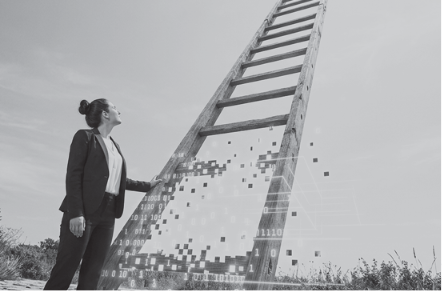
But there’s one worry I can’t reason my way out of, and it involves my own child. Every senior professional I admire got good the same way: years of doing the junior work — the drafting, the modelling, the first-pass diagnosis — badly, then less badly, under someone who corrected them. That junior work is precisely what the machine now does instantly. We’ve removed the bottom of the ladder and kept insisting people reach the top of it. Nobody — not the schools, not the coaching industry, not the companies — has an answer for how the next generation acquires judgment when the grunt work that used to teach it has been automated away. My daughter will grow up with an answer machine in her pocket. My job, as far as I can tell, is to make sure she never mistakes it for a judgment machine.
(The writer is an alumnus of IIT Delhi and ISB, has led product at consumer technology companies, and runs a multi-speciality hospital in Saharanpur. Views are personal.)