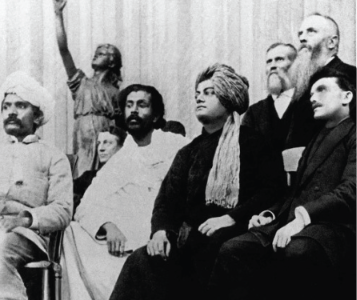
This is the month of September, which became even more significant in the year 1893. It was a turning point for Bharat itself, when a 30-year-old young man, later known as Swami Vivekananda, proclaimed the glory of Hindu Dharma and Bharatvarsha from the stage of the Parliament of the World’s Religions on 11 September 1893. Vivekananda’s journey to the West was not an ordinary one. Later, Rishi Aurobindo realised this fact and, in his article titled ‘The Awakening Soul of India’, published on 26 June 1909 in ‘Karmayogin’, wrote: “There were always indications, always great forerunners, but it was when the flower of the educated youth of Calcutta bowed down at the feet of an illiterate Hindu ascetic, a self-illuminated ecstatic and ‘mystic’ without a single trace or touch of the alien thought or education upon him that the battle was won.
The going forth of Vivekananda, marked out by the Master as the heroic soul destined to take the world between his two hands and change it, was the first visible sign to the world that India was awake not only to survive but to conquer.” Nowadays, this speech is also necessary for Bharat and for the world. Those who claim to fight for freedom and rights and call themselves Gen Z should learn what the character and ideals of Gen Z should be. I don’t think there is any other example of a man who conquered the world at just 30 years of age. What Swami Vivekananda actually conveyed in his first speech was nothing less than the essence of Bharat and its soul , Hindu Dharma. For a long period of subjugation, India had suffered neglect and humiliation on the world stage. But this was also the beginning of India’s resurgence.
Yet, Swamiji himself faced several obstacles on this journey. Upon reaching Chicago, Swamiji learned that he could not attend the convention without formal credentials. Since the cost of living in Chicago was very high, he moved to Boston. There, on August 25, he met Professor John Henry Wright of Harvard University. During their first conversation, Professor Wright was deeply impressed by Swamiji’s vast knowledge and intellectual brilliance. When Swamiji informed him that he did not possess the official credentials required to attend the conference, Professor Wright reportedly replied, “To ask you, Swami, for your credentials is like asking the sun about its right to shine.” Professor Wright then took it upon himself to provide the necessary credentials for Swamiji. In his recommendation, he wrote, “Here is a man who is more learned than all our learned professors put together.” In his response to the welcome address on 11 September, 1893 Swami Vivekananda said: “I am proud to belong to a religion which has taught the world both tolerance and universal acceptance.
We believe not only in universal toleration, but we accept all religions as true. I am proud to belong to a nation which has sheltered the persecuted and the refugees of all religions and all nations of the earth.” This is precisely why Hindu Dharma continues to live—not merely as a system of beliefs, but because of its inherent spirit of acceptance, coexistence, and respect for all paths. What Swami Vivekananda articulated in Chicago was not merely an ideal expressed in words; it was a principle that Hindu society has practised for centuries. A striking example can be seen in the tradition of Kumari Puja, in which young girls are worshipped as manifestations of the Divine Mother. The underlying principle is that divinity can be recognised in every human being, transcending social and religious distinctions. Such traditions reflect the of world politics, where all corners of the world are marked by conflict, his words should be followed in this context.
We basically focus only on Swami Vivekananda’s first speech at the Parliament of the World’s Religions in Chicago. But what he said in the concluding lines of his final speech was equally, if not more, crucial. He said: “In the face of this evidence, if anybody dreams of the exclusive survival of his own religion and the destruction of the others, I pity him from the bottom of my heart, and point out to him that upon the banner of every religion will soon be written, in spite of resistance: ‘Help and not Fight’, ‘Assimilation and not Destruction’, ‘Harmony and Peace and not Dissension’.” Today, we are witnessing broader civilisational ethos of Hindu Dharma, which does not merely preach acceptance but seeks to embody it in practice. Swami Vivekananda stood on foreign soil and spoke about a Dharma where God is not but common people. After listening to Swamiji’s speech, the renowned British writer Annie Besant described him in these striking words: “A striking figure, clad in yellow and orange, shining like the sun of India in the midst of the heavy atmosphere of Chicago, a lion head, piercing eyes, mobile lips, movements swift and abrupt….” The Nobel laureate and renowned French novelist Romain Rolland said that listening to Swami Vivekananda’s words, when one lies down, he sits up. If you sit, you will stand up, and if you stand, you will run.
According to a report published in Chicago’s Sunday Herald on September 15, following Swamiji’s speech, he emphasised that brotherhood among human beings should be regarded as one of the most desirable goals of humanity. Just as Swamiji’s message was crucial for understanding the originality of Bharat and Hindutva, his words also point towards a strategy of geopolitics. In the current troubled situation various forms of extremism across countries. Somewhere along the way, however, we may have forgotten the very principles that can help establish lasting peace in the world—principles articulated by a young man of just thirty years of age, not today, but 133 years ago, at the Parliament of the World’s Religions in Chicago on September 27, 1893. The author is Jagran Josh Awardee 2023. He is a columnist and writer, who has authored five books.