Human birth is a great blessing. We are indebted to our parents for giving us our physical bodies. Pitri-rinn and Matri-rinn (the debt of the father and mother) can never be fully paid off, but we can endeavour to pay it off to some extent.
Our scriptures tell us that it is important to perform Shraadh with Shraddha (devotion) as an endeavour to pay off the rinn (debt) of our ancestors. Fifteen days in the year have been earmarked as Pitr-paksh and dedicated to our ancestors for performing Shraadh.
In 2026, September 26th to October 10th shall be Pitr-paksh. The Pitr-paksh commences on Poornima day that falls on September 26th, and is called the Poornima shraadh of Shuklapaksh in Bhadrapad maas. The first Shraadh shall be on Pratipada (first day) of Krishnpaksh in Ashwin maas, on Sept 27th; the last one being on Amavasya, Oct 10th.
Pitr-paksh is a time to offer gratitude and obeisance to our ancestors who may be in the higher realms. They may have been reborn too.
The day of the lunar month on which a person dies determines his Shraadh day. It is believed that the ancestors who have not been reborn exist as Pitrs in Pitrlok. Those in the higher realms visit the Earth and accept tarpan from their progeny during the Shraadh period. Offerings to ancestors are called Tarpan. Naivedyam to God is called Arpan. Shraadh tarpan is a way to repay the Pitri Rinn (parental debt). It is a time to thank our ancestors for all that they did for us and remember them with respect and gratitude.
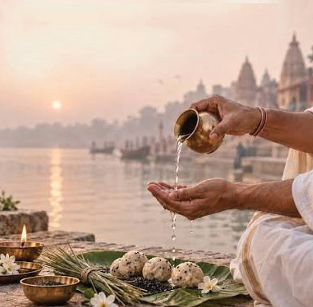
The scriptures say that one year on the Earth equals one day in Pitr-lok. So, fifteen days of Shraadh on Earth are equal to one hour in Pitr-lok. The fifteen-day Pitr-paksh period is when they come to the Earth to have a meal. We should do shraadh on the correct day as per the death of the ancestor. The simplest way to do Shraadh-Tarpan is to put a little milk, black til, jau and rice in a pot of water. You can add some flowers and kusha (grass) and offer it to the ancestors while facing South. Offering it respectfully, while taking the name and Gotra of the deceased, amounts to Shraadh Tarpan. The water should preferably fall on a Tulsi plant or near a Peepal tree or on the grass; not on the floor. Anything that is offered in the memory of the ancestors with Shraddha or reverence amounts to Shraadh.
We can also offer food to Brahmins and do Havan. It is believed that the food offered to a Brahmin on the relevant tithi (day) as per his death is conveyed to the ancestor in its subtle form. Those who do not know the death dates of their ancestors can do Shraadh on the last Shraadh day, i.e. on Sarv-Pitri Amavasya. During this period, food is also offered to cows, crows and dogs. Since this period is dedicated to our ancestors, we do not perform weddings, mundan, buy new clothes or indulge in any ceremonies that mark auspicious beginnings.
The day on which Pitrs are allowed to come on the earth and accept a meal from their progeny is designated and fixed. It is believed that if the progeny of the deceased offer food to Brahmins and do Pitr-Tarpan, the ancestors go back satisfied. One can even do tarpan for anyone known or unknown to them. It is believed that the souls for whom no one performs Shraadh-tarpan remain in the cosmos in an unhappy and grieving state. But if somebody does Shraadh for them, they move on in their onward journey.
Strangely, those who do not respect their parents, grandparents and elders while they are alive also do Shraadh tarpan after their death. Those who value and respect their parents while they are alive get their blessings in person. After the parents die, they want to atone for their sins. They do Shraadh to pay homage to their ancestors. I wonder if there is any merit in this. Shraadh is what you do with shraddha (devotion). Why should devotion manifest only after parents die?
Let me narrate a true story. A middle-aged man, while visiting an old age home, met an old lady who was known to him. He was quite surprised to see her there. She was the mother of a well-known man of Chandigarh. He asked her why she was living in the old age home.
She whispered, “Please don’t tell anyone in this old age home or even outside about my identity and that I live here.”
The man asked, “Your son is known to be a philanthropist! Why has he put his own mother in an old age home? The world should know of this!”
But she said, “Na beta, aisa karne se, mere bete ki chavi kharaab ho jaaegi.” (If that happens, it will bring dishonour to my son in the eyes of the world.)
That’s the love of a mother! How shabbily her son had treated her, and she was still willing to protect his honour! Parents only know how to give. They ask for nothing in return. The only thing they wish for is love and respect … while they are alive.
The best interpretation of the word ‘parent’ has been given by Sri Sathya Sai Baba. He said that the word ‘parent’ denotes pay-rent. Pay rent to your parents. We should pay the rent of Respect, Empathy, Niceness and Time. After parents pass on, we get a share in their property, jewels, etc. They give us all they had; but do we do enough to deserve it?
There is a tradition of putting kheer under Banyan or Peepal trees during Shraadh. When we put kheer under Peepal or Banyan trees, crows eat the kheer along with the fruits of these trees. The undigested seeds in the fruits would get transferred to wherever the crow poops. This would result in the propagation of Peepal and Banyan seeds. Peepal is the only tree that emits oxygen even at night. The Banyan tree has medicinal properties galore. This was a method crafted by the Rishis for the propagation of these valuable seeds. There is a reason for every ritual; we just don’t know about it.
Shraadh is done to pay homage to our ancestors, and to pray for their souls to be happy and peaceful, wherever they are. The ancestors, in turn, send us their blessings! Just as we value the property, jewels, etc. of our deceased ancestors, in offering homage, let’s value our siblings, for they are the living memories of our parents; they are part of our parents’ flesh and blood. If we have good relations with our siblings, that too gives peace to the departed souls of our ancestors.
Let’s pay some rent … and honour the memory of our parents, grandparents and other ancestors during Pitr-paksh. And if we involve our children while doing so, they shall learn from our example, and the tradition shall stay alive even after we are gone.