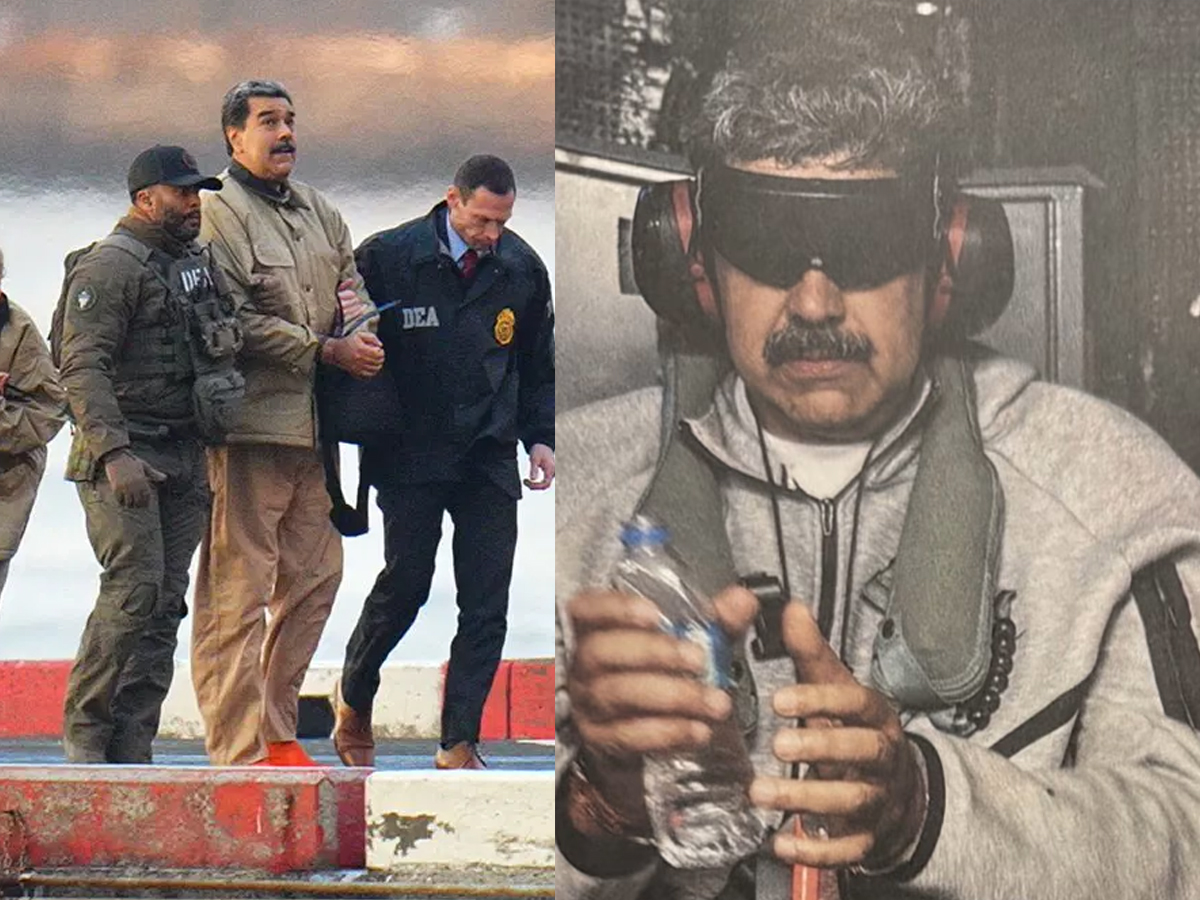
US President Donald Trump has shocked the world by launching an unprecedented, massive midnight military operation, “Absolute Resolve,” on January 3, 2026, against Venezuela, taking hostage President Maduro and his wife, Cilia Flores, and evacuating them to America by framing charges of drug trafficking and other illegal activities against the national interest of the US and the world order. US action has triggered Global scrutiny of the legitimacy of lifting the incumbent head of state in violation of established international norms
Venezuela has a total area of 912050 km², of which 882050 km² is land area. The population is approximately 30 million, and the GDP is approximately USD 110 billion, driven by oil and energy resources. The country has the world›s largest oil reserves, totalling about 303 billion barrels, which is approximately 17% of the world›s total oil reserves, even more than Saudi Arabia.
Venezuela has a military strength of approximately 120,000 and is equipped with Russian-made fighter aircraft, ships, and missiles, primarily to serve as a deterrent, particularly against U.S. ships and aircraft. However, Venezuela›s counter-air defence system proved highly inadequate and inferior against U.S. operations.
The US administration had meticulously planned this operation for a few months in a phased manner, yet under strict secrecy. President Maduro was under strict scrutiny of all his activities, including the daily mapping of the presidential house, his staff, and security arrangements. The intelligence agencies would have made penetration into the inner circle to ensure swift action to ensure quiet, bloodless hostage-taking and remove the President from the country to the US naval base.
Meanwhile, the US forces’ deployed carrier strike group comprises an aircraft carrier, a cruiser, multiple destroyers, a submarine, a replenishment ship, and aircraft, including strike fighters, electronic warfare planes, a Reaper drone, and fighters, supported by an amphibious ready group to enforce a blockade of any outside military support to Venezuela and to ensure an economic blockade of the country, thereby weakening the country’s logistical strength, ultimately leading to a disturbed economy and civil unrest in the country.
US forces started military operations on “D” day with a cyber attack on the crucial civil and military establishments, leading to an interrupted power supply, destroying air defence and other military deterrent and counter-offensive resources. This was followed by a massive, tactical air attack at midnight, involving more than 150 fighters and bombers, as well as several drones, deployed from the naval base and carrier strike group. The operation had direct participation of the Delta Force elite group, part of the Special Operations Aviation Regiment, and acted smoothly, hostage and evacuating President Maduro.
In addition to the US’ sharp focus on Venezuela’s oil resources, China’s growing economic and strategic presence and partnership in Venezuela have undoubtedly acted as a catalyst for US military action, “Operation Absolute Resolve,” against the Maduro regime. The US considers Latin America its backyard, and the presence of any other global power in this region may directly challenge US dominance across both North and South America.
China has been deeply engaged in Venezuela and has started dominating throughout Latin America and the Caribbean region in recent years, since the regime of President Hugo Chavez, the political mentor of the ousted Maduro regime. Since then, China has invested billions of USD in Latin America in various high-tech projects linked to oil and Energy resources, infrastructure development, and space technology, particularly in Venezuela, Chile, and Brazil. China has further signaled its intention to dominate in Latin America, the so-called US backyard, by engaging directly and by promising USD 9.2 billion to the Community of Latin American and Caribbean States (CELAC), an organization comprising 33 countries in the region.
India has modest strategic stakes and trade relations with Venezuela, which was largely dependent on oil imports; India was a major buyer and processor of crude oil from 2000 to 2010, and ONGC Videsh held stakes in the Orinoco Belt. However, US sanctions on Venezuela in 2019 led to a sharp decline in oil imports from the country, in part to prevent secondary sanctions on Indian firms that engaged with the country. The ONGC has suffered a colossal loss of locked $ USD 1 billion due to US sanctions; the same may be unlocked if US firms take over the control of Oil resources in Venezuela.
An emergency meeting of the UN Security Council is being convened on Venezuela’s urgent request on 5 Jan 2026 to discuss the implications and way forward following unprecedented military action by US forces in Venezuela.
Mr. António Guterres, the Secretary-General of the United Nations, has expressed concern about the unprovoked military action by US forces in Venezuela, which has created the potential for turmoil in the region and set a dangerous precedent with global consequences.
The UN Independent International Fact-finding Mission on Venezuela and the Human Rights Council have expressed deep concern about recent events in the country, which may lead to violations of human rights and the UN Charter by US forces and local allies. Although the mission and the HRC are investigating allegations of human rights violations, drug abuse, and other illegal actions that may have occurred during the long period of the regime led by President Maduro.
Russia, China, Brazil, and several other countries have sharply condemned the U.S. military action. At the same time, Israel, the UK, Argentina, and Ecuador have supported the U.S. In contrast, numerous countries, including the Government of India, have adopted a cautious, balanced stance, citing the need to resolve issues between the U.S. and Venezuela through peaceful dialogue.
There is global concern about the US’s intention to indefinitely administer Venezuela until a new government is installed. The US has also announced its intention to assume control of oil and other energy resources under the guise of reshaping and developing Venezuela’s infrastructure and economy. This amounts to the colonization of Venezuela. Meanwhile, the Supreme Court of Venezuela has appointed Vice President Delcy Rodríguez as the nation’s interim president. Hence, the Government of Venezuela expects international forums to recognize her as the interim president until the permanent incumbent is duly elected by the country, rather than a proxy appointed by the US administration.
The present unprovoked aggression, hostage-taking, and the removal of the elected President from the country, along with US military action against the legitimate Venezuelan regime, should not be viewed as a standalone event.
Although there have been multiple instances of US interventions in Latin America to destabilize established regimes, including in Panama in 1989, Chile in 1973, the failed invasion of the Bay of Pigs in Cuba in 1961, and in Guatemala in 1954, the present “Operation Absolute Resolve” in Venezuela has opened Pandora’s box, igniting a trail of wishful thinking and a drive to force smaller countries to succumb to a modified form of colonization. Latin American countries like Brazil and Colombia, countries in the Middle East, and Iran are in a highly vulnerable zone of conflict. Similarly, this action may trigger unrest in the Asia-Pacific region, particularly in Taiwan and the South China Sea. The reasonable settlement of the Ukraine-Russia conflict may also be affected.
The US action has clearly dealt a deep blow to the integrity of Article 2 of the UN Charter, underscoring that all Member States must refrain from the “threat or use of force” against the territory or political independence of any other nation.
The course of action by the international order, including the UN, will set a precedent to ensure the preservation of the principles of international law, the right to freedom, national sovereignty, and the UN Charter. An international monitoring group under the UN umbrella, comprising military, civil administration, and hu man rights monitoring, is to be established to assist the Venezuelan authorities in restoring democratic governance. The US military must withdraw from Venezuela, and President Maduro, his wife, and others who have been held hostage by US forces should be released immediately and taken to a neutral, secure location until the situation is normalized. The new regime in Venezuela may initiate detailed investigations to determine whether any abuses of governance, violations of human rights, or illegal actions by the long-standing Maduro presidency occurred, and to take punitive action against the responsible parties and culprits, regardless of their status or position.
A red line must be drawn globally to establish a clear line of demarcation for initiating military action across international boundaries in self-defense, counterterrorism, drug trafficking, and to uphold the country’s right to choose and act in accordance with the system of governance.
Restructuring the UNSC and the UN’s operations is an immediate and inevitable priority to make this global body more meaningful, relevant, and effective in light of current global dynamics.
Major General J.K.S. Parihar, Sena Medal, Bar to Vishisht Seva Medal (Retd.) Former Additional Director General, AFMS and Expert on Defence and International Strategic Affairs