
Navratri has different meanings for different people. To some, it’s a time to pray, meditate, observe fasts and perform rituals. To others, it brings opportunities for dressing up in their festive best, feasting or even detoxification and weight loss. Many start deep cleaning of their cupboards, kitchen, etc. during Navratri. Navratri is strategically and scientifically placed at the change of season by our ancestors. This is true for both the Sharadiya Navratri and the Chaitra Navratri.
At this time, immunity is low, and it does good to detox. Detox means cleansing the body of toxins by changing the diet to exclude some foods while including others. Fasting basically means control or restraint, both on a physical and mental level. In contemporary times, dietitians often advise clients to go off cereals and pulses for a few days. The prescribed food in Navratri does just that.
While we are supposed to go off wheat, rice, grains and pulses, we can switch to buckwheat flour (kuttu ka atta), which is very high in protein and fibre and Barnyard millet (samak chawal), which is rich in vitamins and minerals and tastes like rice. Fresh fruits and juices are prescribed in abundance. And that’s what detox is all about! It’s ridiculous to think that the Goddess would get annoyed if we eat normal foods or common salt during Navratri. The divine energy cannot stoop to this level.
The restraint that we enforce on ourselves is for our own benefit. Fasting gives rest to and regulates the internal organs. Rock salt or sehnda namak is rich in potassium and is a great detoxifier. Our forefathers probably made these rules and rituals to better our health and help us transition through the change of season. Our traditions are very scientific, if only one has the time to understand and imbibe them.
While it’s a fashion statement to have certain foods being on a diet plan designed by a high-fi dietician, it’s a matter to be looked down upon if you are doing a religious fast. I wonder why. When we are ill, we follow the prescription of a doctor, without having in-depth knowledge of the medicines prescribed. Why do we question the rituals that are time-tested by the experience of our forefathers? If you are on a holiday to a hill station or a beach, the purpose of the holiday is to cut off from the daily routine, rest and rejuvenate yourself physically and mentally.
I personally think religious fasting usually allows fruits/ milk, or curd to simplify the job of cooking. In a religious fast, one is supposed to spend the better part of the day in prayer. There may be no time to cook. So it’s just an easier option to have fruit and milk. Let’s not find ways to convert fasts into feasts! Why order a Navratri-thali comprising ghia-ki-kheer, puris made of kuttu-ka-atta and alu-tikkis, sabudanapaapad, potato-singharapakodas, vegetables loaded with ghee, though devoid of onion and garlic, etc.? What is the point? Let’s observe the traditions while understanding their significance.
Let’s take pride in being Indian and preserve our culture by looking deeper. If we don’t, in one or two decades, all this will be history! The Navratri festival is placed in the lunar calendar such that it gives an opportunity to rejuvenate yourself on a different plane. Navratri brings the opportunity to connect with the divinity within ourselves. It brings an opportunity to cleanse and detoxify the body. Just like our car needs to be serviced periodically, the body and mind too need servicing.
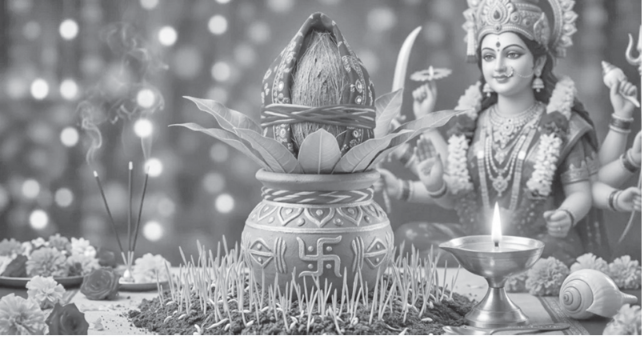
As the Earth turns on its axis and the seasons gradually tide in and tide out, the body needs to detox and prepare for the next season. Barley seeds are sown in Navratri. A kalash of water and a coconut is kept alongside, to honour the first crop cultivated by humankind when Brahmaji created the universe. If you sow barley seeds in Navratri as khetri in your house, it ensures that you stay in town and do not travel. If you fast, you can detox. If you follow a routine of doing prayers to the Devi, you end up filling your day with prayer, positivity, detoxification coupled with a healthy diet.
It’s a time for resetting and rejuvenating! Doing Kanya poojan on Ashtami or Navami day is a reminder to value the girl child. Our ancestors foresaw that the girl child may be endangered in the times to come in our society, so they made a ritual for worshipping little girls as little goddesses twice a year during Navratri. Despite this, we have innumerable instances of female foeticide, infanticide, rape, dowry deaths, etc. Everything starts from our attitude towards the girl child.
If each one of us were to realise that a child is a child, be it a girl or a boy, so much would be solved and resolved. If each mother were to counsel her son; if each sister were to counsel her brother, we could change the mindset of the perpetrators of crime against women. If there are no girls, who will give birth to the new generation? The world would come to an end. For those not spiritually inclined, Navratri is a time to revere Prakriti (nature) and offer thanksgiving for all that nature has bestowed upon us. Resources like the Earth, air, water, minerals, oils, etc. should not be wasted or misused.
It is important to conserve the environment for the generations to come. Prakriti is the visible aspect of the invisible, omnipotent and omniscient divinity. Sri Sathya Sai Baba says that the word Stree is made up of Sa, Ta and Ra. Sa signifies Sattvic, Ta signifies Tamasic and Ra signifies the Rajasic nature of women. Stree thus represents the combination of the three gunas. You can judge a house by the Greh-Lakhmi (lady of the house); she represents the ‘everything’ of the house.
While doing Devi Poojan and Kanya-Poojan, let’s extend respect to all the living goddesses around us … our mother, wife, sister, daughter, daughter-in-law, granddaughter, and just any girl out there! This time, when you do Kanya poojan at the culmination of Navratri, do remember that God made everything in pairs, by design. He made day and night, summer and winter, hot and cold …and boys and girls, men and women! Both are equally valuable. The feminine half of Divinity, or the Devi, is the better half in Ardhnarishwar! During the Navratri, do find time to visit a Devi temple, sing Devi Bhajans or read the Mahishasura Mardini Stotram/ Durga Chalisa/ Durga Saptshati or any other prayer that appeals to you. And revere and adulate the beautiful form of the divine mother!
Let’s live in the awareness of the divine energy of which we are a part, and revel in the knowledge of our true identity! Jai Mata Ki!