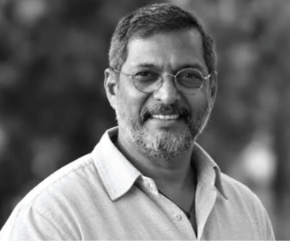
In Indian cinema, there are certain actors who earn a permanent place in the hearts of audiences not merely through their acting, but also through their simplicity, personality, and distinctive dialogue delivery. Nana Patekar was one such versatile and influential actor. His real name was Vishwanath Patekar. Along with Hindi and Marathi cinema, he also established a distinctive identity through his work in theatre. His voice, facial expressions, manner of delivering dialogues, and ability to portray characters close to real life distinguished him from other actors. Nana Patekar was born on January 1, 1951, in Murud Janjira, Maharashtra. He spent his childhood in ordinary circumstances.
The difficulties and struggles he experienced gave depth to his personality, and their influence could later be seen in his acting. He studied at the Sir J. J. School of Art in Mumbai. Even before entering the world of acting, he had a deep interest in art. His association with theatre became the strong foundation of his acting career. Nana Patekar began his film career in the 1970s. During his early years, he did not receive very major roles, but even in small parts he left a lasting impression. Gradually, the film industry began to recognize the seriousness and impact of his performances.
He went on to portray a wide range of characters in films such as Ankush, Pratighaat, Parinda, Krantiveer, Agnisakshi, Ab Tak Chhappan, Apaharan, Welcome, and Raajneeti. Nana Patekar’s social life has also been an important aspect of his personality. He has remained sensitive to the problems faced by farmers and people living in rural areas. Drought and the economic hardships of farmers have long been serious issues in Maharashtra. Nana Patekar worked to help farmers in need and also encouraged others to contribute to social causes. He worked alongside social activist Makarand Anaspure to assist farmers. Through these efforts, attempts were made to help economically vulnerable farmers and their families.
He has maintained that people who are in a position to help should come forward to support those in need. Nana Patekar’s social outlook is also reflected in his films. Many of his films have highlighted issues such as corruption, injustice, poverty, violence, political systems, and the problems faced by ordinary people. This is why many of his characters do more than merely entertain; they also encourage audiences to think about social issues. One of Nana Patekar’s defining qualities is his simplicity. Despite spending decades in the film industry, he has continued to present himself as an ordinary person. He has been known to value work and acting more than showmanship.
His straightforward and outspoken manner of speaking has also been an important part of his personality. His voice and distinctive style of dialogue delivery created a unique impact in Hindi cinema. Many actors have drawn inspiration from him. He exemplifies the fact that acting does not depend merely on a handsome face or glamour; talent, hard work, experience, and the ability to express emotions effectively are far more important. Nana Patekar is among those artists in Indian cinema who regarded acting not merely as a means of entertainment, but also as a medium for expressing social and human emotions.
His films often portray the suffering of ordinary people, social inequality, injustice, and dissatisfaction with the system. At the same time, his comic performance in Welcome demonstrated that he could perform a completely different kind of role with equal effectiveness. His memorable dialogues, powerful voice, and natural style of acting gave him a special place among audiences. His diverse performances can be seen in films such as Krantiveer, Parinda, Ab Tak Chhappan, Raajneeti, and Welcome. Alongside acting, his social efforts to help farmers and people in need also constitute an important part of his personality. Nana Patekar’s life conveys the message that success is not merely about achieving fame. True success becomes meaningful when a person understands social responsibility along with the use of his or her talent.
His contribution to Indian cinema will be remembered for a long time, and his dialogue delivery and acting will continue to inspire generations of performers. The greatest strength of Nana Patekar’s acting is its naturalness and inner intensity. He does not portray a character merely through external appearance or costume; instead, he makes the character’s psychological state the foundation of his performance. His characters clearly convey emotions such as anger, pain, helplessness, rebellion, humour, and sensitivity. What is particularly remarkable is that he can sometimes communicate the state of mind of a character to the audience without uttering a single word. The expression in his eyes, tension in his face, sudden changes in his voice, and pauses between dialogues make his performances exceptionally powerful.
Parinda: A Vivid Portrait of Violence and Psychological conflict
In this film, Nana Patekar’s performance is regarded as one of the important milestones of his career. He played Anna, a man who is powerful and terrifying within the criminal underworld, yet whose personality contains complex layers of personal emotions and psychological instability. In this role, Nana Patekar does not merely become a villain. He brings out both the violence and insecurity within Anna. His face often appears calm, yet the danger hidden beneath that calmness is immediately felt by the audience. This is the strength of his acting. He does not create fear simply by shouting; in many scenes, his slow and controlled manner of speaking produces an even more frightening effect. The modulation of his voice is also crucial to the role. While delivering dialogues, he leaves pauses between words, giving the impression that something is constantly taking place within the char- acter’s mind. In this way, his performance expresses not only outward aggression but also inner tension.
Krantiveer: An explosion of rebellion, anger, and social consciousness
In this film, Nana Patekar’s acting appears in one of its most powerful forms. Pratap Narayan Tilak is a character deeply frustrated with the system, carrying within him a profound anger against injustice. His performance is not merely an expression of personal rage; rather, it represents the anxiety and frustration of an ordinary citizen confronted by an unjust social order. In the film, his dialogue delivery becomes his most powerful acting instrument. He does not merely speak his lines; he infuses them with emotional energy. At one moment his voice is extremely restrained, and the next it becomes sharp and aggressive. This variation reflects the psychological state of the character. Particularly in his speechlike sequences, body language becomes extremely important. The movement of his hands, facial expressions, intensity in his eyes, and force of his voice work together to make his dialogues highly effective. This is why his performance in Krantiveer does more than entertain; it also encourages audiences to reflect upon social and political questions.
Ab tak chhappan: A study in restrained and controlled acting
Here, Nana Patekar’s acting is completely different from his performance in Krantiveer. He plays Sadhu Agashe, a police officer who is extremely ruthless toward criminals. In this role, rather than relying on loud voices and lengthy speeches, Nana Patekar makes greater use of restraint and silence. His face often appears expressionless, but it is precise- ly this lack of visible emotion that conveys the character’s toughness. He communicates a great deal with very few words. The expression in his eyes while looking at a criminal, a brief moment of silence, and the short dialogue that follows are enough to reveal the character’s state of mind. His physical language is equally controlled in this role. He avoids unnecessary gestures. The way he walks, sits, and looks at another person becomes an integral part of the character. As a result, Sadhu Agashe appears like a real and serious police officer.
Welcome: the comic side of a serious actor
This film undoubtedly reveals a completely different dimension of Nana Patekar’s acting ability. As Uday Shetty, he did not restrict comedy to humorous dialogues; instead, he used facial expressions, voice modulation, and timing to create humour. His distinctive quality is that he does not perform the character as though he himself considers it ridiculous. He plays Uday Shetty with complete seriousness, and it is precisely this seriousness that creates the comedy. This technique makes his performance particularly effective. His anger itself becomes a source of humour in the film. The sudden rise in his voice while delivering a dialogue, the tension on his face, and his helplessness when confronted by circumstances make audiences laugh. This demonstrates that Nana Patekar can be equally effective in both serious and comic roles.
Raajneeti: An encounter With the face of Power and ambition
In Raajneeti, Nana Patekar once again appears in a serious and political avatar. His character, Brij Gopal, is a man who understands political circumstances and plays his role within the game of power. The distinctive quality of his performance here lies less in dialogue and more in the politics conveyed through his eyes and behaviour. While speaking to another person, he appears to be listening not merely to their words but also to understanding their intentions. His voice generally remains controlled, making the character appear experienced and politically astute. Here, Nana Patekar demonstrates that a powerful character does not always require a loud voice or aggressive performance to become effective. At times, a calm face and controlled voice can make a character even more powerful.
The distinctive style of his acting
Nana Patekar’s acting style can be understood through three principal characteristics—voice, eyes, and pauses. His voice has a distinctive roughness that lends authenticity to his characters. He uses appropriate pauses between dialogues to create emotional impact. His eyes are also an important medium of expression. Many times, without speaking a word, he communicates anger, pain, or suspicion through his face and eyes alone. His use of pauses—that is, the silence before or after delivering a dialogue—also holds special significance in his acting. Another major characteristic of his style is his avoidance of excessive theatricality. Even when his character is extremely emotional or angry, he often keeps those emotions under control in many scenes.
This makes his performances appear more realistic. Thus, Nana Patekar’s film acting is not merely the art of delivering dialogues. He constructs his characters through voice, silence, facial expressions, eyes, body language, and psychological depth. Fear and violence in Parinda, rebellion in Krantiveer, toughness in Ab Tak Chhappan, humour in Welcome, and political intelligence in Raajneeti—his performances in all these roles are distinct from one another. It is this versatility that places him among the exceptional actors of Indian cinema. The sudden demise of this distinctive and vibrant actor has left his admirers deeply saddened. Actors like Nana Patekar are born only once in centuries in Hindi cinema.
*Dr. Manish Kumar Chaudhary, Assistant Professor, Daulat Ram College, University of Delhi, (Continuously engaged in research and writing on films)