
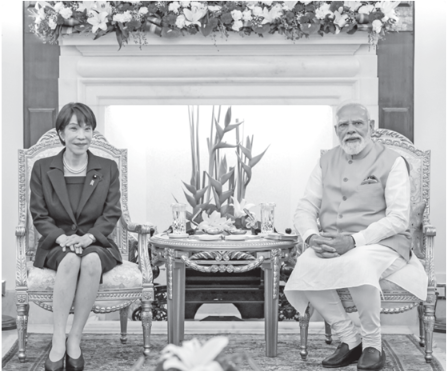
As Prime Minister Shri Narendra Modi welcomes Japanese Prime Minister Sanae Takaichi to Bharat for the 16th Annual Bharat Japan Summit, the meeting assumes significance far beyond the customary exchange of diplomatic courtesies. It comes at a time when Asia is witnessing its most profound geopolitical transformation since the end of the Cold War. The IndoPacific has emerged as the principal theatre of strategic competition, supply chains are being reconfigured, technological sovereignty has become a national imperative, and nations are reassessing long-held assumptions about security and economic resilience. Against this backdrop, the Modi–Takaichi summit is not merely another bilateral engagement. It represents the convergence of two ancient Asian civilisations that increasingly perceive themselves not only as economic partners but as responsible stakeholders in shaping a stable, rules-based, and multipolar Asian order. For over two decades, Bharat and Japan have steadily transformed their relationship from one centred on development assistance and economic cooperation into a comprehensive strategic partnership encompassing defence, technology, infrastructure, maritime security, critical minerals, semiconductors, resilient supply chains, and peopleto-people exchanges. Today, this partnership stands among the most stable and trusted relationships in the Indo-Pacific. Yet the significance of the present summit lies not simply in the breadth of cooperation already achieved, but in the changing strategic context within which it is taking place.
A New Japan for a New Asia
Japan today is undergoing one of the most consequential transformations in its post-war history. For nearly eight decades following the Second World War, Tokyo largely defined itself as an economic superpower constrained by a pacifist constitution and dependent upon the United States for its security umbrella. While Japan emerged as one of the world’s foremost industrial and technological powers, its strategic role remained deliberately restrained. That era is rapidly drawing to a close. The rise of an increasingly assertive China, recurring tensions across the Taiwan Strait, North Korea’s expanding missile capabilities, disruptions in global supply chains, and the weaponisation of economic interde pendence have compelled Japanese policymakers to fundamentally rethink their national security architecture. Prime Minister Sanae Takaichi represents this strategic reawakening. Widely regarded as one of Japan’s most influential conservative leaders, Takaichi has consistently argued that economic security, technological leadership, defence preparedness and national resilience can no longer be treated as separate policy domains. Rather, they constitute different pillars of national power that must reinforce one another. Her advocacy for strengthening Japan’s defence capabilities, investing in emerging technologies, protecting critical infrastructure and expanding strategic partnerships reflects a broader transformation underway within Japanese policymaking. This evolution has profound implications for Bharat. Unlike previous decades, when Tokyo’s engagement with New Delhi was driven primarily by infrastructure financing and developmental cooperation, contemporary Japan increasingly views Bharat as an indispensable strategic partner in maintaining stability across the Indo-Pacific. Likewise, Bharat recognises Japan not merely as a source of investment and technology but as a trusted democratic partner sharing common concerns regarding maritime security, economic resilience and a free, open and inclusive Indo-Pacific.
From economic partnership to strategic convergence
The Bharat–Japan relationship has matured remarkably over the past decade. The Special Strategic and Global Partnership announced in 2014 has steadily expanded into virtually every major sector of edented momentum. The Acquisition and Cross-Servicing Agreement (ACSA), expanding naval exercises including JIMEX and Malabar, intelligence sharing, and increasing interoperability between the armed forces illustrate a partnership that has evolved far beyond symbolism. national power. Japanese participation in flagship infrastructure projects such as the Mumbai–Ahmedabad High-Speed Rail, industrial corridors and metro systems has complemented growing cooperation in defence exercises, maritime domain awareness, cyber security, space technologies and critical and emerging technologies. The two nations today cooperate closely through the Quad alongside the United States and Australia, reflecting a shared commitment to preserving freedom of navigation, respect for international law and an open maritime order in the IndoPacific. Defence cooperation has likewise acquired unprecEqually significant is the emergence of new domains of cooperation. Semiconductors, artificial intelligence, quantum technologies, resilient supply chains, green energy, rare earth processing and trusted digital infrastructure have become central pillars of bilateral engagement. In an era where technological superiority increasingly determines geopolitical influence, Bharat and Japan possess complementary strengths that can together shape the next generation of industrial growth. This convergence is driven not merely by common interests but by shared strategic perceptions. Both countries recognise that economic dependence upon a single source creates vulnerabilities. Both seek diversified supply chains. Both support a rules-based maritime order. Both value democratic governance, strategic autonomy and regional stability. And both understand that prosperity cannot be sustained without security.
More than strategy: A partnership of civilisations
Much has been written about defence agreements, infrastructure projects and trade figures. Yet these metrics alone cannot fully explain why the Bharat–Japan relationship has acquired exceptional resilience. Unlike many contemporary strategic partnerships that are primarily transactional, the relationship between Bharat and Japan rests upon a much deeper civilisational foundation. The intellectual exchanges between Swami Vivekananda and Japanese thinkers, the admiration of Okakura Kakuzō for Asian civilisation, the support extended by Justice Radha Binod Pal at the post-war tribunal, the enduring influence of Rash Behari Bose, and the inspiration drawn by Netaji Subhas Chandra Bose from Japan’s resistance to Western colonial dominance have together created reservoirs of goodwill that continue to shape bilateral perceptions. More recently, these civilisational bonds have found new expression in cultural diplomacy. As this author observed in an earlier Organiser article titled “Commemorating Chhatrapati Shivaji Maharaj in Japan: A Monument to Transnational Cultural Synergy,” the unveiling of Chhatrapati Shivaji Maharaj’s statue in Japan represented far more than a commemorative event. It symbolised a shared appreciation for civilisational heritage, national self-respect and historical continuity. The memorial demonstrated that cultural diplomacy can often strengthen strategic partnerships in ways that conventional statecraft cannot. The Shivaji memorial illustrated an important reality: enduring partnerships between nations are ultimately built not only through governments but also through shared civilisational values, mutual respect and historical empathy. It is this deeper foundation that distinguishes BharatJapan relations from many other partnerships across the Indo-Pacific.
The summit in historical perspective
Every annual summit naturally produces announcements relating to investments, technology transfers, infrastructure projects or defence cooperation. While these outcomes remain important, they represent only the visible layer of a much larger strategic transformation. The meeting between Prime Minister Modi and Prime Minister Takaichi occurs at a moment when both nations are simultaneously redefining their roles within an emerging multipolar order. For Bharat, the objective is to consolidate its position as a leading power, a trusted manufacturing hub, a technology innovator and the principal voice of the Global South. For Japan, the challenge is equally historic: adapting to changing geopolitical realities while preserving its democratic institutions, technological leadership and civilisational identity. The convergence of these trajectories explains why the present summit deserves to be viewed not merely as another diplomatic engagement but as an important milestone in the evolution of an Asian strategic partnership rooted in both shared interests and shared values.
Yet, to fully appreciate the significance of this moment, one must also understand the profound domestic transformation unfolding within Japan itself. Behind its expanding strategic role lies a society grappling with demographic decline, labour shortages, immigration, questions of cultural integration and an unprecedented debate over national identity. These internal developments are increasingly shaping Tokyo’s external outlook and, consequently, the future trajectory of Bharat–Japan relations.
*Shri Siddhartha Dave is an alumnus of United Nations University, Tokyo, an eminent columnist and a former Lok Sabha Research Fellow. He writes on Foreign Affairs and National Security. Author can be reached at siddhartha.dave@ gmail.com