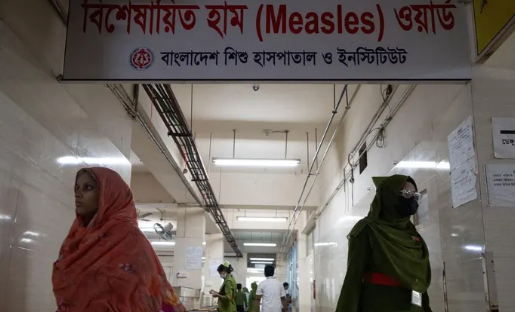
The ongoing measles epidemic in Bangladesh is not a normal outbreak of disease. It is the heart-breaking picture of thousands of children dying from a preventable illness because of a crisis born out of political vengeance. The vaccination system that Bangladesh built over decades to protect the lives of its children has collapsed. It collapsed because of the political revenge, administrative incompetence and irresponsible policy decisions of the illegal interim government led by Muhammad Yunus, and the current BNP government formed through a staged election. Measles is a disease that can be easily prevented through regular vaccination. Bangladesh was once a global role model in controlling this disease. Yet today, in Bangladesh, more than one thousand children have died. According to official figures, as of September 12, 2026, the number of child deaths from measles has reached 1,012. Various sources indicate that the real number is likely to be even higher. So far, the total number of infections stands at 189,789, while 149,471 children have been admitted to hospitals. Reuters reported on September 9, 2026 that Bangladesh is now facing the world’s worst measles outbreak, with nearly one thousand suspected and confirmed deaths recorded since March. These figures are not just numbers. Behind every number, there is a child. Behind every child, there is a family. Behind every death, there is the cry of a helpless mother. What hurts most is that these deaths were preventable. With sincerity and timely action, they could have been stopped. Many of these children could have lived. We had the necessary skill and experience. We had a clear vaccination structure. We had trained health workers at the field level. We had a long-standing partnership with UNICEF, GAVI and WHO to ensure uninterrupted vaccine supply. Yet all of this was destroyed, and innocent children were pushed towards death.
Causes of the measles epidemic in Bangladesh
WHO has stated that nationwide MR vaccine stockout, routine immunization gaps and the absence of regular supplementary measles-rubella campaigns increased the number of children at risk. In other words, this outbreak did not happen because of the virus alone. It happened because the prevention system collapsed. The stages of this collapse were:
• The continuity of routine vaccination was broken.
• Supplementary campaigns were not conducted on time.
• The tested UNICEF-GAVI procurement system was cancelled, putting vaccine availability at risk.
• MR vaccine stockout was allowed to happen.
• Surveillance and real-time tracking were not ensured.
• Vitamin A, nutrition support, hospital preparedness, isolation and pediatric care were not ensured.
Measles is a highly contagious disease. It spreads very quickly. When population herd immunity becomes weak, children suffer first. The youngest children, those who have not yet reached the age for the first dose, those suffering from malnutrition, those living in slums, Rohingya camps or densely populated areas, face the greatest danger. If a child dies before reaching the age of vaccination, who is responsible? That child could not take the vacstop. Saving children’s lives must be given the highest priority. cine by himself or herself. Society’s collective immunity was supposed to protect that child. When that protective wall collapses, the most helpless children are the first to lose their lives.
success of vaccination programme during the awami league government
Bangladesh’s Expanded Programme on Immunization, or EPI, is one of the country’s greatest public health achievements. From full vaccination coverage of only about 2% of children in 1979, Bangladesh achieved internationally recognised success in routine immunisation within a few decades. During the Awami League government, the vaccination programme was not just an administrative duty of the Ministry of Health. It was a state priority. Our goal was clear: no child in Bangladesh should be left without vaccines. From 2009 to 2024, we expanded the MR vaccine programme and built a strong measles prevention system. In 2012, the first dose of the MR vaccine for children was introduced, followed by the second dose at 15 months of age. Since then, in coordination with UNICEF and GAVI, we ensured regular vaccine availability, maintained routine immunisation and conducted large scale vaccination campaigns across the country. In the special vaccination campaign held in 2014, around 52 million children received the measles-rubella vaccine. The following steps must be taken immediately: In 2022, Bangladesh reported 311 measles cases. In 2023, the number was 281. In 2024, it came down to 247. This means the disease was fully under our control. If everything had continued properly, we would have declared Bangladesh measlesfree in 2027.
failure and responsibility of Yunus-led interim government
When the Yunus-led interim government seized power in August 2024, it inherited a strong vaccination system. According to WHO and UNICEF data, Bangladesh then had around 97% coverage for the first dose of measles vaccine and around 93% coverage for the second dose. In 2023, confirmed measles cases were only 281. But the interim government led by Muhammad Yunus broke that continuity. The supplementary MR campaign that was supposed to take place from the middle to the end of 2024 was suspended. The Health, Population and Nutrition Sector Programme, or HPNSP, which had been operating since 1998 as the institutional foundation for vaccine procurement and the health sector, was effectively cancelled without any alternative. The biggest mistake was moving away from the tested vaccine procurement system through UNICEF, which had been in place for decades, and shifting towards an open tender process. UNICEF warned the government several times about this. Still, Yunus ignored that warning.
• Ensure uninterrupted vaccine supply through UNICEF, GAVI and WHO.
As a result, the government failed to procure new vaccines. In the words of an EPI official, not a single vaccine could be obtained through any method. In March 2026, the national stock of six types of vaccines, including measlesrubella, ran out. According to reports, MR coverage fell to 59%, a devastating decline from the 97% coverage recorded eighteen months earlier. The Yunus government inherited an effective EPI structure. It inherited high vaccination coverage. It inherited established relationships with UNICEF, GAVI and WHO. It inherited the experience of trained health workers at the field level. It inherited the budget allocation. But it failed to protect that continuity. It did not listen to UNICEF’s warning. It did not understand the risk in time. It did not act when action was needed.
responsiBility of the Current Bnp led government
The failure of the Yunus government created the foundation of this epidemic. But the current government led by Tarique Rahman cannot avoid responsibility either. From the moment it came to power, the crisis was already becoming clear. Its duty was to urgently ensure vaccine supply, identify children at risk, conduct case tracing, prepare hospitals to treat infected children, and keep the public regularly informed. But what did we see? Instead of responsibility, we saw the politics of blame. The health minister stood • Conduct national mapping of zero-dose and under-vaccinated children. in parliament and gave false information, blaming Awami League. But the reality is that the last major MR campaign took place from December 2020 to January 2021. If the campaign is held every four years, the next campaign was due from the end of 2024 to the beginning of 2025. That means it was due during the Yunus government. The Yunus government did not conduct it. Instead, it also disrupted the normal vaccination programme. In a democratic and transparent system, politics should be based on data. Lying about children’s deaths or shifting blame is inhuman politics. The current government should have searched for the truth instead of looking for political gain. It should have asked why coverage fell, why stockout happened, why the campaign did not take place, and why hospitals were not ready. During Covid, the Awami League government proved that even when a crisis is severe, Bangladesh can respond with great success if there is proper leadership, planning, international cooperation and field level management. Calling today’s measles epidemic “inevitable” is false. It could have been prevented. We knew how to prevent it. The problem was leadership. Because of their failure, Bangladesh today is witnessing a procession of child deaths.
what must Be done now
The most urgent task now is to acknowledge the truth. The politics of blame must • Launch special campaigns in slums, poor areas, border regions, Rohingya camps, densely populated areas and hard-to-reach regions.
• Introduce a real-time surveillance dashboard in every district.
• Increase measles wards, isolation facilities, oxygen supply, ICU capacity and paediatric support in hospitals.
• Ensure Vitamin A, nutrition support, and proper management of pneumonia and diarrhoea.
• Conduct an independent investigation into the 2024-25 vaccine procurement failure, campaign delay, vaccine stockout and data discrepancy.
• Explain to the people why UNICEF’s warning was ignored.
• Provide state recognition, assistance and compensation to the family of every child who died.
No one has the right to play politics with children’s lives. The death of more than 1,000 children from a preventable disease is not an ordinary failure. It is a warning to the state. Those who created the path to this preventable disaster must be held accountable. They must be brought before justice.