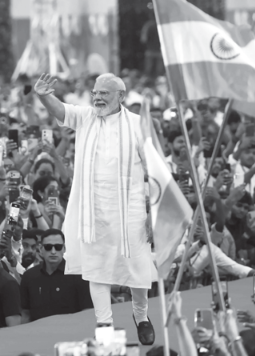
Through the Seva Sankalp Abhiyan, thousands of Bharatiya Janata Party (BJP) workers familiarised citizens across the country with the 25 years of continuous service to the nation rendered by PM Narendra Modi. Lamps of blessings were lit to convey heartfelt wishes and extend best wishes to him. The campaign was an innovative initiative to connect with people from all sections of society through visits to prominent development centres, felicitating Anganwadi workers, and engaging with influential personalities, among other activities.
On 7 October, lakhs of citizens across thousands of locations in the country also took a pledge to make Bharat a developed nation by 2047, raising the inspiring slogan, “We Will Do It.” Over the past 25 years, PM Modi has not only contributed to Bharat’s economic progress but has also established Bharat’s cultural pride and civilisational heritage on the global stage. In Bharat, Dharma is not confined merely to worship and rituals; it also teaches social responsibility and a sense of duty. Maharishi Kanada explained Dharma in the Vaisheshika school of philosophy.
According to this principle, Dharma encompasses both dimensions of human life: moral development and material prosperity. When this concept is examined in the context of governance, Abhyudaya implies formulating policies for economic development that promote employment, agriculture, infrastructure, science, and the dignity and welfare of women and disadvantaged sections of society. Through initiatives aimed at cultural revival, PM Modi has made significant efforts to advance Bharat’s economic progress.
The Opposition, however, has often viewed initiatives undertaken for cultural revival through a lens of criticism. The extent to which these efforts in the religious and cultural spheres have transformed the economy is a subject worthy of study. A few examples can help illustrate this impact. When a religious site is developed, the transformation extends far beyond the temple premises. The entire surrounding landscape changes. Roads are upgraded to facilitate the movement of pilgrims and tourists, while railways, airports, hotels, restaurants, shops, local transport services, handicrafts, and the sale of local products all contribute to transforming the lives of the local population.
Those whose livelihoods are associated with religious tourism—including tourist guides, flower garland sellers, and shops selling prasad (religious offerings)—also experience greater economic opportunities and improved prosperity. These outcomes have been facilitated, among other initiatives, by the Government of Bharat’s Pilgrimage Rejuvenation and Spiritual Heritage Augmentation Drive (PRASHAD) Scheme. Under the scheme, a budget of Rs 1,726.74 crore has been allocated for 54 projects.
According to one estimate, the scheme has generated economic activity worth approximately Rs 5,000–8,000 crore so far. Bharat has approximately 2 million sites of Sanatan faith, including temples. Religious tourism accounts for nearly 60% of the country’s tourism, contributing 5.22% to GDP and 13.34% to employment. Approximately 75 million people derive employment from religious tourism and related activities. According to the Gujarat government’s budget-related figures, the Somnath Temple receives an average of 25,000 devotees daily for darshan in 2024–25.
Over the course of the year, approximately 9.7 million people visited the temple to seek the blessings of their deity. In 2013, the number of devotees stood at around 7–7.5 million, representing an increase of approximately 26%. The annual economic activity generated by pilgrimage to Somnath is estimated at Rs 15,00018,000 crore. PM Modi once remarked in a speech, “Mujhe toh Maa Ganga ne bulaya hai” (“Mother Ganga herself has called me”). The people of Kashi have witnessed a remarkable transformation in their city post- 2014, a difference they often describe as being as vast as the difference between the earth and the sky.
PM Modi also considers it his good fortune to represent Kashi in Parliament. On 13 December 2021, the first phase of the Kashi Vishwanath Corridor was inaugurated at a cost of Rs 339 crore. Before the redevelopment of Kashi, approximately 7–8 million pilgrims visited the city annually. By 2025, this figure had risen to around 70 million devotees visiting Kashi for darshan. Between 2021 and 2025, a total of 252.8 million devotees visited Baba Vishwanath. According to Professor Rajnath, a faculty member at Sampurnanand Sanskrit University, if each visitor spends even approximately Rs 5,000, the resulting economic activity would amount to Rs 1.25 lakh crore.
Tourism revenue has consequently increased by 65%. Through initiatives such as the KashiTamil Sangamam, Kashi has also emerged as a bridge of cultural unity between North and South of Bharat, strengthening the spirit of national integration. Following the construction of the grand Ram Temple in Ayodhya after a prolonged struggle, the city’s entire economic landscape has undergone a transformation. According to a study by the Indian Institute of Management (IIM), Lucknow, Ayodhya previously received around 170,000 pilgrims annually, while shopkeepers earned approximately Rs 400–500 per day.
In 2025, however, 299.5 million devotees visited the city to seek the blessings of Lord Ram. Ayodhya’s GST collection stands at Rs 400 crore, while tourism revenue is projected to reach Rs 18,000 crore by 2028, compared with the current annual figure of Rs 10,000 crore. Business revenues have increased fivefold. The number of restaurants has grown from 200 to 2,000, while bank branches have increased from 15 to 60. Hotels and homestays have also witnessed unprecedented growth.
In 2025, Uttar Pradesh is estimated to have received an additional Rs 20,000–25,000 crore in tax revenue attributable to tourism, including the growth driven by Ayodhya. Following the inauguration of Mahakal Lok by PM Modi on 11 October 2022, the number of pilgrims visiting Ujjain increased by 50% compared with 2019. Previously, around 20,00025,000 devotees visited daily; today, the figure has risen to between 80,000 and 100,000. The economic development of Indore and Ujjain has also brought the two cities closer in terms of their economic integration.
Madhya Pradesh has recorded 89.21% growth in tourism, with pilgrims visiting Mahakaleshwar making a significant contribution to this expansion. In 2013, when the devastating Kedarnath disaster occurred, Narendra Modi, then Chief Minister of Gujarat, visited the affected region. During that period, he also resolved to contribute to the reconstruction of Kedarnath. With the development of all-weather roads, the Rishikesh–Karnaprayag railway line, air connectivity, and other infrastructure, tourism across Uttarakhand’s four sacred pilgrimage sites, including Adi Kailash, has increased manifold. Kedarnath alone received 1,656,539 pilgrims in 2025.
In just the first one and a half months of the 2025 pilgrimage season, revenue of Rs 300 crore had reportedly been generated. A one-night booking at the Modi Meditation Cave costs Rs 11,000, and in 2025, the cave and associated accommodation facilities generated revenue of Rs 3.8 crore. The Maha Kumbh held in Prayagraj created a world record. The scale and management of the event have become a subject of study for the world.
The Maha Kumbh also served as a platform for bringing people from across the globe together. According to official figures, more than 660 million people took a holy dip in the sacred waters of the River Ganga. The Uttar Pradesh government reportedly generated an additional Rs 500 crore in revenue through GST collections attributable to the event. Tourism generated an estimated Rs 1.5 lakh crore in economic activity and revenue.
The government invested Rs 6,982 crore in developing the Maha Kumbh area, generating estimated economic returns and revenue of Rs 2–3 lakh crore. The event also created employment opportunities for more than 600,000 people. Before the Pran Pratishtha ceremony of Shri Ram Lalla, PM Modi visited the Kalaram Temple in Nashik and undertook an 11-day spiritual journey to various temples across the country as part of his resolve towards the fulfilment of his mission.
His visits included the Veerabhadra Temple in Lepakshi, the Guruvayur Temple in Kerala, the Shree Rama Swamy Temple in Thrissur, Kerala, the Sri Ranganathaswamy Temple in Tamil Nadu, and the temples at Rameswaram and Dhanushkodi. According to traditional beliefs, Lord Shri Ram had connections with these places during his period of exile. The Prime Minister’s visits helped increase pilgrim footfall at these destinations, contributing to changes in their local economies. In the November 2023 episode of Mann Ki Baat, PM Modi called upon citizens to embrace the concept of “Wed in India”, encouraging people to celebrate their weddings within the country.
Previously, Bharatiyas held approximately 5,000 weddings abroad each year, with estimated expenditure amounting to Rs 1 lakh crore. However, estimates for 2025 indicate that approximately 4.6 million weddings generated business worth nearly Rs 6.5 lakh crore. Holding weddings in India benefits a wide range of sectors, including hotels, aviation, transportation, jewellery, clothing, catering, and event decoration. Celebrating weddings domestically could potentially save Rs 25,000–50,000 crore in expenditure that would otherwise flow overseas.
The Wed in India initiative promotes the vision of Atmanirbhar Bharat while showcasing the beauty and appeal of Bharatiya destinations to the world. This, in turn, encourages the growth of international tourism. After Emperor Harshavardhana and Maharani Ahilyabai Holkar, PM Modi may be regarded as one of the first political leaders in India’s history to undertake cultural revival on such a scale. He has also provided direction to Bharat’s economic progress. The contribution of pilgrimage tourism to economic development can also be studied through numerous other destinations, including Tirupati and Vaishno Devi.
These destinations demonstrate the potential of religious tourism to generate employment, support local enterprises, improve infrastructure, and strengthen regional economies. Those who criticise PM should also examine the initiatives he has undertaken in this sphere and assess their wider economic and social impact. The thoughts and endeavours of PM Modi are directed towards the welfare of Bharat’s 1.4 billion citizens. They reflect his deeply rooted commitment to public service and his conviction that service to the people is ultimately service to the nation.
*Shivprakash is the National Joint General Secretary (Organisation) of the Bharatiya Janata Party