Sri Sri Ramakrishna Paramahamsa once declared that he would accept food from people of all communities, disregard caste restrictions and offer the first portion of his food to others. Through his words and actions, he challenged the social hierarchies and untouchability prevalent in society, conveying the message that all human beings are one. It is said that a day or two before his Mahasamadhi, he told his disciple Narendra Nath, “Today, I have given you everything I possessed and become a fakir!” Swami Vivekananda carried this message of harmony to the world. On 27 September 1893, in his concluding address at the World’s Parliament of Religions in Chicago, he declared, “In spite of resistance: ‘Help and not Fight’, ‘Assimilation and not Destruction’, ‘Harmony and Peace and not Dissension’.”
Harmony and peace are complementary: without harmony, lasting peace is impossible. At the individual level, harmony means the integration of body, mind, intellect and soul; within a family, it means understanding among its members; in society, it requires cooperation among people of different castes, religions and linguistic communities; and internationally, it demands accommodation among nations. The present global situation reveals the consequences of its absence. Whether it is the RussiaUkraine war or the IsraelPalestine conflict, people across the world continue to demand peace. Within societies, caste and religious differences often become sources of conflict, while the absence of harmony within families contributes to their fragmentation. The joint families that once characterised rural Bengal are increasingly disappearing. Today, humanity desperately needs harmony and peace.
As we enter the sacred period of Devi Paksha, we must recognise Maa Durga as an eternal symbol of both. Unfortunately, Durga Puja is increasingly transforming into ‘Durgotsav’, with colourful pandals and innovative themes sometimes overshadowing the deeper message embodied in the Goddess’s image. Undoubtedly, Durga Puja has become a universal festival that welcomes people across communities. However, its universal character remains inseparable from the Hindu religious and civilizational tradition from which it emerged. Therefore, while celebrating its inclusive spirit, we must preserve its religious essence and deeper significance.
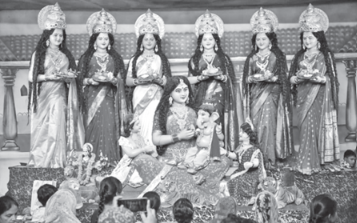
Maa Durga is the protective Mother who destroys demonic forces, obstacles, fear and unrighteousness. Her divine family offers a profound representation of harmony. Saraswati embodies knowledge and education, Lakshmi represents wealth and prosperity, Ganesha symbolises auspicious beginnings and is associated with enterprise, while Kartikeya represents military strength and protection. Together, they signify essential elements required for a healthy family, society and nation. Some sociological interpretations also associate Saraswati, Kartikeya, Lakshmi and Ganesha with the four traditional varnas—Brahmana, Kshatriya, Vaishya and Shudra—symbolising their coexistence within a shared civilizational framework.
The symbolism extends to the animal kingdom. The lion, regarded as the king of the forest, and the tiny mouse coexist in the same divine tableau, alongside creatures representing different habitats and characteristics. Despite their natural differences and positions in the food chain, they appear together in the presence of the Universal Mother. This offers a powerful message of harmony among diverse beings. Similarly, the Nabapatrika, popularly known as Kolabou and associated in folk belief with Ganesha’s bride, represents the plant world and the fertility of the Earth. Comprising nine plants, it symbolically encompasses diverse forms of vegetation. Thus, the image of Maa Durga presents an integrated vision of life, reminding us that the well-being of society depends upon the coexistence of diverse elements.
Another significant tradition associated with the making of Maa Durga’s idol is the inclusion of soil collected from the doorstep of a courtesan’s home, alongside sacred materials such as Ganga water. This ritual carries a profound social message, challenging notions of purity and impurity that often perpetuate exclusion and discrimination. Maa Durga’s image proclaims the victory of righteousness over unrighteousness. Strength alone cannot guarantee victory; it must be guided by dharma. In a traditional philosophical interpretation, Durga represents sattva guna, associated with wisdom and purity; her lion represents rajas guna, associated with activity and dynamism; and Mahishasura embodies tamas guna, associated with ignorance and darkness. Tamas must be overcome through the force of rajas, while rajas must be guided by sattva. This is why the lion stands over Mahishasura while remaining under the control of the Goddess. The message is clear: every family, society and nation contains constructive and destructive tendencies. When power is guided by wisdom and righteousness, destructive forces can be restrained. Maa Durga, the ten-armed Goddess carrying ten weapons, also reminds us that harmony and peace require strength and the courage to confront forces that threaten them.
The celebrated Devi Sukta of the Rigveda declares, Aham Rashtri. Sri Aurobindo, in his Durgastotram, invoked Maa Durga as the giver of strength, love, knowledge and power. He prayed for the energy and determination of the Asura but the character and wisdom of the Deva. Swami Vivekananda, too, regarded the Divine Mother as the sustaining force of the universe. Recognising the importance of spreading these ideals, Vivekananda initiated Durga Puja at Belur Math, a tradition now revered across the world.
Hindu tradition reveres womanhood as a manifestation of the Divine. Kumari Puja during Durga Puja reflects the belief that the primordial Divine Power resides in the young girl, and the Devi Purana prescribes this worship as an important ritual. The Krittivasi Ramayana recalls Rama’s autumnal invocation of the Goddess through the expression, Akaley sharate kail Chandir bodhan. Poet Mukundaram Chakrabarti, known as Kavikankan, also described the Goddess’s untimely awakening to facilitate Ravana’s destruction. According to this tradition, Lord Rama performed the Akal Bodhan of Maa Durga before defeating Ravana and rescuing Sita.
Today, as we confront violence, social fragmentation and the erosion of human dignity, let us draw inspiration from this tradition. May we worship Maa Durga as the embodiment of harmony and peace, the giver of strength, love and knowledge, and the destroyer of unrighteousness. May her worship inspire us to build harmonious families, an inclusive society and a strong nation. Above all, may it give us the courage to defeat the demons of our times and establish the triumph of dharma.
*The author is Jagran Josh Awardee 2023. He has authored five books. The views are personal.