The scriptures mention a time when there was a terrible war between the Gods and the demons. The Gods were outnumbered and were losing. They sought the advice of Lord Brahma. He advised that the wives of the Gods should fast for the long life and well-being of their husbands on the fourth day of the Kartik month and pray for their victory. The wives of the Gods were so terrified of the prospect of the Gods losing the battle that they obeyed Brahmaji. Their prayers led to the triumph of the Gods in the war. This, then, became a tradition as the fast of Karwa Chauth.
The oft-retold story of Karwa Chauth talks of a queen called Veerawati, who had seven brothers. She was visiting her parents’ house, where she kept the fast of Karwa Chauth. She fainted from hunger and exhaustion during the fast. Her brothers were anxious for her well-being. They lit a fire behind a tree and told her that the moon was out. Veerawati broke her fast. But as she ate, her husband fell unconscious. His body was riddled with pins and needles. When she reached home, she was shocked to see him in that state.
She prayed to Mother Parvati to give her back her husband. The Goddess guided her to fast, pray and keep removing the needles from the body of her husband. He regained consciousness after one whole year of tender, loving care. But when he woke up, he had forgotten everything. He mistook the maid for his wife. The wife spent the following year in prayer. One day, while she was sobbing and praying to Mother Parvati while retelling her story to the Goddess, she babbled, “The queen became a maid; the maid became the queen; the queen became a maid …” The King overheard this and all of a sudden he remembered everything. And Veerawati got her husband back! Well! The story is ancient, and folklore has perhaps added many twists and turns to it. Let’s just enjoy it as an anecdote and understand the passion behind the festival.
As a little girl, I was enamoured by the festival of Karwa Chauth and the glass bangles, mehndi, etc. that came with it. I have a beautiful memory of my mother wearing a maroon and gold silk saree, glass bangles, sindoor and jewellery. Some of her friends were over for the Katha on Karwa Chauth day. After the Brahmin told the katha, my father interpreted the story in a very different way. He said that sometimes the spoken word is sharper than arrows and causes immense mental agony. Often we say nasty things to our spouse. Resultantly the spouse becomes mentally numb. The arrows of sharp words and reactions have to be removed to repair the relationship! If someone is emotionally hurt, we have to shower love and care for the wounds to heal. When we make up, those pins and needles lose their sting. The fast is a day to celebrate the relationship of love and care between married couples. It is a day to reiterate your love to your spouse. And if you feel offended about why the reiteration has to be done every year, just pause to think: How many times a day do you hug your babies and say to them, “I love you!” It’s just an expression of love. Why shy away from it?
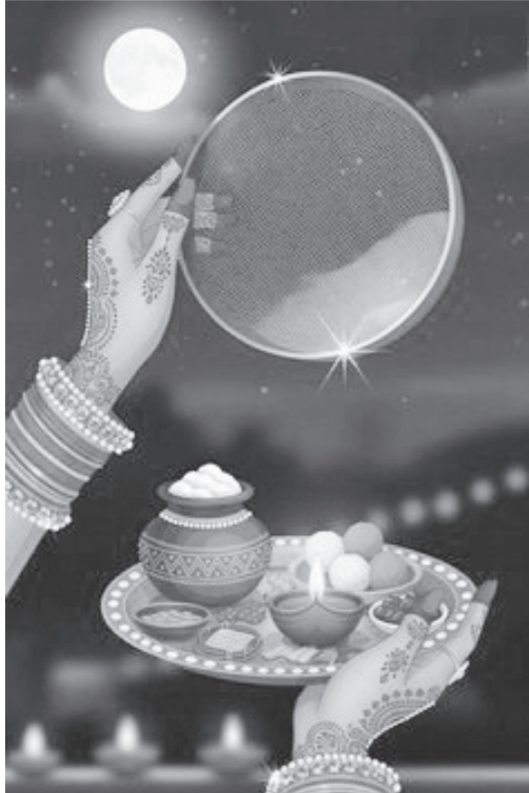
In ancient times, while most women were not working women, women would deck up and wear their bridal finery, apply Kumkum and wear bindis, bangles, bichhue, payal, maang tikka, etc. Wet Mehendi was a perfect excuse to stay away from daily chores. They were not supposed to cook, clean, spin the wheel, etc. (The Katha narrative also says- ‘Katti na ateri naa, ghoom charakhra phaerien naa, vaan pail paayeen naa …’) Women would congregate and pray, listen to the Vrat-katha, play games, laugh, sing and dance together. At moonrise they would offer Argh (water) to the Moon and then break the fast.
Why should we find fault with or question the sanctity of the fast? Do we ask the why and what about Valentine’s Day, Father’s Day, Halloween, etc.? Let’s just enjoy the fun part of the festival! Let’s enjoy the matthi, feni and mithai! Mothers and mothers-in-law shower love and blessings on the young Suhagans in their homes at this time, more than ever.
There is a feast of high calorific value before dawn, called Sargi. This feast ensures that hunger stays at bay all day. These ready-to-eat foods are made available so that the women who are fasting are absolved from cooking for the day.
Many young girls ask why they should fast for their husbands and why the husbands should not fast for them. I would say, cherish the festival as your day to be pampered. Why not enjoy the decking up and the girlie fun that comes with it? In earlier times, a newly wedded wife did not know the husband at all and was expected to conduct herself in accordance with the traditions of the new family. Women were each other’s support system. They would guide and stand up for each other. Isn’t it quite the same as meeting your friends over coffee or for a kitty? There may be no eating or drinking, but there is so much to share, learn and celebrate together! And it’s not too difficult to fast after having feasted at dawn. You can relive your wedding day … having the first sip of water from your husband’s hands is a treat like no other!
We know for a fact that each one’s time of passing is determined by God alone. So how does the Karwa Chauth fast factor in for the long life of the husband? I believe that there is great power in prayer. If we can pray for ourselves, our children and parents, why can we not pray for the long life of the husband? The mother-in-law’s blessing, ‘Akhand Saubhagyawati bhav …’, is the most valuable blessing one could get. I treasure the presence of my husband by my side, and am not ashamed to admit that I don’t know how to live without him.
Don’t we insist on ‘ladies first’ in social settings? Why not in death too? I want to exit the world before my husband. I want him to hold my hand and send me off! I fast for him not because of any societal pressure but because I find happiness in doing it. Women may be softer than men on many fronts, but when it comes to sacrificing, praying or fasting for their husbands, they are strong!
Today, the so-called liberated and modern mindset is questioning and undermining our festivals, Karwa-Chauth, Diwali, etc. Why should we give up what is ours? Halloween and Valentine’s don’t belong to us … let’s own what is ours and cherish it. Valentine’s Day is the day Westerners express love. Let’s value and enjoy our special day too … why should we doubt our beliefs? Let’s celebrate our beliefs and traditions with uplomb!