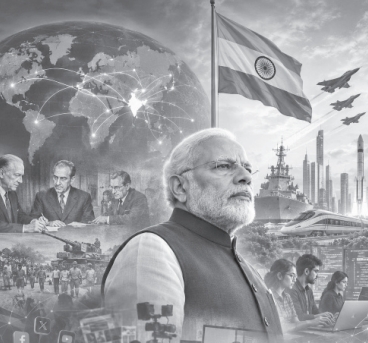
India’s rise is no longer merely an economic story; it is a geopolitical development reshaping the global balance of power. From manufacturing and defence production to digital infrastructure, scientific research and international diplomacy, India is asserting itself with growing confidence. Under Prime Minister Narendra Modi, the country has pursued strategic autonomy while strengthening its position as an emerging economic powerhouse. These developments reflect the country’s growing capacity to influence global affairs while protecting its strategic autonomy. Naturally, such a transformation brings opportunities, competition and questions about whether powerful external interests may seek to influence India’s political direction.
Is a global regime-change playbook taking shape against India? The question deserves serious scrutiny, particularly in an age when political narratives can travel across borders instantly. History proves that foreign intervention in other countries is a reality. History offers important lessons. In 1953, the western intelligence helped orchestrate the overthrow of Iranian Prime Minister Mohammad Mossadegh after his government nationalised Iran’s oil industry. In Chile, western covert activities contributed to the destabilisation surrounding the 1973 military coup against President Salvador Allende. From Iran and Guatemala to Chile, Afghanistan, Iraq, Libya, Venezuela and Cuba, history records multiple instances of Western intervention in other countries’ political affairs, including efforts to influence or change governments. These episodes demonstrate that geopolitical interests have sometimes taken precedence over democratic principles. These examples underline the need to remain vigilant against foreign interference in domestic politics.
Recent developments in South Asia have intensified these concerns. In Bangladesh, student protests expanded into a nationwide movement amid allegations of state violence resulting Sheikh Hasina resigned and left the country in August 2024. In Nepal, youth-led protests in September 2025 contributed to Prime Minister K.P. Sharma Oli’s resignation. Both upheavals highlight how foreign influence, digital mobilisation and domestic unrest can combine to destabilise governments and reshape political outcomes. India must examine whether similar vulnerabilities could be exploited in our own political environment. They may include spreading misleading information, discrediting electoral institutions, intensifying political polarisation and repeatedly portraying constitutional authorities as illegitimate. Domestic political actors, online influencers, advocacy groups and international media can all shape public narratives. Whether their activities form a coordinated foreign-backed operation in any particular case requires evidence of funding, communications, direction or organised conduct.
The conduct of opposition parties also deserves scrutiny. Opposition is essential to democracy. But repeated allegations that constitutional institutions are compromised, without sufficient supporting evidence, can weaken public confidence. The Election Commission, judiciary and investigative agencies must remain accountable, but political disagreements should not be used to undermine their credibility without evidence. Even the targeting of NSA Ajit Doval, the Supreme Court, the Indian Army and the BSF raises serious questions about the intentions of opposition parties. Opposition parties are targeting the Special Intensive Revision (SIR) with political motives, despite its legitimate objective of cleaning electoral rolls, removing duplicate and ineligible entries, and ensuring free and fair elections. Opposition parties lost the 2014 election when Gyanesh Kumar was not the Chief Election Commissioner, and the BJP retained power in 2024 without SIR—raising questions about the basis of their allegations against the electoral process. If SIR is allegedly illegal and electoral outcomes are illegitimate, how do opposition parties explain Congress’s victory in Kerala and its role in government in Tamil Nadu after SIR? Such contradictory claims raise questions about the consistency of their arguments.
Earlier, Rahul Gandhi’s allegations over Rafale, Pegasus, Hindenburg, EVM hacking and border disputes dominated media headlines, but several claims faced serious questions over evidence and credibility. In the Rafale case, he apologised to the Supreme Court for attributing a remark to it that the Court had not made. This pattern raises questions about whether opposition parties are fulfilling their democratic responsibility through evidence-based scrutiny or prioritising political agendas over constructive accountability. Even mainstream media in India are branded “Godi Media” when they question opposition leaders about evidence and facts, raising concerns about their willingness to face scrutiny and engage in constructive democratic debate.
The digital ecosystem adds another dimension. Social media platforms, recommendation algorithms and online advertising can influence which political messages reach millions of people. So called independent content creators, misleading clips, unverified allegations and coordinated amplification can also distort public understanding. Arvind Kejriwal urged India’s Gen Z to take to the streets, drawing parallels with youth-led protests in Bangladesh and Nepal that led to changes of government. Meanwhile, Rahul Gandhi highlighted the global implications of the state of Indian democracy. Such statements, alongside international seminars critical of India, have intensified debate over foreign influence in domestic politics. George Soros has publicly discussed his political ambitions concerning India, while foreign funding to NGOs and advocacy networks demands transparency and scrutiny. Any proven attempt to misuse such funding to spread disinformation or interfere in India’s democratic processes must be investigated and dealt with strictly under the law.
A confident nation must defend its sovereignty and protect its constitutional institutions. India is too large, diverse and democratically resilient to be reduced to a battlefield of competing narratives. Its voters have repeatedly demonstrated their ability. The democratic agencies are the country’s greatest safeguard against manipulation. India’s rise will attract admiration, competition and strategic pressure. Its best response is a stronger economy, transparent institutions, responsible digital platforms and a democracy whose legitimacy rests on the informed consent of its people. No external power, political alliance or online campaign should be allowed to substitute its own narrative for the democratic verdict of India’s citizens.