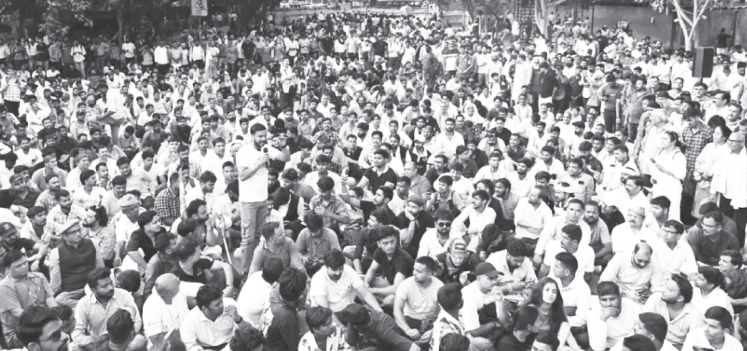
Student protests disrupted the political scene, but the industry continued business as usual.
On 15 July, India’s cabinet approved Semicon 2.0, a semiconductor programme worth about $13bn. On 20 July, five days later, police broke up a march by thousands of young students to Parliament to protest a leaked medical entrance examination. The images spread across major global cities. During the same fortnight, the Nifty 500 rose 1.9 per cent. Let us look at the sequence of events in Indian markets. Indian stocks have had a difficult year. The Sensex fell 2.5 per cent in a single session after Trump’s ultimatum to Iran over the Strait of Hormuz, taking it to a near twoyear low. It dropped again in July when Iran closed the strait, and yet again in mid-August on reports of an indefinite blockade. The week closed with the Sensex at 78,009 and the Nifty below its 200-day moving average for the fourth consecutive week. Foreign institutional investors have pulled roughly $29bn out of Indian equities this year. Each of these developments was linked to oil prices, rupee levels or US interest rates.
A major youth mobilisation in India, one of the largest in years, went unnoticed on any index. What does it mean? India’s institutions absorbed the shock of student agitation; a federal minister resigned; a reform task force was appointed; and the protests were called off. Unlike the youth protests in Dhaka in 2024 or Kathmandu in 2025, where political and economic upheaval occurred simultaneously, the Indian market’s resilience proved real. The Indian polity, specifically the ruling party, has deep federal roots and has proven able to correct course and move on. Anyone forecasting that Narendra Modi is about to pack his bags has misread Indian democracy. Markets functioned, responded to the economic shocks, and ignored political turbulence. I will not call this market indifference or a vote of confidence; I will read it as “market maturity”. Let us look at the politics of protests. It began with the leaked paper, which was the trigger, with rising unemployment as the main issue. For a middleclass youth, a well-paid job is something they compete for in an examination hall. The private economy is not generating enough such jobs. Fitch, affirming India’s rating this month, made a similar observation: rising concern among the young about employment.
Millions of graduates competing for a limited number of state jobs is a verdict on Indian business failing to generate adequate employment. Amid recent developments in the private sector, the semiconductor programme demonstrates this market indifference. Tata Electronics’ plant in Assam involves a $2.8 bn investment and about 15,000 jobs. Its Dholera fab with PSMC promises over 20,000 jobs. Micron’s $2.75bn Sanand plant was inaugurated on February 28 amid the Hormuz crisis. Apple’s Indian supply chain, generating over $10bn in sales and $25bn in production, employs more than 200,000 people across five factories, a notable achievement. Now compare the above employment numbers with those for aspirants of medical exams, one among many such disciplines. It is called the National Eligibility cum Entrance Test (NEET).
The National Testing Agency under the Ministry of Education confirmed 2,279,743 registraA major youth mobilisation in India, one of the largest in years, went unnoticed on any index. Amid recent developments in the private sector, the semiconductor programme demonstrates this market indifference. Tata Electronics’ plant in Assam involves a $2.8 bn investment and about 15,000 jobs. Its Dholera fab with PSMC promises over 20,000 jobs. Micron’s $2.75bn Sanand plant was inaugurated on February 28 amid the Hormuz crisis. Apple’s Indian supply chain, generating over $10bn in sales and $25bn in production, employs more than 200,000 people across five factories, a notable achievement. people were NEET in the statistical sense. tions for this year’s medical entrance examination; 1,999,895 appeared, and 1,121,185 qualified, despite far fewer seats available. And the government’s own Periodic Labour Force Survey for 2025 records that a quarter of young Indians are Not in Employment, Education or Training (also termed NEET). The acronym similarity is not a joke. India administered a NEET examination to 2.3 million aspirants in a year when one in four of its young India’s most celebrated industrial policy, Make-inIndia, is capital-intensive but labour-thin by design. It will not be able to address the concerns raised by the youth. The complaint on the street was never that work was unavailable; it was that decent work was. The survey answers that question too: 4.2 per cent of the workforce has any formal vocational or technical training. The market’s lack of reaction at Delhi’s Jantar Mantar is not evidence that the grievance is not genuine.
It is evidence that India’s listed capital and labour markets are running on separate tracks, and that the people on the street are not, in any meaningful sense, stakeholders. That leaves the burden of adjustment entirely with the state, with uncomfortable arithmetic. A government that bowed to a student movement and faces elections in Uttar Pradesh early next year may not respond with reforms but with freebies for voters. From the Gulf, I observe a critical calculation. For fifty years, this region has been the safety valve for India’s surplus labour, with remittances supporting the very states that supplied the protesters. Emiratisation and Saudisation are now narrowing this outlet when India’s youth need it most.
A similar situation exists in North America with the H-1B and green card backlogs. The valves are closing as pressure rises. The uprising, slowly making inroads across the rest of India, is a wake-up call for those who need to hear it. Industrial growth needs to be linked to job creation. The uprising is likely to impact the upcoming state elections, which are a few months away. However, the 2029 election, when Modi will seek another mandate, will require support from the youth, who are on a warpath for now.
The writer is the Country Director, United Arab Emirates, at the World Agriculture Forum and writes on public policy in the IndiaGulf corridor. The views are personal.